
Letter: Clearcutting in Amethyst and Buffam Brooks Is Unnecessary
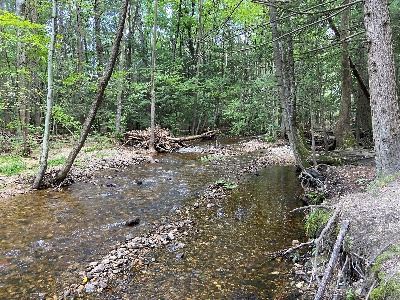
Amethyst Brook Conservation Area. Photo: amherstma.gov
I am writing to express deep concern about Eversource’s proposed vegetation removal and clear-cutting activities along the 29.3-mile reliability project corridor — particularly at the convergence of Amethyst and Buffam Brooks in Pelham. This is one of the most ecologically sensitive and historically cherished areas along the route, and the proposed actions here raise serious environmental, safety, and community concerns.
It is a beautiful natural area that generations of residents have enjoyed for recreation and reflection. It is a sensitive riverfront habitat, home to wildlife and contributing to local water quality. This is a deep gorge with steep banks and cliffs — the site of a 1950s rockslide that caused the partial collapse of North Valley Road.
Downstream flooding in residential areas (including what is now affordable housing) would be more likely with more heavy rains/severe weather. The proposed cutting will remove trees at the bottom of the gorge, down to the very edge of the water, despite the fact that the bases of transmission towers sit at elevations of approximately 500 and 530 feet — while the brook itself lies at 360 feet. In other words, the trees being targeted could not possibly grow tall enough to threaten the lines; they would have to “fall uphill” to do so.
Eversource has acknowledged that the company has long operated here with a “light touch,” selectively topping individual trees only when necessary. Now, they propose to abandon that successful, site-specific approach in favor of a one-size-fits-all “standard vegetation management practice” — a practice wholly inappropriate for this sensitive gorge.
Adding to the confusion, Eversource repeatedly asserts that “no TRRP (Transmission Right-of-Way Reliability Project), activities are planned within the Buffam Falls Conservation Area.” Technically that may be true, but it is misleading. The right-of-way in question — the narrow gap between the Buffam Falls Conservation Area and the Alschuler Conservation Restriction — is precisely where the two brooks converge, where Buffam Falls tumble into a wading pool and flow toward a shaded swimming hole beloved by local residents. This “gap” is at the very heart of the conserved landscape, not apart from it.
Local hiking trails that connect both conservation areas are missing from Eversource’s maps, giving the false impression of a discontinuity that does not exist. These trails cross the right-of-way and would be visibly and permanently scarred by clear-cutting.
The Pelham gorge is a case-in-point that illustrates the broader failure of this project’s vegetation plan to consider site-specific conditions. Along 29.3 miles of corridor, there must be many acres where full clear-cutting could be safely avoided without compromising reliability. Applying rigid “standard practices” across such a varied landscape is a mistake — and in places like Amethyst and Buffam Brooks, it would be a an avoidable environmental and aesthetic travesty.
I respectfully urge Eversource and the reviewing agencies to:
- Suspend vegetation removal in this area until a site-specific erosion and habitat assessment is conducted.
- Retain existing trees and vegetation on steep slopes and near the brook where there is no genuine risk to transmission lines.
- Restore and accurately map local trails and conservation boundaries in all project materials.
Adopt a selective, light-touch vegetation management approach consistent with historic practices and the ecological sensitivity of this site.
Diana Peters-Ross
Diana Peters-Ross is a resident of Amherst.
Thanks to Diana Peters-Ross for her letter. Countless others have expressed similar concerns and not just concerning the convergence of Amethyst and Buffam Brooks in Pelham. Eversource came out with a similar plan some years ago but apparently withdrew that in the wake of public protests. Such protests are needed once more due to the overreach involved in the overall scheme. Examples of that opposition is available at the site Responsible Grid . For instance: “They [Eversource] propose to cut trees that, by their own figures, aren’t anywhere near the wires. Within 100’ of their lines, they plan to remove all species with mature heights of >30’. Trees would have to be a lot taller than that to contact wires that are up to 100’ away and up in the air. They’re proposing straight-line cut zones that neglect even basic calculations using tree heights, wire heights, and distance (let alone additional factors that the EEA certificate directs Eversource to factor in, such as topography and species’ typical heights). They say they need access to the wires, but they already have the equivalent of 6-16 Mass Pike lanes cleared. Their proposal would increase that to the equivalent of 16-35 Mass Pike lanes. They don’t explain why their access needs are so extreme. ”
Sadly, most utility companies do not value forests for all the services they provide 24/7/365 for free. Natural solutions for carbon capture, heat mitigation, water quality & the biodiversity emergency are a critical part of what trees and forests give to us. Ignorance or arrogance regarding such timeless services is inexcusable.
Please take the time to visit Responsible Grid for more details on the shortsightedness of this ill-conceived plan.