
Bockelman Reports The State of the Town Is Strong. Councilors Halt Discussions of Housing Plan and Town Manager Evaluation
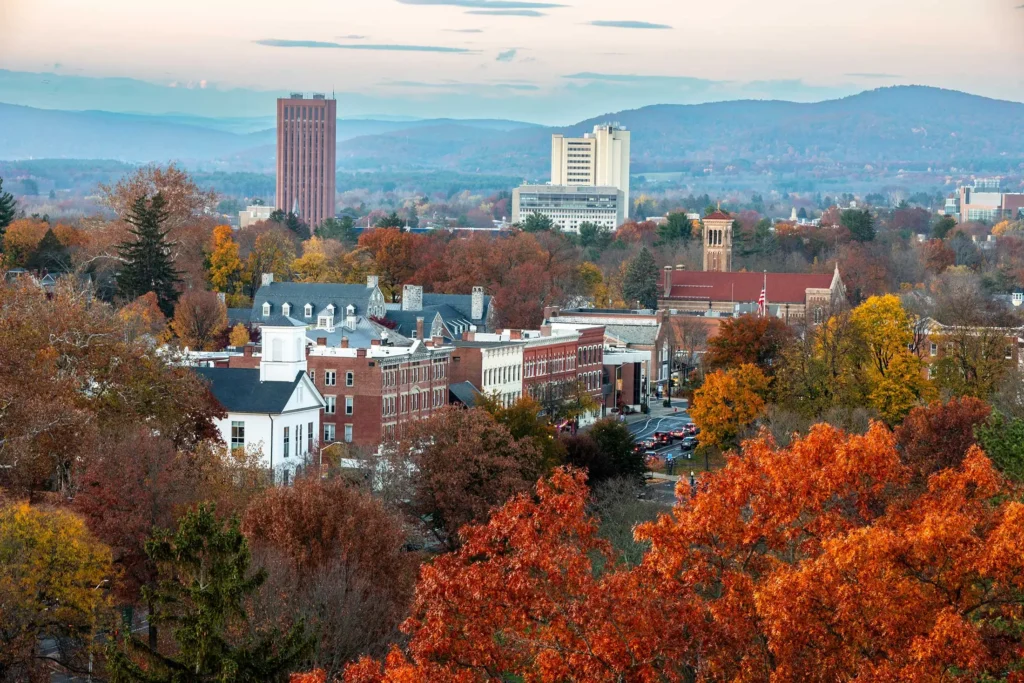
Photo: amherst.edu
Report on the Meeting of the Town Council, December 1, 2025
This was a hybrid meeting held in Town Hall and broadcast on Amherst Media and Zoom. It was recorded.
Present: Lynn Griesemer (President, District 2), Andy Steinberg, Mandi Jo Hanneke, and Ellisha Walker (at large), Cathy Schoen (District 1), Pat DeAngelis (District 2), George Ryan (District 3), Pam Rooney and Jennifer Taub (District 4), and Ana Devlin Gauthier and Bob Hegner (District 5). Absent: Freke Ette (District 1) and Hala Lord (District 3).
Staff: Paul Bockelman (Town Manager) and Athena O’Keeffe (Council Clerk)
Council President and Town Manager Give State of the Town Presentations
In most years, representatives of the Elementary School Committee and Jones Library Trustees give presentations regarding the successes and challenges they face, but this year time constraints limited the presentations to Council President Lynn Griesemer and Town Manager Paul Bockelman, as required by the Town Charter. The Amherst School Committee, Jones Library Trustees, and Oliver Smith Will Elector submitted written reports. Annual reports from the Board of License Commissioners and Amherst Housing Authority are due before the end of the year.
Griesemer’s and Bockelman’s presentations highlighted town government’s achievements of the previous year. In her seventh annual address, Griesemer emphasized the hard work of the Town Council in the record number of 31 council meetings in addition to council committee meetings, district meetings, and building and town-wide budget committees. She noted that she, Andy Steinberg, and Mandi Jo Hanneke serve on Massachusetts Municipal Association committees, and several councilors have advocated in the state legislature for local enactment of ranked choice voting, transfer fees on high-end real estate sales, and voting rights for lawful permanent residents in municipal elections.
Other accomplishments have been changes in the Inclusionary Zoning bylaw and passing a bylaw against public urination and defecation. Still to be realized in the area of racial equity are the creation of a Resident Oversight Board to deal with complaints against the police and the appointment of members to the Amherst Black Reparations Committee. Also, the council needs to act on the revised bylaws for the Human Rights Committee and the creation of a Transportation and Parking Commission, with the associated changes in the public way policy.
Bockelman offered thanks to town staff and to the members of the town’s 44 resident committees. He noted the progress on capital projects with the completion of the North Common and the Centennial Water Treatment Plant and the progress on the new elementary school and the Jones Library expansion. He stressed the solid financial standing of the town and the progress made on improving the town’s roads and sidewalks. He also noted that Amherst was one of the first communities to achieve the Climate Leader designation from the state after adopting the Specialized Stretch Energy Building Code, joining the Valley Green Energy Community Choice Aggregation, and installing two fast EV chargers in the municipal lot behind CVS. In addition, the town’s vehicle fleet is increasingly fuel efficient, with the anti-idling technology in fire department vehicles and an EV for parking enforcement.
Bockelman highlighted progress in human rights and racial equity in making a clear statement of the town’s intention not to cooperate with ICE, support of LGBTQ+ residents and visitors, creating a Commission for Persons with Disabilities, and taking steps to create a Residents Oversight Board. He was especially proud of the Morning Movement Program for middle schoolers run by the Recreation Department and the Police Department. Over sixty students signed up.
Bockelman ended his presentation with a quote from a colleague, “Go hard on the issues and easy on the people.” He explained, “We ask people to do difficult jobs in the public eye, easily criticized by those who don’t understand the challenge of getting things right. I think it’s the attacks, more than the actual content of any disagreement, that can make town employees and those engaged in the civic process feel undercut and discouraged. We must all do our part to undertake this work with an attitude of love and gratitude for one another, even those with whom we disagree.”
Shiao Presents Assessment of the Elementary Schools
Amherst School Committee (ASC) Chair Jennifer Shiao said she had requested 10 minutes on the meeting agenda, but was told she could have three minutes in public comment time to give the ASC’s annual report. She noted that Amherst is one of only a small number of districts statewide that has returned to pre-COVID MCAS scores in both English language arts and mathematics and stated, “This success reflects targeted instructional support, strong family engagement, and the sustained commitment of our educators.”
However, she cautioned that there are major challenges ahead with moving from three K-6 schools to two K-5 schools and a sixth-grade program at the middle school. She emphasized that each school requires full staffing, administration, and student services, so there will be no substantial cost savings. In addition, costs for transportation, utilities, health insurance, and essential services continue to increase. She stressed the need for clarity, communication, and sustained community support, especially with regard to the planned move of the sixth grade to the middle school.
Although not required by the charter, the Regional Schools also submitted an annual report written by the superintendent.
Oliver Smith Will Elector Report
Judith Souweine, Amherst’s Oliver Smith Will Elector, stated in her annual report that no Amherst residents had applied for funds this year. One nurse who was awarded funds last year received $600 this year. The Oliver Smith Will is a charity established over 200 years ago that awards money to widows, brides, nurses, and tradespersons from Deerfield, Greenfield, Easthampton, Amherst, Hadley, Hatfield, Northampton, and Williamsburg. It awarded $22,310 in 2025.
The annual report from the Jones Library Trustees was not in the meeting packet. The Board of License Commissioners and Amherst Housing Authority are also required to submit reports. Bockelman and Griesemer said that their PowerPoint presentations would be added at a later date.
Due to Objections, Housing Production Plan and Town Manager Evaluation Postponed
The Town Council postponed decisions on the Housing Production Plan (HPP) and the Town Manager evaluation report. In the case of the 140-page HPP prepared by Barrett Consulting, Cathy Schoen raised objections during the October 23 Community Resources Committee (CRC) meeting. She felt the data contained in the report were excellent, but disagreed with the tone and context of the report. She submitted a detailed memo to the council, in which she stated that the report makes it sound like Amherst has done little to grow or diversify its housing stock. She also disagreed with the emphasis on creating more student housing and the lack of discussion of expanding infrastructure to service more housing. Lastly, she felt the target growth of 700 to 900 new units over the next five years was too high.
CRC members Jennifer Taub and Pam Rooney also disagreed with the emphasis on student housing and the fact that much of the town’s recently built housing was created for students and is too expensive for a family to afford. Rooney suggested that a recommendation to build more student housing on the UMass campus be added to the report.
Taub summarized the CRC discussion about the HPP. She said that the state requires municipalities to submit a housing production plan as a prerequisite to receiving “safe harbor designation.” Through their housing production plans, municipalities commit to producing a minimum number of affordable units. Amherst has already achieved safe harbor designation, because over 10% of its housing stock is affordable. The town is not obligated to implement every recommendation in the plan, but can use it as a framework. The previous plan was drafted in 2013. Town Planner Nate Malloy added that the consultants’ work is completed, and they are unlikely to accept more than minor changes to the report. The Planning Board has already accepted the report.
Councilor Mandi Jo Hanneke strenuously objected to Schoen’s memo. She said, “If we don’t submit something to the state, we might not be eligible for state funding. There is disagreement as to what type of housing we need to build and how dire our housing situation is, and how to solve that housing situation, but we need to admit that we have a housing crisis. We hired experts to recommend to us what we need to do. Not everything in there is something I want to do. I think we need to just adopt this plan as is and move on, because discussing, fighting, and bickering over the specific language in this housing production plan does not move us to getting more housing created.”
Pat DeAngelis was more direct. She asked, “Does the HPP meet the state requirements? The answer is yes. The Planning Department supports it; the Planning Board supports it. What I hear is personal opinions about what I like and what I don’t like. It’s not our job to take one councilor’s ego. We need to get our ego out of this report. We do not have to implement any of it.”
George Ryan agreed and said, “These disagreements—we’ve heard them before and we’ll hear them again, about what direction we should go in—are going to continue, and that’s a healthy thing. They’re not going to be resolved by a HPP, whatever is in it. What the Barrett Group has presented us is a menu of options. You pick out the items that you think make the most sense, but the assumption is that you’re not going to eat everything on the menu.”
Rooney proposed minor changes in the draft document, but was not able to craft a motion with the exact changes she suggested, so she opted to use her right to postpone consideration for the HPP until the December 8 council meeting, cutting off further discussion.
Hanneke Objects to Griesemer’s Summary of Town Manager Evaluation
Griesemer submitted a summary of Town Manager Paul Bockelman’s evaluation as given by councilors, staff, and the public. The report’s summary states:
“In the Town Council’s Policy Goals, a majority of Town Councilors stated that the Town Manager “met or made expected progress” in some Action Items of all three goals: Climate Action, Community Health, Community Safety & Social Justice, and Housing & Economic Vitality. Similarly, in the Town Council’s Administrative Goals, a majority of Town Councilors stated that the Town Manager “met or made expected progress” in some Action Items in all three goals: Infrastructure Management, Administration & Leadership, and Strategic Relationships. At the same time, the Town Manager only “partially met” or “partial progress was made” in other Action Items toward the same goal. In the areas of responsibility under the Charter, a majority of Town Councilors rated the Town Manager as having “satisfactorily met and/or exceeded these expectations in the past year” for 21 of the 24 items. Councilors also provided a set of Strengths and Areas for Improvement for the Town Manager. Councilors communicated strengths across communications, fiscal stewardship, capital project delivery, and staff leadership; while areas for improvement also included communications.”
Hanneke was “quite disappointed” in the draft. In addition to some incomplete sentences and mislabeling of the appendices, she objected to inaccuracy in some of the analysis when some unfinished goals, such as providing training regarding racial equity, are listed as “met” or “partially met.” The only area listed for improvement was communication, but she noted that there were several other areas that some councilors felt were unfinished.
Griesemer then proposed that councilors send her suggested changes, and she would incorporate them into a revised report. She also used her right to postpone discussion until the next meeting, cutting off further discussion.
Zoning Change on Main Street Favorably Received
Building Commissioner Rob Morra brought the three-parcel zoning change on Main Street to the council for a first reading. The proposed change is to rezone 229, 257, and 285 Main Street from General Residence (R-G) to Neighborhood Business (B-N). The change would allow the Amherst Inn at 257 Main Street to be able to rent out all of its eight rooms, and not limit the business to four guests under its 1997 Special Permit. No changes are proposed for any of the properties, although the owner-occupied duplex at 229 Main Street does have space to expand. All three parcels are located in the Dickinson Local Historic District and would need approval from the Local Historic District Commission to make any external changes.
The change was approved by the Planning Board, CRC, and the Governance, Organization, and Legislation committee.
A vote will be taken on the change at the December 8 meeting.
It would be nice if the Town Council postponed the vote on the HPP, until the newly elected Town Councilors are in their seats .
The fresh thoughts on this would be nice . We need affordable housing , not student housing .
And we need an infrastructure ,that can support putting out fires at these large scale projects .
Put the brakes on the HPP vote .