
Opinion:Yes, We Have a Reason to Hope for the Democratic Party. But It’s Not What You Think
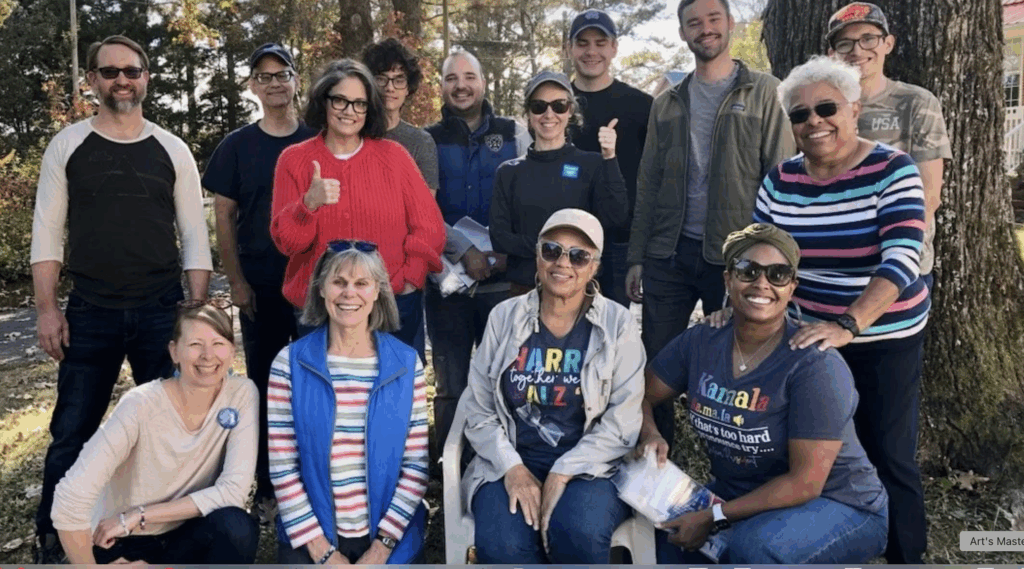
Granville County (NC) Dems, a partner of We Stand Together. Photo: We Stand Together

No one is happy with the Democratic Party these days, and for good reasons. Although Dems made encouraging gains in the 2025 elections, they failed to capitalize on that momentum when they caved on the government shutdown. Last month a Marist poll found that 71% of Democrats lack confidence in their party, and that number has probably risen after so many Democratic leaders refused to back Zohran Mamdani, even after he was elected. Unsurprisingly, contributions to the party have dwindled, and two weeks ago the Democratic National Committee (DNC) revealed that it had to borrow $15 million just to pay its bills.
So now, with the crucial 2026 elections less than a year away, many of us are asking, “If the Democratic Party can’t do the job, who can we find to lead us to victory over MAGA?”
I have an answer to that question, but first I want to untangle what we mean when we say, “the Democratic Party.” Usually, we’re referring to an institution headquartered in Washington and run by a bureaucracy of professional political workers. We tend to forget that the Democratic Party is also you and me and some 75 million other Americans who vote for Democratic candidates.
Among us are some 30,000 unpaid activist Democrats who have joined some 3000 Democratic state, county, and town committees across the country. In blue states like Massachusetts, most county and town committees have little to do because there is almost no chance that Democratic candidates will lose here. But in red and purple (swing) states, the best of them are extraordinarily active. They canvass in their neighborhoods, they print and distribute sample ballots, they educate voters, they organize precincts and precinct elections, they recruit and support candidates to run “down ballot,” they organize for national, state, and municipal elections, and they support Democratic Party candidates by knocking doors for them, sharing their headquarters with them, and orienting them to the needs and concerns of their town or county.
So, no matter how you and I feel about the Democratic Party as an institution, we should not overlook that right this minute, even as you read these words, thousands of unpaid, volunteer grassroots Democratic activists are working very hard to defeat MAGA in their communities. I believe that they can be our most effective leaders going forward, if we start supporting them.
Here are four reasons why this is so:
1.Local Democratic committees are best positioned to connect with voters in their communities.
Countless polls and news articles tell us that in swing districts all across America, the Democratic Party is perceived as “out of touch” with most Americans, centered in the viewpoint of a relatively wealthy “elite” that lives in urban areas in the Northeast and West Coast. This disenchantment with the party led 2.5 million Democrats in 2024 to register and vote as Republicans. In that same election, more than 90% of the nation’s counties became more red.
Political scientist Suzy Mettler, author of The Urban-Rural Divide (2025) explains why:
“You go back to 2008 – 2020 — at that point rural Americans are looking at the Democratic Party and they’re starting to think of it having a center that is affluent people, wealthy people, people better off than themselves, who are running the party and who don’t seem to understand them or their communities.”
The only remedy for this problem is to find a way for these alienated voters to feel seen and understood by the party. They will identify as Democrats only if they become certain that Democrats care about them. These feelings of trust and identification can best be nurtured through face-to-face contact and personal relationships. Think tanks, pundits, focus groups, ad agencies, and better “messaging” cannot do this work. Nor can even the most charismatic political candidates, partly because their role demands that they be as much persona as person, and partly because their contact with voters is inevitably intermittent and transactional. No matter what they say and promise, their public appearances before voters are shadowed by the implicit message: “I am here because I want you to vote for me.”
What’s needed is an ongoing, non-transactional, caring Democratic presence in every key county in America, especially in swing districts and swing states. Amazingly, the foundation of such a caring presence already exists: Democratic county committees. Composed entirely of volunteers, these committees reach out to voters in their communities all year, every year. They do so not because they’re paid, and not because they want something in return, but simply because they care deeply about the everyday working Americans in their communities. That message gets across in every conversation they have.
Alas, the national Democratic Party does not fund these committees, so most are compelled to support themselves through their own fundraising. But even the most dedicated of them can’t raise nearly raise enough to achieve their full potential, and many must constantly struggle just to pay for a decent headquarters and basic necessities like lawn signs and printed sample ballots. Overworked, under-resourced, and frustrated, many of the activist Democrats who join them eventually burn out and quit.
It would seem obvious, then, that the Democratic Party leadership should stop steering almost all the money it raises (in 2024, $1 billion more than Republicans) to political candidates and to its own (costly) fundraising apparatus. Instead, if it really wants to win back Democrats it has lost and gain new ones, it should allocate a significant portion of what it raises to the most active and important of its front-line Democratic committees. But the Party leadership hasn’t taken this step, and it shows no sign that it ever will. Until it does, we rank-and-file Democrats and Independents must step in and fill the gap.
2.Only local Democratic activists can restore Democratic visibility where it’s most needed:
Democratic activists in swing districts all across the country report that the main challenge where they live is Democratic “invisibility.” As loyalty to the Democratic Party has waned, and the hyper-visible MAGA movement has flourished, many rural Democrats have chosen to lie low. Consequently, many rural and rustbelt folks have concluded that the party no longer exists in their communities.
Democratic candidates alone cannot restore Democratic visibility to these areas, both because they strive to focus public attention on themselves (not the party) and because — win or lose — they cannot be actively present in their communities year-round. Nor can outside progressive canvassing organizations restore Democratic visibility to these areas, both because their field teams consist mainly of people from outside that county or town, and because they consistently present themselves as non-partisan. To be sure, their work often pays off: they successfully register many new voters and motivate many inactive voters to go to the polls and cast a ballot. But outside canvassers don’t address the underlying problem of Democratic Party invisibility, and they might even inadvertently exacerbate it. Like candidates, canvassing organizations come and go. And when they appear on rural folks’ doorsteps, they present themselves as a non-political alternative to the Democrats, implicitly conveying that, “We are listening to you, but we are not Democrats.”
Fortunately, the problem of Democratic invisibility is only a perception problem, not a reality. Democrats do exist in all these areas, many of them do vote, and though many are reluctant to show themselves, some have bravely stepped forward to form and serve on the local Democratic committees. The path to restored Democratic visibility in the places we need it most must begin with investing in those local Democratic committees.
Unfortunately, the national Democratic Party leadership – and indeed most Democrats nation-wide – don’t seem to see these activists, not even when they’re working in the most critical swing districts of the country. On November 25, the Democratic Congressional Campaign Committee proudly announced a major new initiative aimed at winning rural voters. Great news – except that it made no mention r of Democratic county committees.
3. Only local Democratic committees can provide the lasting political infrastructure we need:
Many analysts agree that in areas where Democrats are weak but must win, the Democratic Party must build a robustly active year-round Democratic presence. Major progressive organizations have explicitly affirmed this necessity on their websites. Swing Left, for example, claims that it invests “continually in communities and organizers to build the long-term infrastructure necessary to gain and hold power for Democrats because we cannot expect to drop in every two or four years and have the trust and organization we need to win… An empowered Democratic Party is critical to move us forward.” Similarly, Sister Districts says that it aims “to break the boom-and-bust cycle of elections, and to withstand shifting political tides. That’s why our commitment extends beyond immediate electoral contests.”
But (inexplicably) neither of these organizations funds the “long-term infrastructure” that is already in place: local Democratic committees. Nor do they try to “empower” the Democratic Party by empowering the local Democratic activists who are already working and who have an urgent need for support. Almost all independent progressive organizations claim to be oriented toward the “grassroots,” yet I know of only three – all of them small — that have funded grassroots Democratic activists specifically. Until that changes, we rank-and-file Democrats and independents will have to provide that funding ourselves.
4. By supporting local Democratic committees, we can radically transform the party itself:
By now, it’s become clear that the national Democratic Party leadership has lost its way. It’s supposed to be guiding the party of the many not of the few, of the working and middle class, not of the wealthiest Americans. That’s its deepest, most fundamental mission and raison d’etre. But to be true to this mission, its leadership must cease gathering in places like Martha’s Vineyard and stop depending so heavily on contributions from America’s wealthiest donors.
Even more importantly, it must start dispersing power from its glitterati and bureaucracy to its activist base. Such dispersal could begin by empowering and adequately funding the all-volunteer Democratic committees who are its grassroots activists. To be true to the party’s mission, the everyday Americans who are the Democratic Party must be allowed to be the Democratic Party. That means shifting at least some of the power and priorities of the national Democratic party downward and outward, into the hands of the thousands of Democrats who have already organized themselves into their community’s county and town Democratic committees.
But I don’t think the entrenched party leadership will take these sensible steps until we rank-and-file Democrats (and Independents) pressure them to do so. Radical change always proceeds from the bottom-up, and the “bottom” of the Democratic Party is its volunteer grassroots activists. Right now, the most critically located ones in swing districts and swing states are so busy doing their work that they cannot even imagine stepping back and demanding more support from the Party leadership. But it’s conceivable that, when they feel seen, respected, and supported by their fellow Democrats, they will take that step and say, “We demand more.”
In the meantime, I know of three ways to contribute to these activist Democratic committees. The best is to join and work with the few organizations that already support them in swing states. There may be others, but the ones I know of are Swing Blue Alliance, All in for North Carolina, and We Stand Together – the last of which is the only one that focuses exclusively on helping Democratic county committees. If you are already a member of Swing Left, Indivisible, MVP, or Sister Districts, you might urge these organizations to diversify their political projects and start supporting Democratic activists at the local level. You can also write to your Democratic representatives and leaders– including here in Amherst, State Representative Mindy Domb and State Senator Jo Comerford — and ask them to pressure the Party leadership to invest in its own grassroots.
Most importantly, we have to remember that the Democratic Party is us. Only we can change it and make it more effective. Let’s start by giving a hand to our fellow rank-and-file Democrats who have volunteered to serve on Democratic county committees in swing states and districts. If we support them, they will be the Democratic Party that leads us to victories in 2026, 2028, and beyond.
Nick Bromell is Professor Emeritus of English at UMass Amherst and the founder and co-organizer of We Stand Together. He can be reached at nkbromell@proton.me