
Letter: Please Support Middle School Athletics
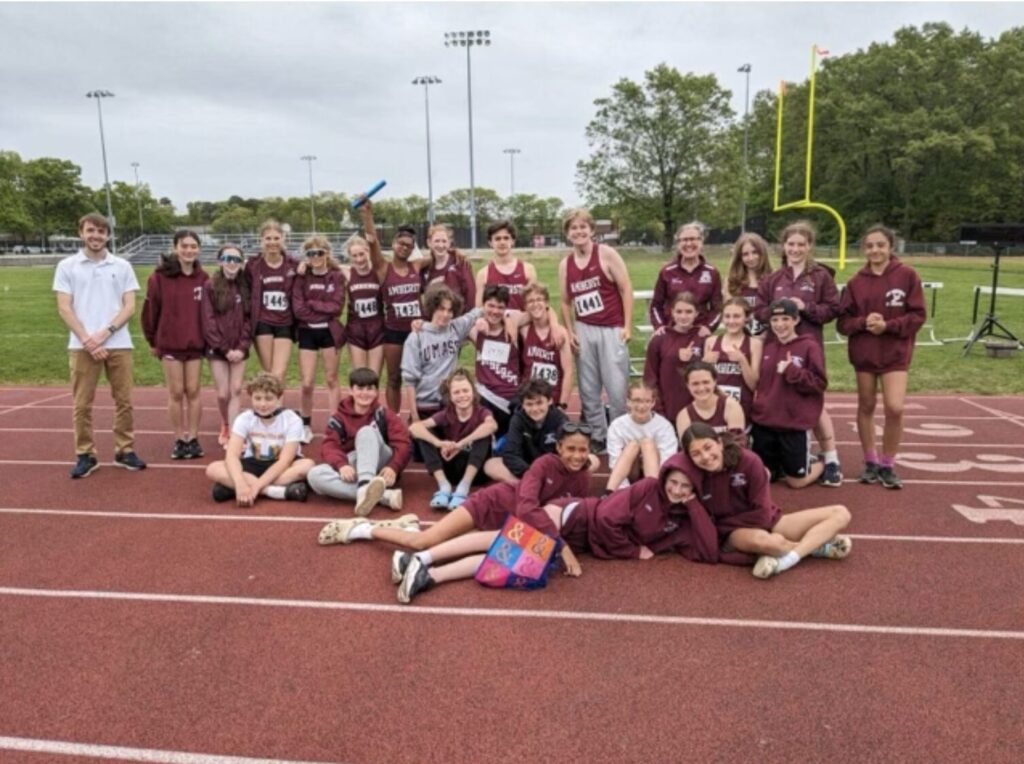
2024 Amherst Regional Middle School Track Team. Photo: Chris Lindstrom
The following letter was sent to the Amherst Town Council and Town Manager Paul Bockelman on December 8, 2025.
I am the parent of four children and have been a resident of Amherst for more than 30 years. My three older children graduated from the Amherst public schools after successful experiences in soccer, track, volleyball, and several other sports. Their participation in athletics contributed significantly to their academic success and provided structured, healthy activities that kept them engaged and supported.
My youngest son is now in 7th grade, and I am concerned that the current athletic offerings at the middle school are extremely limited—and in some cases nonexistent. The absence of accessible, structured sports opportunities is a real loss for our students at a critical age. For the past two years, I have contacted school administrators to request the addition of boys’ soccer to the fall schedule and indoor track to the winter schedule. I was recently informed that these requests must be directed to the town, as the town oversees middle-school recreational athletics.
The Morning Movement and Mentoring program before school is appreciated and is a valid effort, but it does not address the need for appropriate after-school athletics. After-school hours are when students most need structured, engaging, skill-building activities. Amherst often speaks about investing in its people. Please do so now—by investing in the youth who will shape the future of this community.
It is important for the town to understand how closely connected middle school offerings are to the health of our high school athletic program. Amherst High School athletics operate on a very lean budget. The Athletic Director meets with athletic directors across Western Massachusetts well before each season to plan cooperative teams (“co-ops”), which are formed when a school does not have enough high school athletes to field a team. When numbers fall short, the high school can apply for a waiver to allow 7th and 8th graders to participate. If that still isn’t enough, the school seeks co-op partnerships with neighboring districts. For example, student athletes from Granby and Pathfinder can participate in Amherst football program. Amherst does not have a girls ice hockey team, so interested athletes participate at Longmeadow. Hopkins participates in the Amherst swimming program and Amherst athletes can participate in the wrestling program at Granby. When the high school has enough student athletes—as they do in boys’ soccer and indoor track—middle schoolers cannot participate, regardless of skill, because these rules are governed by the MIAA. This highlights why a strong feeder program at the middle school level is essential.
This year, for example, Amherst was only able to field a single varsity girls’ basketball team due to low participation. Although middle school athletes are allowed to play to help fill a roster, high school players cannot be cut to make space for a more skilled middle school athlete. This reality underscores how essential it is for Amherst to provide strong, consistent youth and middle school development programs. Without early opportunities, fewer students enter high school prepared or confident enough to join a team.
The town should be working in collaboration with the Athletic Director to support and enhance the full pipeline of athletic opportunities—from youth through high school. Our students deserve programs that develop skills, build confidence, and create continuity across levels.
Moreover, expanding middle school sports does not require major investment. Soccer and track require minimal equipment, and the middle school gym could easily accommodate indoor soccer or winter conditioning. Amherst’s proximity to several colleges also presents an excellent opportunity to partner with college students seeking community engagement or academic fieldwork experience.
Middle school is a pivotal age. Students benefit enormously from positive, structured activities between the end of the school day and the late bus—time that too often is spent on phones or unsupervised at home. Athletics promote equity, physical and mental health, and the sense of belonging that every adolescent needs.
There has been extensive discussion in Amherst about the importance of investing in our people. I urge the town to extend that investment to our youth by expanding athletic opportunities at the middle school level. Survey families. Engage students. Ask them what programs they want. They are the future of our community, and strengthening youth athletics is a direct investment in their well-being, development, and long-term success.
I include below a note that I received from the Amherst Regional Public Schools’ Athletic Department.
Renata Shepard
Renata Shepard is a resident of Amherst.
Statement from the Amherst Regional Athletic Department
The Athletic Department appreciates the ongoing dedication of Amherst families who advocate for expanded athletic opportunities for our students. High-quality middle school athletic opportunities are essential for building the skills, confidence, and participation needed for strong high school teams. Currently, Amherst Regional High School operates with one of the leanest athletic budgets in Western Massachusetts, and we rely heavily on careful planning, cooperative programs, and MIAA waivers to ensure that our students have access to the full range of sports.
We want to emphasize that a strong, well-supported middle school program is essential to maintaining healthy participation levels at the high school level. Victoria Dawson, the AD works closely with athletic directors throughout Western Massachusetts to plan seasons, form cooperative teams where necessary, and ensure compliance with MIAA regulations. Because of budget and staffing limitations, student athletes often must find their own way to co-op opportunities. The department cannot provide this support for only a couple of teams without creating inequities. Title IX considerations make equitable access for all programs critical, and we must be mindful of providing fair opportunities for both boys’ and girls’ sports.
Collaboration between the Town and the Athletic Director is critical to building a sustainable, equitable athletic pipeline for all Amherst students. A robust, town-supported feeder system would provide meaningful benefits for student development and would significantly strengthen the sustainability of our high school programs. We welcome the opportunity to collaborate with the Town to assess needs, explore resources, and build programming that supports all Amherst youth. Together, we can create a pathway that fosters physical health, emotional growth, and long-term engagement in athletics.
Please tell us how competitive organized sports contribute to physical and mental health, which are indeed very important, any more than simply allowing students the time, space, and perhaps gentle encouragement ( screaming coaches or parents doesn’t help) to get a good workout. I suggest reading Alfie Kohn’s book “No Contest, The Case Against Competition, How We Lose In Our Race To Win”. and Terry Orlick’s book “Winning Through Cooperation”, as well as George Orwell’s essay “The Sorting Spirit”.
Developing a life long habit of aerobic exercise is the ticket to a life long healthy connection between mind and body.
The relationship between athletes and coaches (good coaches) is precious. Organized sports DO set off a lifelong knowledge of bodily control. Kids may not have the interest in doing that on their own because it can be challenging, and that’s the perfect time for a kid to flex and explore physical ability. Developing coping skills, commitment, team spirit, responsibility, accountability, ability to handle difficulties, how to deal with wins and losses are lifetime skills. Strength is not only physical, but mental and emotional. Team sports can do it well. We ARE capable of creating positive team sports experiences for our youth. If you are involved with our school’s athletic department, you could see that they care. If coaches and parents are screaming and being “mean” , that’s a different story. Not everyone gets a medal, but you must still show good sportsmanship.
Give me some reputable sources who say competition is better than cooperation in every aspect of our lives, and tell me what you think of my sources. Shouldn’t players and fans be focusing on the quality of play, rather than determining winners and losers? I was a three sport athlete through high school and college and can assure you that, as Orwell points out, quite a lot of ugly passions often arise, because to compete means my gain requires your loss. Is that the kind of society you want to live in?