
What Can Amherst Expect from an Underfunded CRESS in the Coming Year
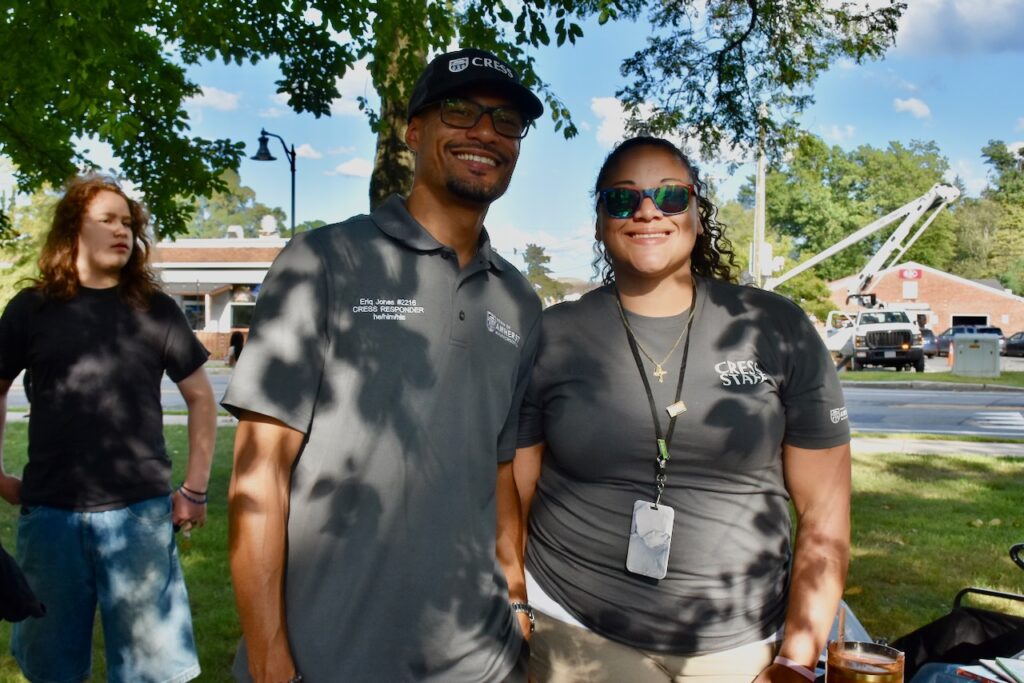
CRESS civilian responders Eriq Jones and Taylor Taggart offered information about the CRESS program along with coloring books and colored pencils at a town sponsored back-to-school event in August 2025. Photo: Art Keene
The Community Responders for Equity, Safety and Service (CRESS) recently had their budget cut, but, according to CRESS supporters, the program was never properly funded.
“CRESS isn’t being given the chance to do what it was intended to do,” Allegra Clark, co-chair of the town’s Community Safety and Social Justice Committee (CSSJC) , said.
“It’s gonna be easy to point the fingers and say it failed but I think it’s under-resourced”
CRESS was founded in 2022 as one of several recommendations by the Community Safety Working Group (CSWG) to support racial justice in Amherst. CRESS was envisioned to be an alternative to policing; an unarmed civilian responder service composed of multi-racial teams trained in community safety and care, that would respond to public safety situations not involving violence or criminal activity.
The CSWG was a diverse group of Amherst residents charged with “study[ing] the complex issues of delivering community safety services…to ensure racial equity.” The group was formed after George Floyd was killed by a police officer in May, 2020, and awareness of police brutality became widespread across the country.
“CRESS teams will be the first responders to all situations that don’t involve violence or serious criminal activity, including mental health issues, homelessness, substance abuse, trespass, truancy, wellness checks, youth, and schools,” stated the original CSWG report detailing their recommendations.
For the 2026 fiscal year (FY26), two CRESS responder positions were frozen in the annual budget. According to CRESS director Camille Theriaque, that was 20% of the program’s current staffing. The Amherst Police Department (APD) also had one position frozen.
The Equitable Approaches to Public Safety (EAPS) grant that funds the CRESS Implementation Manager position was renewed for FY26, but it is possible that the grant will not resume for FY27, said Theriaque. The role of the Implementation Manager is to serve as the primary point of contact with other Town departments and other agencies that serve the Amherst community to develop the CRESS Department, including the Town Manager, Director of CRESS, Massachusetts Department of Public Health (DPH), consultants, academic institutions, Amherst Police, Fire, Public Health, and others.
It was originally thought that the EAPS grant wouldn’t be renewed for this fiscal year so the previous implementation manager, Katherine “Kat” Newman, was let go.“It’s hard. It’s disappointing,” said Theriaque, regarding the cuts.Theriaque said that CRESS and the town are working together in search of additional grants to fund the frozen CRESS positions.
Currently, CRESS has five responders, one vacant responder position, one administrative assistant and one director. The department is in the process of hiring the sixth responder position.Their office resides in the Bangs Community Center which restricts their operating hours from 8 a.m. to 4 p.m. Monday-Friday when the building is open to the public.
The League of Women Voters Amherst (LWVA) Racial Justice Committee recently released a report on Amherst’s progress on each of the CSWG’s recommendations. Ash Hartwell led the research in the CRESS section of the report. One of the main insights from the report was an analysis of the hours CRESS would likely receive the most amounts of calls. The Law Enforcement Action Partnership (LEAP) conducted a study of Amherst public safety and found that 67% of calls to public safety dispatch that are appropriate for CRESS to respond to are made between 4 p.m. and 8 a.m., when CRESS is not accepting calls. The CSWG recommended that CRESS be operational 24 hours a day and 7 days a week.
According to Theriaque, currently there are no future plans to relocate to a venue outside of the Bangs center. Hartwell said that the current hours of operation limit what CRESS is able to do. “[CRESS is] cut off at the waist,” he said.
The CSWG also recommended that there be 12 responders, one director, one implementation manager, one administrative assistant, along with 11 other staff positions, according to the LWVA report. The CSWG suggested that the responders work in six two-person teams. Instead, at its creation, CRESS was only staffed with eight responders, one director, one implementation manager and one administrative assistant.
Rather than CRESS growing in number of staff, as of this year, its staffing has decreased. The CSWG envisioned that as the program developed, there was supposed to be a shift from the number of APD officers to more CRESS responders, as CRESS took on more calls that had once gone to the APD. Clark said the number of CRESS responders was never supposed to be in addition to the number of police officers. Rather, over time, the former was meant to increase and the latter decrease as CRESS became more established.
According to the LEAP report, 72.7% of the calls to 911 would be appropriate for CRESS to respond to.
CRESS has not yet been able to fully integrate with public safety dispatch yet, meaning that CRESS is mostly responding to calls that come directly to its office and not calls going to 911.
Police Chief Gabe Ting has explained in a conversation with CSSJC member Everald Henry that the issue is that CRESS has no documented Standard Operating Procedures (SOPS) as to what responders should do in the event that a call does not go as planned. One example Ting offered was a what-if situation in which CRESS was responding to a noise complaint and the person pulled out a weapon. There are currently no standard procedures to follow in such a situation, he said.
Clark speculated that the delay in establishing SOP’s may have resulted from the previous director, Earl Miller having come from a background in mental health rather than public safety. Theriaque, comes from a background in public safety and has been working with dispatch to establish .“If you do not have a basis, then chaos erupts,” she said.
CSSJC co-chair Debora Ferreira has acknowledged the need for SOPS but has lamented that they have been in the works for four years now.
Theriaque envisions CRESS’ integration with dispatch before the end of 2025. She has been having bi-weekly meetings with APD and dispatch to ensure protocols are approved. They have to be cleared by the Police Chief, Dispatch Supervisor, and Town Manager to make sure the protocols are compliant with laws.
However, at the December 10 CSSJC meeting, Theriaque said that CRESS will not be able to respond to all nonviolent call types by the end of the year.
Although Theriaque is hopeful for the future of CRESS, she says it will be difficult to continue the amount of services currently provided given the budget cuts. Police and fire have been established for a “millenia,” she said, whereas the notion of community responders is new. Further, no community responder team has operated in the same way as ours and CRESS is still finding what works for their model. “You have to crawl before you walk before you run,” she said. “We are making our way.”
Theriaque wants the town government to continue in their support for CRESS and wishes for an increase in budget and in the number of responders to operate more hours.
“I know myself and a few other councillors have struggled to understand why it’s taken so long to implement some of the things that would help CRESS function better,” Town Councilor Mandi Jo Hanneke (at large) said.
With the FY26 budget cut, it was announced that CRESS would undergo an in-depth assessment this fiscal year. The results of the assessment have yet to be released.
Unanswered Questions
There are still many questions to answer about the future of CRESS. Some of which include:
– How exactly will the staffing cuts impact what CRESS is able to do? Which services previously provided are most likely to be eliminated?
– When will CRESS move out of the Bangs Center to be able to extend its hours to meet its mandate? Where will they move to?
– Are there any plans to restore CRESS’s staffing? What will be its allocated budget in future fiscal years?
I am wondering if any discussions around the formation/implementation of CRESS included whether or not sworn responders ought to bear religious symbols while in uniform. Very recently, for example, Quebec passed a law restricting police and other civil servants from displaying religious symbols. Quebec is one example among many.