
Opinion: Jones Library Request for More CPAC Funding Unjustifiable
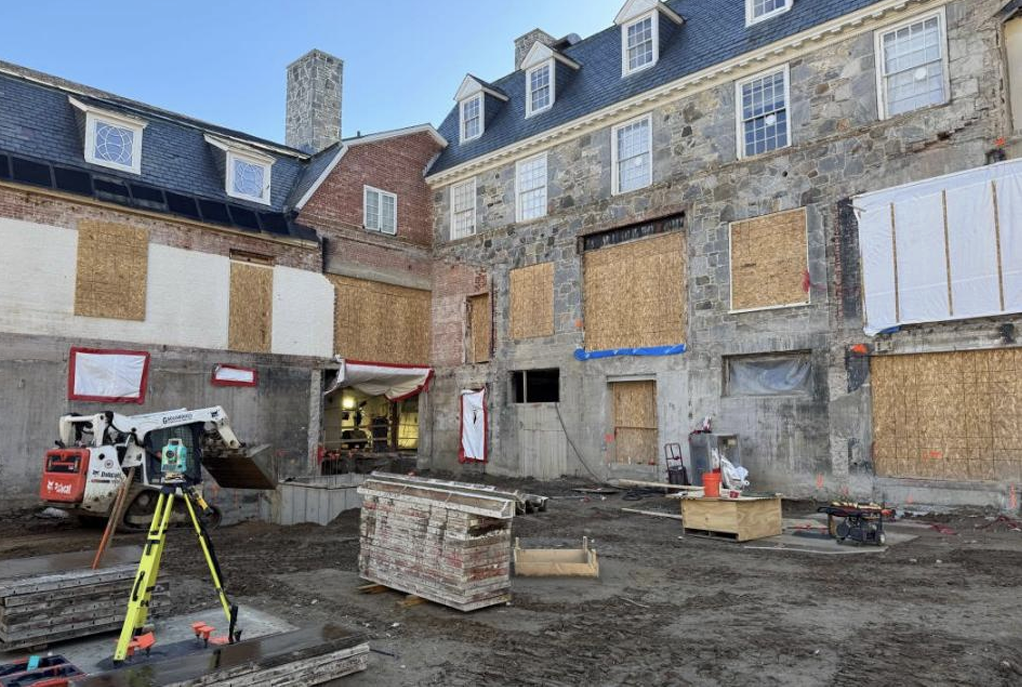
Rear of Jones Library following the demolition of the 1993 addition. Photo: amherstma.gov
The Community Preservation Act Committee (CPAC) will begin deliberations on January 15 regarding how to distribute an available $2.4 million among 16 projects that total $6.5 million in requests. One of those requests is from the Jones Library Trustees for over $1.2 million (fully half of the total available funds) and described as “fundraising” toward their building project. There are several reasons why the CPAC should recommend against that request and why the Town Council (which is the final decision-maker on the authorization of CPA spending) should vote against it.
- The requested funds would violate CPA rules against supplanting (that is, using CPA funds to replace existing municipal funds that had already been designated for a project or operating cost). The items in the application are included in the borrowing for the project that has already been authorized by the town.
- The Amherst Historic Commission has recommended against CPA funding for the windows and questioned whether the other work is eligible for CPA funds for the reason stated above.
- The project violates several of the Secretary of the Interior’s Standards for Rehabilitation and is therefore ineligible for CPA funds according to CPA rules.
- The requested additional $1,252,306 would break promises made by Town Councilors to not spend any more town money on this project. CPA funds are Amherst taxpayer dollars.
- The $1M in CPA funds authorized for the Jones expansion in FY 2021 was for Special Collections but has already been used to pay the general contractors for demolition and site work, not for its intended purpose. This misuse of CPA funds should be disqualifying for any further requests.
CPA funds should not be recommended by the CPAC or authorized by the Town Council for the Jones Library building project, and there are actual prohibitions against doing so.
Prohibitions against supplanting prohibit the use of CPA funds for this project:
TheMA Department of Local Revenue, Division of Local Services has provided guidance that clearly prohibits the authorization of CPA funds at this point in the project.
“Once a community authorizes a borrowing with another financing source for debt service, it cannot amend or change the financing source to a community preservation fund financing source. This is prohibited under the “non-supplanting” provision of the CPA. G.L. c. 44B, § 6.”
The town has authorized $46,139,000 in borrowing to pay for the project and has already borrowed money to pay for the project. It has been clearly stated that the contingency included in that total project cost would be used to cover any expenses incurred for the work specified in the Section 106 process and the subject of this CPA application.
The Amherst Historic Commission recommended against funding and questioned the eligibility of the application:
The Amherst Historic Commission (AHC) met on October 20, 2025 to discuss historic preservation related CPA applications. They recommended against using CPA funds for the windows because they were part of the project budget. They also questioned the use of CPA funds for the historic woodwork as they believed (correctly) that it was also part of the project that had already been funded. A report from the AHC meeting was supposed to be delivered to the CPAC reflecting the AHC’s deliberation but this was not mentioned in the CPAC public meetings to date.
Prohibition of use of CPA funds for projects that violate Standards for Rehabilitation:
As has been demonstrated previously, the library building project violates five of the ten Secretary of the Interior’s Standards for the Treatment of Historic Properties and is, therefore, ineligible to receive CPA funds. The Section 106 process, conducted with regard to the use of federal funds fo the project, acknowledged these violations and their adverse effects of the project. The MOA that resulted from this process only decreased the extent of these violations; it does not eliminate them, a deficiency that drew the objections of both the Massachusetts Historic Commission and Advisory Council on Historic Preservation. Furthermore, as with the rejection of Massachusetts Historic Tax Credits for this project, CPA rules require adherence to the Standards to qualify for funding.
The text of the Community Preservation Act states:
“‘Rehabilitation’, capital improvements, or the making of extraordinary repairs, to historic resources, open spaces, lands for recreational use and community housing for the purpose of making such historic resources, open spaces, lands for recreational use and community housing functional for their intended uses, including, but not limited to, improvements to comply with the Americans with Disabilities Act and other federal, state or local building or access codes; provided, that with respect to historic resources, “rehabilitation” shall comply with the Standards for Rehabilitation stated in the United States Secretary of the Interior’s Standards for the Treatment of Historic Properties codified in 36 C.F.R. Part 68; and provided further, that with respect to land for recreational use, “rehabilitation” shall include the replacement of playground equipment and other capital improvements to the land or the facilities thereon which make the land or the related facilities more functional for the intended recreational use.”
Promises that no more town money would be committed to this project:
Members of the Town Council have repeatedly stated that the Town’s portion of the project cost will not exceed $15,751,810. The Library includes the $1 million in CPA funds as part of their portion, but since CPA funds are Amherst taxpayer dollars, an argument can be made that those funds should be counted in the town’s portion. Regardless, the library is responsible for all costs not covered by the existing funding (from the MBLC, town, and CPA). The memorandum produced by Town Manager Bockelman in April 2025 (when the Town Council reconsidered moving forward with the project) explicitly states
“The Library Trustees have committed to raising the remainder through Federal and state grants and private fundraising.”
Amherst CPA funding is none of those things (it comes from a surcharge on town property taxes plus a 25% state match) and should not be recommended or authorized by the CPAC and Town Council, respectively.
Previously approved CPA funds for the library project have already been spent, but not on work stipulated in the application:
The Amherst CPA Committee and Town Council approved $1 million in CPA funds for FY 2021 for construction work related to the Special Collections for this project. A Bond Anticipation Note (BAN) was taken out earlier this year and an account for $1 million in CPA funds created by the town. Two withdrawals were made from this account to pay Fontaine Bros. (General Contractors): $422,770.90 on August 1, 2025 and $577,229.10 on September 10, 2025, leaving a zero balance. The work performed by the General Contractors during that timeframe was almost exclusively for demolition and site work. No work specifically related to Special Collections appears to have been performed, appearing to be counter to the intent and purpose of these funds. MGL (Part I, Title VII, Chapter 44B, Section 6) clearly forbids this:
“Funds that are set aside shall be held in the Community Preservation Fund and spent in that year or later years; provided, however, that funds set aside for a specific purpose shall be spent only for the specific purpose.”
The approval of these FY2021 CPA funds was itself highly controversial at the time, with three members of the CPA committee and the public questioning its legality and appropriateness. A single attorney from the town’s legal counsel offered an opinion that “the use of CPA funds to construct the Special Collections Room is consistent with the CPA” but that “it is the CPAC that ultimately makes recommendations to the Town Council”. While these funds were ultimately authorized, a report from the dissenting members of the CPAC makes a strong case against it.
Summary
For the reasons given, the Amherst CPA Committee should reject the Jones Trustees’ request for FY 2027 CPA funds. This request would add over $150,000 in debt service every year for a decade and represent a doubling of the portion of the total annual CPA debt service consumed by the Jones Library expansion project (an increase from 20% to 40%). There are several other very worthy CPA eligible projects seeking these limited funds and these Amherst taxpayer dollars should be directed there instead.
I concur with this excellent reporting.
Town councilors that read the Indy: do the right thing, as you have clearly stated it
Town councilors who claim to not read the Indy: do the right thing, as you have clearly stated it
Amherst Town government seems to have difficulty doing the right thing when it comes to the Jones Library boondoggle. CPA funds are taxpayer dollars and Jones Library Trustees have already misused the CPA funds they were granted the first time around. Town Councilors: the right thing here is to hold the line and, to quote former Town Council President, Griesemer, “not a penny more” for the Jones Library. Let the Library Trustees do what they promised to do with their highly-paid fundraisers…raise the funds.
Just to follow-up on this:
The CPAC has not addressed the concerns raised in the letter referenced here and a second letter has been sent to ask that they do so before voting on recommendations to the Town Council (probably at their next meeting on February 5). I also questioned how an application that received the second lowest ranking was being considered for nearly $600,000 out of a $3M budget.
The issue here is not about whether someone likes or doesn’t like the library project. It will have no impact whatsoever on the completion of the project or the specific items in the application – that work will happen as the construction contract stipulates and the funding has already been authorized. Supporters of the project and those who have either contributed to or assisted in fundraising, including members of the CPAC itself, must abide by the rules of the CPA and acknowledge that this project does not qualify for this funding.
The other projects that seek CPA funds are very much in need of these resources and and should be recommended instead.
Thanks, Maria, for doing your best to get the CPAC to follow the law and to operate in the best interest of the Town as opposed to the ever-hungry-for-tax-funds Jones Library, Inc.
CPA Guidelines issued by the Mass. DOR (https://dls-gw.dor.state.ma.us/gateway/dlspublic/igrmaintenance/index/739) make your points clear:
* “Once a community authorizes a borrowing with another financing source for debt service, it cannot amend or change the financing source to a community preservation fund financing source.”
* “Funding is allowable for the rehabilitation of a historically significant municipally-owned building listed on the state register of historic places, provided the expenditure falls within the CPA definition of ‘rehabilitation,’ is not within the CPA definition of ‘maintenance’ and the work complies with the Standards for Rehabilitation stated in the U.S. Secretary of the Interior’s Standards for the Treatment of Historic Properties.”
It is troubling that at least two of the three members advocating for awarding CPA funds to the library have had close professional ties to Kent Faerber, the applicant.
They argue that the library expansion will benefit a relatively large number of residents, but fail to acknowledge the unprecedentedly large amount of funds that the Town has already committed to the project.
The Committee should bear in mind that knowingly recommending an ineligible project for CPA funds could be considered a fraudulent use of taxpayer funds and could expose the Town to unwanted consequences.