
Opinion: Welcome to Amherst – Everytown USA
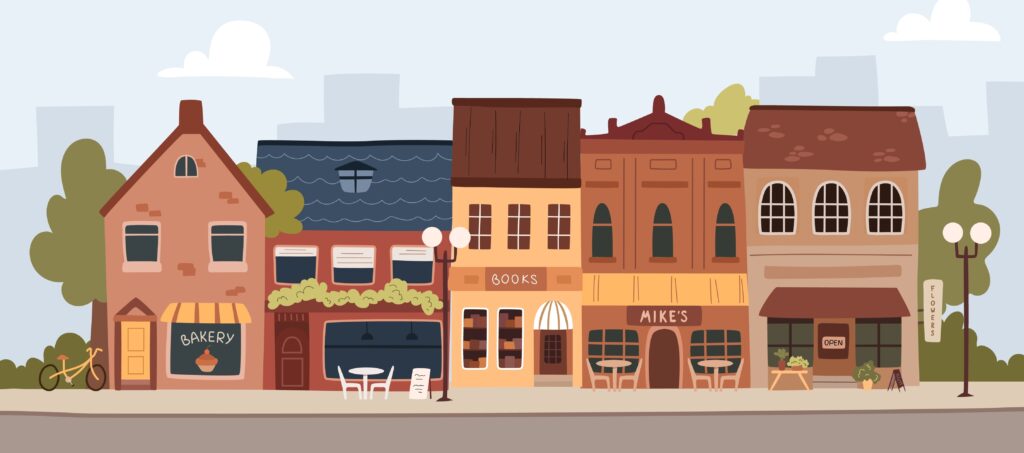
Photo: Shutterstock
Recently The New Yorker had a cartoon about Amherst. A road sign says “Welcome to Your Home Town”. Under that, a panel: “Please describe what every building used to be.” And under that, two panels: “They finally fixed that pothole. Took them long enough.” and “What’s with all the roundabouts?”
All over America I imagine folks saying “Look! The New Yorker has a cartoon about our town! And that is what Amherst has become, Everytown USA. For those who have lived here for awhile, there is lots to be nostalgic about. Downtown used to have a thriving commercial base. No longer, but we still have a Chamber of Commerce. Small businesses used to thrive. No longer, but we do have a Business Improvement District. It made decisions to turn downtown into a student district. Give them plenty of restaurants. Support the Cinema, create an entertainment venue. But students don’t need bookstores, clothing stores, gift shops, or hardware stores. We don’t have enough of these left to sustain the dynamic street life which was a keynote of Amherst before we stopped speaking to each other.
A few times a year, the commercial and business organizations give us a street fair, a town fair, and a food fair, reminiscent of the days when we were a community. Newcomers may be impressed with the bread and circuses but older residents are depressed. And as for roundabouts – what a joy still to find a few stoplights with their clear, unambiguous messages: stop, slow down, and go. I can do all three without fear, nervousness, or honking at stoplights but not at our new roundabouts.
How did this happen? How did Amherst become Everytown? There will be different answers to this question, but I will identify several. First, in 2010 Amherst created a Master Plan, as required by the state. This is when Mr. Density and Mr. Infill took up residence in town. This Master Plan, which was never approved by Town Meeting (because the Town’s approval was not sought), was a plan primarily for land use, not people use. I initially served on the Long Range Planning Committee which was charged with the plan’s development and I was charmed and encouraged by the initial consultants who created charettes which truly involved the community and crafted creative and imaginative plans. But those consultants were dismissed and the community work largely ignored. New consultants and a new committee developed the 2010 plan which gave the green light to density and in-fill without ever asking the questions “how much density and in-fill?” or “where should density and in-fill occur?” Ten years later, the new Town Council finally adopted the Master Plan without a murmur and found consultants who would recommend answers: “as much as possible” and “downtown.”
Another answer to the question, how did we become Everytown, is the Home Rule Charter adopted in 2018, a deeply flawed document that destroyed the checks and balances which had prevailed in Amherst. Prior to that date, the Finance Committee was appointed by the elected Town Moderator, and the Planning Board was appointed by the Town Manager, who was chosen by the Select Board. After that date the Finance Committee became a subcommittee of Town Council, which also appointed the Planning Board.
A third answer – and I write it through my tears – is that Amherst lost the great New England democratic tradition of Town Meeting and replaced it (and the Select Board) with Everytown’s form of government. Everytown has some version of a town council. The source of power and influence is in a few hands which may or may not belong to those holding positions in governance. I will not say more about this here because I have written about it often in The Indy, and so have many others. Suffice it to say that the concentration of power in Amherst is no accident.
I write this as 2026 looms a few days ahead. What can we do in the new year to restore democracy and a balance of power in our governance and preserve what is left of our landscape and history? Many Amherst residents are not particularly concerned about this because they came to Amherst from other Everytowns and don’t plan to stay here very long. Others want their trash picked up, the streets plowed and the potholes filled but otherwise don’t pay too much attention to town government. Residents with longer memories are getting long in the tooth and find it difficult to turn nostalgia into action. Housing for new families is scarce, having given way to student dormitories and out-of-town investors.
But maybe the answer is simpler. Democracy is hard work, and in Everytown much of that work is done for residents, not by residents.
It is quite possible that in Everytown this is what residents want. I have tried to resist this notion for a long time. I recognize that even if there is some truth in it, Amherst is blessed with a great many residents, both longtime and recent, who care deeply about the town and work tirelessly to sustain and improve it. Many of them participate in town government. Others write for this paper and other local papers. Some are working hard to recover and document the industrial and social history of our town, while others insist on reminding all of us, including our government, where we are falling short of our aspirations.
The New Year brings a new town government and to its members I say thank you. We will be watching you and I hope you will be hearing from us. Let us all commit ourselves to restoring and sustaining our unique town, where only the “h” is silent. Happy New Year!
Michael Greenebaum was Principal of Mark’s Meadow School from 1970 to 1991, and from 1974 taught Organization Studies in the Higher Education Center at the UMass School of Education. He served in Town Meeting from 1992, was on the first Charter Commission in 1993, and served on several town committees including the Town Commercial Relations Committee and the Long Range Planning Committee.
The master plan from 2010 was by no means the beginning of the town pressing for infill and density. This 1973 town plan document ( https://www.amherstma.gov/DocumentCenter/View/24482/1973-SCOG-Report-2?bidId= ) actually proposes exactly some of the changes that have happened in Amherst over the last decade (such as increased density north of the center towards UMass). It just look time for the zoning changes, land protections limiting new sprawl (APRs and CRs), and market pressures for much needed new housing to finally tip the scales into making these changes happen. Amherst should not be static. Over the last 40 years it has become a necessary pillar of the Western Massachusetts economy and is one of the only municipalities still growing in the region. Stasis and disinvestment through Nimbyism, anti-growth policies, and pro-nostalgia arguments will hurt more than help Amherst in the long run.
Dear Michael,
From those of us who came to Amherst when it truly was “everyone’s” town, we thank you.
Amherst, as “Everytown USA” is joining the much larger trend of Boston and Ithaca, NY: large mixed use commercial/residential buildings that create zero community and street scene. Or you can drive through the old Midwest and South farmlands. Guess what the farmland is gone and instead you find “Warehouse Boomtowns”. Thank you Amazon, Walmart, and Target. This is the reality of our technology; call it progress or spiritual soullessness. I am an old person, I too am nostalgic and yearn for people talking to each other and everybody knew your name. Allot of fantasy in that TV show Cheers. Was it ever that way, anywhere? PS: I do like roundabouts.
Craig Judicki – thank you for your comment. The SCOG report of the early 70s was forward-looking and, in terms of village centers, determinative. But I don’t think its writers would recognize our current downtown, nor do I recall any mention of density and infill. I stand to be corrected if my memory is faulty. But the 2010 Master Plan certainly did talk about them, without making any suggestion about guidelines or limits to growth. We are now suffering from that omission.
Rita Burke – Thanks for commenting. Our town is unique in that many tiers of the different epochs of our local history and architecture are still standing and in use. There is an admirable effort in North Amherst to recover and document its industrial past, while a move to create an East Amherst Historical District seeks to preserve what was once “Amherst Center.”
Mark Zinan – I sometimes wonder whether I am yearning for a golden past that never really existed. But I was principal of North Amherst’s school for twenty-one years and saw graduate students from all over the world, 3rd generation farm families, junior and senior academicians all send their students to Mark’s Meadow and use the school as the community center it desired to be. And downtown there was a community of bookshop junkies who used the town’s nine bookstores as their literary salons. I know about malls, I-91 and COVID, but we could have this kind of town if we wanted it. And if the powers that be decided that this was the kind of town they wanted, I would gladly support as many roundabouts as they want.
I am always impressed with the downtown of Lee Mass. we pass through on our way to Tanglewood.
Shoe stores , pharmacy, restaurants all as they have been for years . A nice street to stroll .
Amherst also has a disconnect with the rental value of space in downtown . I have heard landlords say that they charge below market value for tenants. As if an act of generosity.
Below market rates, is the true value .
Dear Friends,
Amen, Michael!
I have even longer teeth than most of the other respondents so I can say that Town Meeting rejected the SCOG —Select Committee on Goals—by one vote! The 1975 vision was considered much too urban for us rural folk even though UMass was in its rapid growth phase.
I have right to advance yet another scenario how we got here. Our new (first, I think) Town Manager, Allen Torrey, lived on the pristine South Amherst Common and was intent on its preservation. To that end a massive revision of the zoning bylaw around 1965 required that multi-unit buildings be constructed on town sewer lines. Mr. Torrey saw that the new sewer lines be built on the then agricultural fields on Lake Hitchcock silt along our western boundary from 180 Montague Road to East Hadley to serve the increasing population. North Amherst, a working and farm family district, continues to get all the uses that no one wants in their neighborhood to preserve rural South Amherst’s aquifer and character. And, interestingly, these folks making land use decisions now still live in protected South Amherst!
1965 was also the year of the controversial South West dorms!