
Opinion: A Warm Welcome for the New Emergency Shelter in Northampton
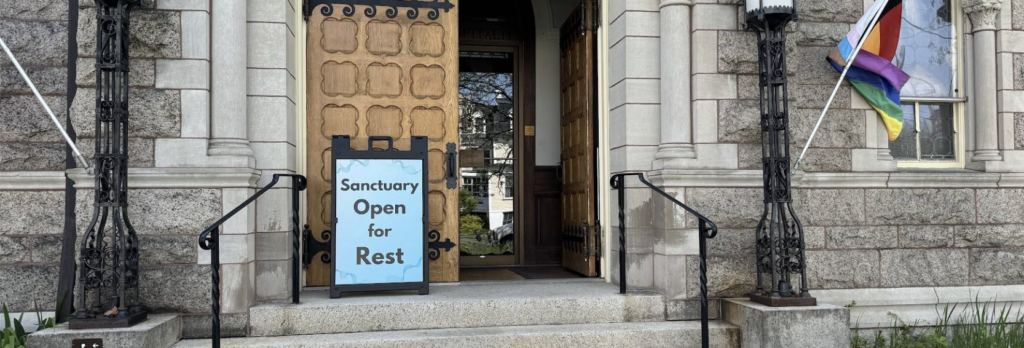
St. John's Episcopal Church in Northampton is the site of a new emergency shelter. Photo: St. John's Episcopal Church
A shorter version of this column appeared previously in the Daily Hampshire Gazette.

Last week, a ribbon-cutting ceremony at St. John’s Episcopal Church in Northampton signaled something far bigger than a new emergency shelter opening: it marked an affirmation of our community’s values.
On January 8, local leaders, volunteers, and neighbors gathered to bless and officially open the Trinity Room, a new winter emergency shelter housed at the church. The Trinity Room will provide a safe, warm place for unhoused people on the coldest nights when the temperature drops below 15 degrees Fahrenheit. The ceremony brought together Bishop Douglas Fisher of the Episcopal Diocese of Western Massachusetts, St. John’s Reverend Anna Woofenden, St. John’s building and grounds team co-chairs David Reckhow and Karen Daneau, and Northampton Mayor Gina-Louise Sciarra, reflecting broad civic, faith-based and spiritual support for this life-saving effort.
For too many in our area, winter is more than an inconvenience: it’s a life-or-death threat. Nights regularly dip into frigid temperatures that can be lethal for those living outdoors. The Trinity Room fills a critical gap when existing shelters reach capacity, offering safety and warmth when the cold is unforgiving.
on the coldest day of the year…approximately 871 people in Hampshire County experienced homelessness, including 635 individuals and 238 people in families — among them 122 children under 18.
The need for this kind of space is not abstract. Annually, local organizations conduct what’s called a Point-in-Time Count, an effort to estimate the number of people experiencing homelessness on the coldest day of the year. According to the most recent Point-in-Time Count data, approximately 871 people in Hampshire County experienced homelessness, including 635 individuals and 238 people in families — among them 122 children under 18. This trend extends well beyond our county. In 2024, Massachusetts saw an estimated 54 percent increase in people experiencing homelessness, one of the steepest rises in the nation, driven by soaring housing costs, limited affordable housing stock, and growing household instability. Preliminary data for 2025 indicates that demand for shelter and services remains high across the region. Yet the significance of this moment runs deeper than calendars and cold fronts. What we witnessed at the ribbon cutting ceremony for the Trinity Room at St. John’s was a community choosing care over indifference. It was a reminder that faith institutions, local government, and neighbors can, and must, work together when human need demands it.
Housing is a public health issue because it shapes the conditions in which people live, heal, and survive. Emergency shelters sit at the intersection of prevention and crisis response. Housing instability and homelessness both cause and exacerbate mental health conditions and substance use disorders. Shelters provide a critical entry point for trauma-informed care, peer support, and harm reduction, reaching people who are otherwise disconnected from services. Homelessness is not evenly distributed; it disproportionately affects people with disabilities, older adults, survivors of violence, LGBTQ+ individuals, and people impacted by systemic racism and economic inequality. Recognizing emergency shelters as part of the public health infrastructure affirms that homelessness is not a personal failure, but a population-level challenge with community-wide health consequences.
Of course, even the most thoughtfully designed shelter is not a complete solution to homelessness. We continue to face a regional housing crisis that is straining families and individuals alike. While emergency and warming shelters provide essential short-term relief, deeper investments in affordable housing, supportive services, and long-term stability programs are needed to reduce the number of people who find themselves without a place to call home.
Yes, the ribbon cutting was symbolic: but symbols matter. They remind us that we still believe our neighbors are worthy of safety, shelter and dignity, regardless of their circumstances. They show that a church’s mission extends far beyond Sunday services, and that city leaders are willing to partner with community organizations in life-saving work.
Most importantly, they remind us that homelessness is not someone else’s problem to solve. It’s a community challenge; and one we’re choosing to meet with humanity, not hesitation.
In the coming weeks and months, let us build on this moment and advocate for more affordable housing options and expanding supportive services. Together, we can work to ensure that no one in our community is left to face freezing temperatures alone. If the opening of the Trinity Room at St. John’s has taught us anything, it is this: when Northampton comes together, we reaffirm our shared humanity.
Amy Cronin DiCaprio is writing on behalf of the Northampton Department of Health and Human Services.