
Amherst Again in Mild Drought
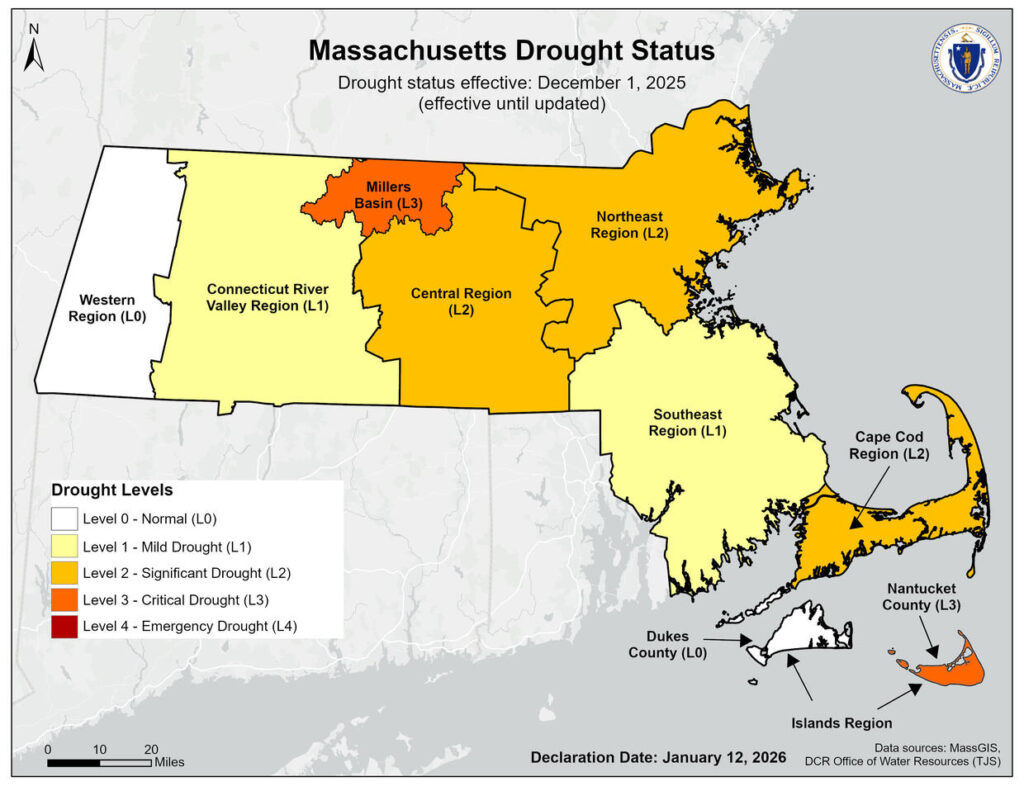
Massachusetts Drought Map, January 12, 2026. Photo: mass.gov
Source: mass.gov
The Massachusetts Executive Office of Energy and Environmental Affairs declared on January 12 that the Connecticut River Valley is in a Level 1 Mild Drought. According to the town’s website, Amherst’s water supply has remained stable and is not threatened by the drought. However, in accordance with the town’s Water Management Act Registration, during a Level 1 Mild Drought, nonessential outdoor water use is restricted to one day per week, before 9 a.m. and after 5 p.m. Therefore, the Town is implementing the following water use restrictions until further notice:
Tuesdays: Nonessential outdoor watering allowed for even-numbered houses from 5:00 PM on Tuesdays to 9:00 AM on Wednesdays.
Thursdays: Nonessential outdoor watering allowed for odd-numbered houses from 5:00 PM on Thursdays to 9:00 AM on Fridays.
Watering of ornamentals and flower gardens with drip irrigation, handheld hose, or water cans is permitted at any time.
Drought Persists from 2024. Impacts Are Significant
During December, Massachusetts received rainfall ranging from 3 to 4 inches, but the month ended with totals at 1-2 inches below normal. When looking back over the past 3 to 6 months, precipitation deficits still persist. The forecasted rainfall is anticipated to bring near normal precipitation through the end of the month.
The current drought, which began in 2024, has continued to have significant impacts on the natural environment, including the drying of streams in nearly all regions, lower water levels in lakes and ponds, and impeding fish passage out to the ocean.
As outlined in the Massachusetts Drought Management Plan, continued detailed monitoring of drought conditions must continue. The drought levels also require ongoing coordination among state and federal agencies to implement drought response actions. Additionally, engagement with municipalities, including local Boards of Health (BOH), is essential. This includes providing technical outreach and assistance to water suppliers and affected municipalities. Residents are asked to report to their local BOH in case of wells drying up; BOHs are asked to report on the condition of local private wells.
Residents can report dry environmental conditions and submit photos to help monitor the situation on the Massachusetts Water Impact Reporter (here). Additionally, a FAQ is now available for questions regarding the current drought status and water conservation, and private well owners can go here for information on how the drought may impact them.
The Massachusetts Department of Environmental Protection (MassDEP) will continue to assist communities in managing their water systems. The Massachusetts Water Resources Authority (MWRA) water supply system is not experiencing drought conditions.
State agencies will continue to closely monitor and assess conditions across the state, coordinate any needed dissemination of information to the public, and help federal, state, and local agencies prepare additional responses that may be needed in the future. The Drought Management Task Force will meet again on February 10th at 9:30 a.m. For further information on water conservation and what residents can do, visit the Department of Energy and Environmental Affairs drought and water conservation pages.
Drought History
The information in this Drought Status History dates to 2001, when the Massachusetts Drought Management Plan was developed in response to a period of deficient precipitation that began in 1999. The most severe drought of modern times was the 1960s drought, which was equivalent to a drought emergency. A less severe drought occurred in the early 1980s.
The Commonwealth experienced another impactful drought in 2016-2017 with drought levels reaching Level 4 Drought (Warning) out of five levels of drought; the drought impacted the agricultural sector, some water supplies, the natural environment and many habitats and species. Read more about the drought, how it fared, and the state responses and actions.
Additional Resources
Open PDF file, 5.47 MB, Massachusetts Drought Management Plan (English, PDF 5.47 MB)
What Should Communities Do During a Drought
Average Precipitation Statistics