
Cherry Hill Is Not a Failing Golf Course
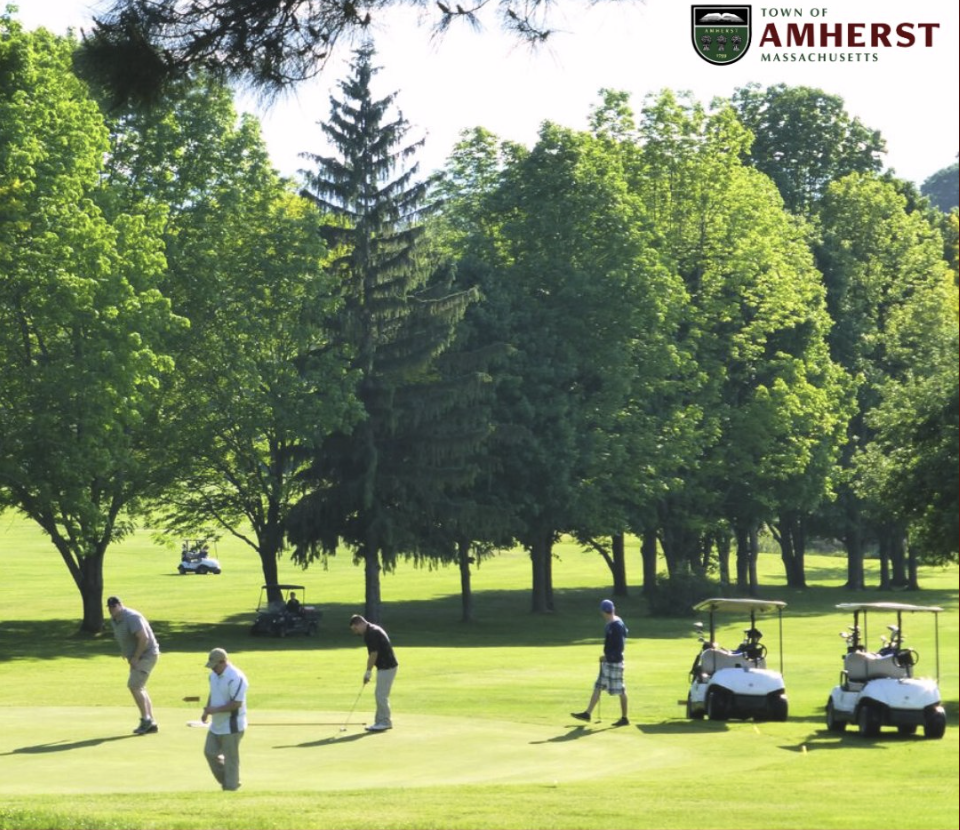
Cherry Hill Golf Course. Photo: amherstma.gov
Report on the Meeting of the Cherry Hill Working Group, January 21, 2026
This meeting was held over Zoom and was recorded.
Present
Michele Miller (Chair), Sanjay Arwade, Ryan Diplock, Sarah Goff, Hilary Matheson, Chris Pariseau, Anurag Sharma,
Staff: Dave Ziomek (Assistant Town Manager) and Rey Harp (Recreation Director)
Members of the Cherry Hill Working Group (CHWG) heard a presentation regarding the economic viability of the Cherry Hill Golf Course from working group member Ryan Diplock, CFA, and Portfolio Manager at Polar Asset Management.
Diplock said that it took him six weeks of collecting information from over 20 documents to arrive at an accurate picture of the economic health of the golf course. He said the golf course is listed in the town budget as a cost center, but its revenues go into the general fund, so it is difficult to get an accurate accounting of the revenue. He emphasized that it is imperative to marry the revenue with the costs and run the golf course as a business. He stated that, without knowing both sides of the equation, it is impossible to make rational decisions about the future of the course. Nevertheless, his analysis showed that the golf course had a profit of $39,569 last year.
In his report, Diplock highlighted the community engagement in the golf course, with over 100 members and over 60 people per day playing on the nine-hole course. However, he noted that, since 2017, the town has failed to maintain capital investment in the course. He suggested ways to improve the course’s profitability and condition.
To raise revenue, Diplock suggested raising membership fees, which have not changed in the past six years, by 15%. He also recommended increasing nonmember green fees from $20 to $28, which is still less than what other municipal golf courses charge. In addition, he suggested extending the season by two weeks, until November 15, and opening daily at 7 a.m. instead of 8 a.m. He also recommended obtaining a full liquor license for the clubhouse and raising the cost of beer and craft seltzers to $5 and $8, respectively.
Most crucial, Diplock advocated for a Golf Course Management System that could pair solo golfers with others requesting the same tee time and maximize the course’s use while satisfying golfers’ requests for reservations. He noted that 57% of bookings were for single golfers, and only 7% were for foursomes. The management system would also track usage and make financial analysis easier. He estimated that a management system would cost $5,000 but would easily pay for itself by increasing efficiency and utilization on busy days from 50% to 70% or 80% capacity.
Regarding other costs, Diplock recommended hiring an associate superintendent and another full-time worker to assist with course maintenance. He also recommended increasing the budget for chemicals from $15,000 to $ 30,000 a year and, most crucially, investing $67,000 a year for the next five years in capital improvements.
Diplock’s advice was to reinvest all profits from the golf course for the next five years into the course to catch up with deferred maintenance. After that, the projected $100,000 to $200,00 in profits could support other recreation services in the town.
In addition to golf course revenue, Diplock suggested nontraditional uses of the property to increase profitability. These include adding a driving range, creating a wedding venue, establishing a golf pro shop offering merchandise, and increasing the food offerings in the clubhouse.
Working Group Discussion
Hilary Matheson voiced concern about raising fees when the course is not in the best condition. She worried about excluding many people with the increase in membership dues and green fees. Diplock emphasized that, even with the fee increase, Cherry Hill would remain one of the most affordable courses in the state, and he doubted that people would drive 45 minutes to save $8 on green fees. He noted that the increase in capital investment will improve the condition of the course.
Anurog Sharma agreed with the need for a management system. He emphasized the need to get more information on the profitability of the course and an understanding of the membership—whether they are residents or nonresidents, their age, and their usage of the course.
Assistant Town Manager Dave Ziomek cautioned that a management system was not in this year’s budget. He also noted that, at one time, the golf course was an enterprise fund so that its expenses and revenue were separate from the town budget; however, it was put into the main budget when it started to lose money.
The working group decided to invite Finance Director Sean Mangano to their next meeting on Wednesday, February 4, to discuss ways to improve the golf course in light of the town’s financial constraints. Ziomek suggested that members forward their questions about finances to him, and he will present them to Mangano.
Ziomek cautioned that the working group was charged with discussing all possible uses of the Cherry Hill property, not only the golf course, and that their recommendations needed to be approved by the Town Manager.
To that point, Sanja Andrade noted that the cross-country skiing is excellent at Cherry Hill and that the Amherst High School Nordic team of about 40 seventh through twelfth graders has been practicing on the groomed trails. There is also a disc golf course at the site.
As someone who golfed there last year, the course layout is good but the conditions of the fairways, greens, and other areas of the course are atrocious. The course is desperately in need of qualified groundskeeper. Even the small pond before the first par 3 is always littered with cans and trash. Even at the lower than average cost to play there its not worth it when you’re hitting of mud, dirt and burnt out grass.
If they can get that course in better shape it can be a really nice course.
As a member of Cherry hill I must admit the course is definitely in need of some repairs especially the tee boxes and a couple greens but to be fair it’s very difficult to expect a top notch course when all you have on staff are 1 full time employee and 2 part time employees they have all the can do to keep up with the daily business of keeping the course playable and in my mind give it 100% plus but they can’t do it all alone mowing greens and fairways must be done daily and leaves little time to do the other things requiring attention.I believe they do the best they can with what they have, and they actually care and are always friendly to the players. Adding at least the option to get a hot dog during the tour would be a nice touch.It’s a nice place to play, and giving it at least a bit more resources would go a long way to improve the course.If going to raise the feels, then you must improve the course at least give them a fighting chance
Could someone tell me why trying to make a ball go into a hole is so exciting? It’s one more form of target shooting, and the only since that makes is that it replicates hitting targets with bullets, bombs, missiles etc, the same way we do in a war, in order to determine winners and losers, If no one kept score there would be no more competitive sports and no more models of war..
I hope the Working Group will see the value of continuing to offer the growing sport of disc golf at Cherry Hill.
It’s a low-cost, low maintenance way for the Town to expand healthy, year-round use of the property, strengthen community connections, and support the existing golf operation rather than compete with it.
Whatever the costs of maintain Cherry Hill, they are minimal to what the proposed multi-family subdivision would now cost the town in road maintenance and snow plowing alone. Open space is the most cost effective land use among the Massachusetts real estate taxing categories. . . And outdoor recreation along with the implied health benefits also a net positive for our tax base. Cherry Hill needs to be brought up to par!
I am not a golfer (tried it, even took lessons, not my thing), but hitting a ball into a hole beats the hell out of using bullets, bombs, and missiles for anything. I’m not a fan of carts (somewhat defeats the aspect of exercise), but I believe the non-combativeness of golf is worthy of support as a good, clean, outdoor activity for anyone of any age. Players at Cherry Hill, no matter the updates needed, treasure this outdoor wonderland, and so should the Town.
That every day, people can afford to play at Cherry Hill is an advantage to the everyday people who pay the taxes for it. None of my three sons, while growing up in Amherst, could have afforded to play golf without it, known in our house as “the people’s course.” Although I am not a golfer, it is a joy for me when they, now all middle-aged men, get together and join my husband to “go outside and play”.
A net positive for our tax base would be housing on the site. Families need homes in Amherst so they can take advantage of what Amherst has to offer, such as a good education for their children. This is what every parent wants. Otherwise the Cherry Hill Golf Course will always be a black hole into which our money flows. And it’s sad to think how many years ago the town bought it.
Perhaps it is time for people to go back in time and review the reasons the town decided to take the Cherry Hill property, including the portion where the co-housing now stands, by eminent domain, from it’s original owner.
At the time the town acquired the property, including the golf course, the owner was negotiating to sell his golf course and his family land to a private real estate investor.
This investor was intending to construct high end condominiums, on a small portion of the site. This condo complex would have maintained its own roads and infrastructure, at no cost to the town.
In the proposed deed, if the plan had gone through as intended, there was a provision by the owner of the land, to sell the golf course portion to the town for $1, ensuring that most of this beautiful property would then remain open space for perpetuity, as a benefit for future generations.
I believe, because of many reasons, mostly political, Town Meeting chose to take all the land, including the golf course, for open space/recreation. They claimed they did not want development on any of the land.
I believe this open space/ recreation idea was even used to procure any money the town received to help buy the property and it was the stated reason for the eminent domain taking of the owner’s land.
So, it does not seem fair, legal, reasonable or even possible that this open space/recreational land could now be considered for housing. Especially, since eminent domain was used to take it from its owner, to prevent housing!
Now, it is the town’s obligation to keep it open space forever as the takers declared and as the original owner had intended.
I live across the street from the Cherry Hill Golf Course, and I see how busy it is every day. It’s clearly a well-used, valued recreational space for people of all ages in Amherst.
What I don’t understand is why the Town’s difficulty managing costs or maintenance automatically leads to talk of development. Struggling to run something well isn’t a reason to give up on it and put houses there. The land was meant to stay open and serve the community, and we should focus on fixing the management and funding challenges, not abandoning that commitment.
Mr. Nelms, disc golf like other sports teaches bravery and resolve; sportsmanship/friendly competition w/new friends; the riches of practice and discipline; the experiences of victory and defeat; requires health/fitness/diet awareness; raises self-esteem and a sense of inclusion; can be easily modified at school to accommodate students with special requirements. Also, a disc golfer can lose up to 450 calories per hour (compared to about 250 for ball golf). Disc golfers use special equipment which must be manipulated and learned, as well as maintained. Definitely a sport.
Kurt Geryk