
Opinion: Children and Performance
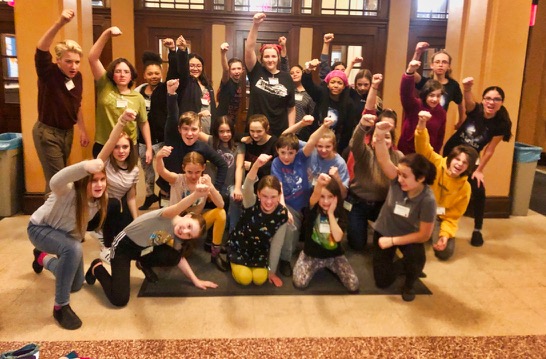
Youth members of the cast of Amherst Leisure Services Community Theater's production of Matilda (the musical) during a rehearsal break at Bowker Auditorium at UMass in 2020. Photo: Phoebe Hazzard
I was not able to attend Amherst Community Theater’s The Wizard of Oz last week, but my spies tell me that both the stage and the house of Bowker Auditorium were filled with children, and that report warms my heart. I congratulate and thank the company both for the pleasure they gave and the service they performed. Let me focus here on the service.
When the Elementary School Building Committee was planning the new school and soliciting comments, I urged them to prioritize a genuine performance space. A “genuine” performance space is one that takes account of performing, seeing, and hearing in its specifications. Sadly, neither the current Fort River nor Crocker Farm’s “cafetorium” meets those criteria; a raised stage by itself is insufficient when it is at the end of a large space ordinarily used for other purposes and which has neither sufficient stage machinery (curtains and stage lamps) nor acoustical treatment nor banked seating for young children. Sadly, this appears to be the case with the new school as well.
And I am sad. Performance ought to be central to the schooling of young children and should follow them through high school. The values of performance cannot be standardized, and in these days when schools seem more and more subject to standardized measures, this should be cherished. Drama, music, and team sports share core attributes that require them to be central to schooling. Let me just mention some of them.
Cooperation
Cooperation is not a key value in classrooms, where it is often called “cheating”. In the performing arts and athletics, it is central to success. Performers and players are keenly aware and appreciative that they cannot succeed without the support of others and that they are as obliged to give that support as receive it.
Personification and Identity
Playing a role and imagining oneself as another are two essential democratic values. This requires a longer essay (or book) to explicate, but the demands of performance are paradoxically important to developing a sense of self. Becoming an “other” is a role one steps into and then out of. Role-playing is natural to young children; as they grow older, roles become connected to scripts, events, outcomes, and developments, and taking a role is a creative responsibility called interpretation. Interpretation requires choice, and making choices is one of the precious human capacities – one that schools rarely prepare humans for.
The Frame and the Clock
Schools are full of bells, which, in effect, tell both children and adults when to step into and out of their roles of students and teachers. A stage with a proscenium helps young performers feel that they are playing a part, and while it is important that they “stay in character” when in the frame, it is equally important to be themselves when they step out of the frame. Similarly, young athletes (and their fans) must realize that inside the clock, they should be highly competitive, but after time has expired, they should leave that behind.
Glory and Satisfaction
In most performing arts and athletics there are those who receive the glory and those who are satisfied to know how essential their contribution – backstage, accompanying, supporting – has been to the success of the performance. In schools, young children should all have chances at both glory and satisfaction. As children grow, roles become more developed and discrete, and paradoxically glory and satisfaction tend to merge. No soloist is unaware or unappreciative of the chorus; no quarterback is ungrateful for a skillful defensive line. And no stagehand really thinks the show could go on without her.
There is much more to be said along these lines, but perhaps this suffices to suggest why performance is so central to schooling. It has been said that teaching values is the job of the home, not the school. To which I say, OK, but children learn their values from the others in their lives, adults and children alike. They watch, and they experience, and they conform. They listen to stories, then they read them, and then they become characters in games. Teaching, whether at home or at school, doesn’t much figure into this learning.
Maybe schools should take their cue from The Wizard of Oz. The Scarecrow got his diploma because he was already smart. The Tin Man got his heart because he was already kind. And the Lion found his courage because he was already compassionate. The Wizard had clearly gone to a good school.
Michael Greenebaum was Principal of Mark’s Meadow School from 1970 to 1991, and from 1974 taught Organization Studies in the Higher Education Center at the UMass School of Education. He served in Town Meeting from 1992, was on the first Charter Commission in 1993, and served on several town committees including the Town Commercial Relations Committee and the Long Range Planning Committee.