
Hundreds of UMass Employees Picket Boston and Amherst Campuses to Demand Fair Wages
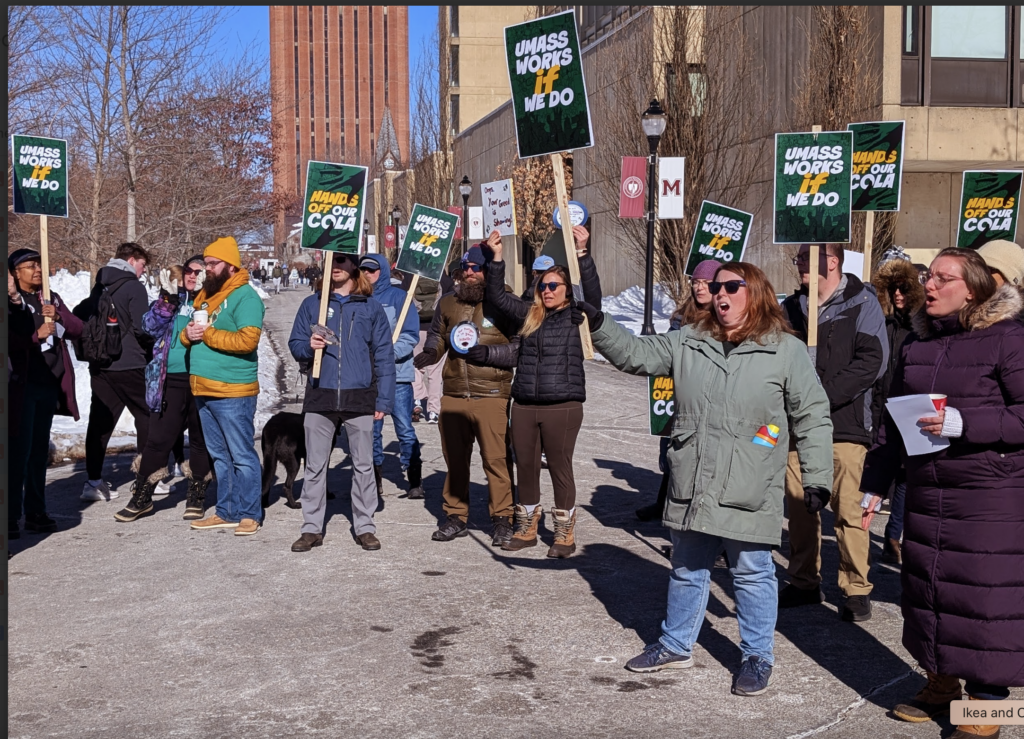
Students, faculty, and members of the community joined the Professional Staff Union in their rally for fair wages on Feb. 5. Photo: UMass Professional Staff Union
Source: UMass Professional Staff Union (PSU)
After 20 months of bargaining, UMass Amherst Chancellor Javier Reyes threatens governor-guaranteed cost-of-living adjustments
Members of the University of Massachusetts’s Professional Staff Union (PSU), which represents 2,400 employees across the Amherst and Boston campuses, have been negotiating their new contract with UMass administration since July 2024. On Wednesday, February 4, and Thursday, February 5, hundreds left their offices and took to picket lines on the Boston and Amherst campuses. The main sticking point? UMass Amherst Chancellor Javier Reyes and his demand that employees forfeit part of their governor-approved cost-of-living adjustments to an opaque “merit-pay system,” to be doled out at UMass management’s pleasure.
The statewide cost-of-living adjustment, or COLA, is negotiated by the governor for all state employees. COLA is not a raise. Its sole purpose is to keep salaries even with inflation. The governor has agreed to a 12.5% COLA adjustment over the three-year period from July 2024—when PSU’s contract expired—to January 2027. And yet Chancellor Reyes has instructed the university’s bargaining team to demand that employees give up 1.25% of the governor’s COLA.
“We all need our full COLA right now,” says Andrew Gorry, co-chair of the Amherst chapter. “Our 2,400 members are managing crushing inflation and the added stress of potential increased healthcare costs, while Amherst’s Chancellor Reyes has continued to put proposals on the table that would result in pay decreases of $1,000 or more for many of our members.”
Frustration with Chancellor Reyes has been growing throughout the bargaining process, and not only because of Reyes’s COLA demands. The union’s contract expired 20 months ago. Negotiation has been fraught with bad-faith bargaining—PSU has even had to file three charges with the Department of Labor Relations (DLR) against Chancellor Reyes’s team.
On top of this, Chancellor Reyes instructed his lead bargainer, Brian Harrington, to trigger his team’s nuclear option in October by filing for impasse with the DLR, a tool that management can use to circumvent bargaining and unilaterally impose the demands that they couldn’t otherwise win. Until recently, the threat of impasse has rarely been used at UMass, though it is becoming a favorite tool of the Reyes administration. “We are pleased that the DLR has, for the moment, ordered UMass management back to the table. Every PSU member at UMass has a right to vote on their contract—and we are optimistic that we will reach agreement at the table,” says Tom McClennan, president of PSU’s Boston chapter.
In early December, the Amherst chapter passed a no-confidence vote in Chancellor Reyes by a stunning 94%–6%, which is the fifth no-confidence vote the chancellor has lost since coming to UMass Amherst in July 2023. “Javier Reyes has united the entire campus against him in a little over two years,” says Amherst co-chair Nellie Taylor, who points to the University Staff Association, Faculty Senate, undergraduate Student Government Association, and Graduate Employee Organization, all of which previously passed votes of no confidence. “He has instituted anti-worker and anti-democratic policies and decisions, which are a bad match with the history and values of public higher education in Massachusetts. We all—students, faculty, staff, and the citizens of the commonwealth—deserve better.”
UMass Boston Will Not Work for Free
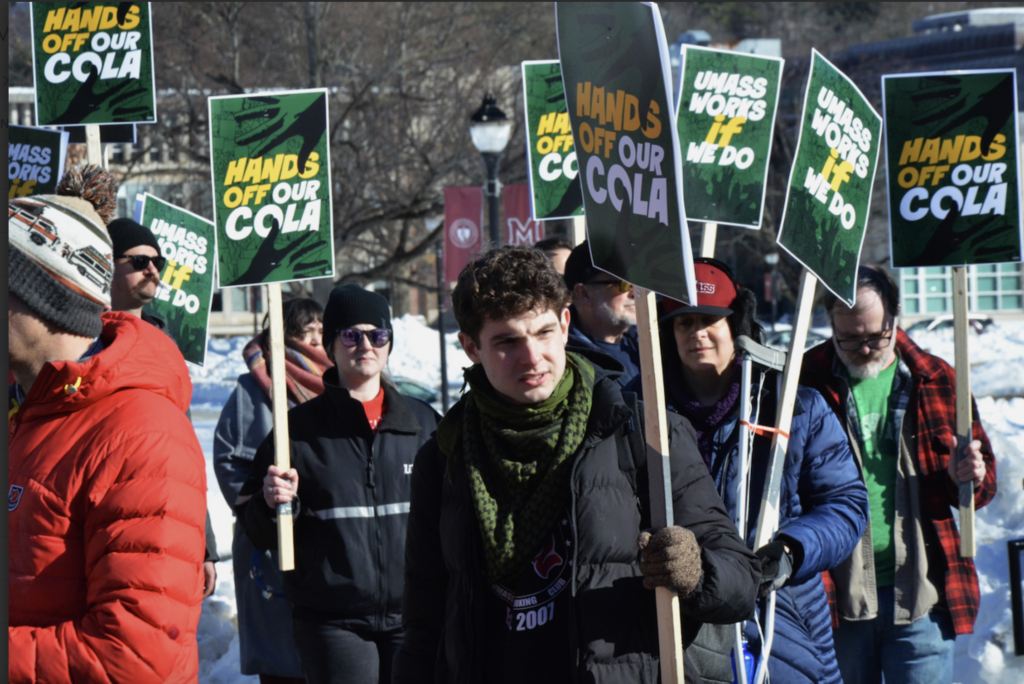
“We work hard at UMB, but we will not work for free!” shouted approximately 250 members of PSU Boston on February 4, who carried signs saying “Hands Off Our COLA!” and “UMass Works IF We Do.”
“We’re out here demanding the same cost-of-living increases as other state employees because we all experience the same increases in the cost of living,” said McClennan to the assembly on UMass Boston’s plaza. Ethan Labowitz, a member of PSU’s contract action team, followed up by saying, “We’re unwilling to accept pay cuts during historically high inflation, in the richest state in the richest country in the world, at a university where our chancellors earn over $700,000 per year. And after meeting and organizing with so many of us, I don’t feel defeated at all. I feel energized to be out here with all of you today.”
Hundreds of PSU members and supporters gathered on the campus plaza in sub-freezing temperatures to demand a fair contract. Drawn together by the threat to the cost-of-living adjustments UMass Boston’s employees rely on and concerns about the rising price of simply getting to work, the crowd marched across the campus plaza and expressed their resolve.
UMass Amherst: We Deserve a Living Wage
A day later, on February 5, the daylong picket got off to a cold, sunny start and a warm greeting from Max Page, president of the Massachusetts Teachers Association. Hundreds of PSU Amherst members signed up for slots throughout the day to continuously staff the picket line, which, with the addition of a brass band, drummers, dancers, and singers, looked like a block party crossed with a labor rally.
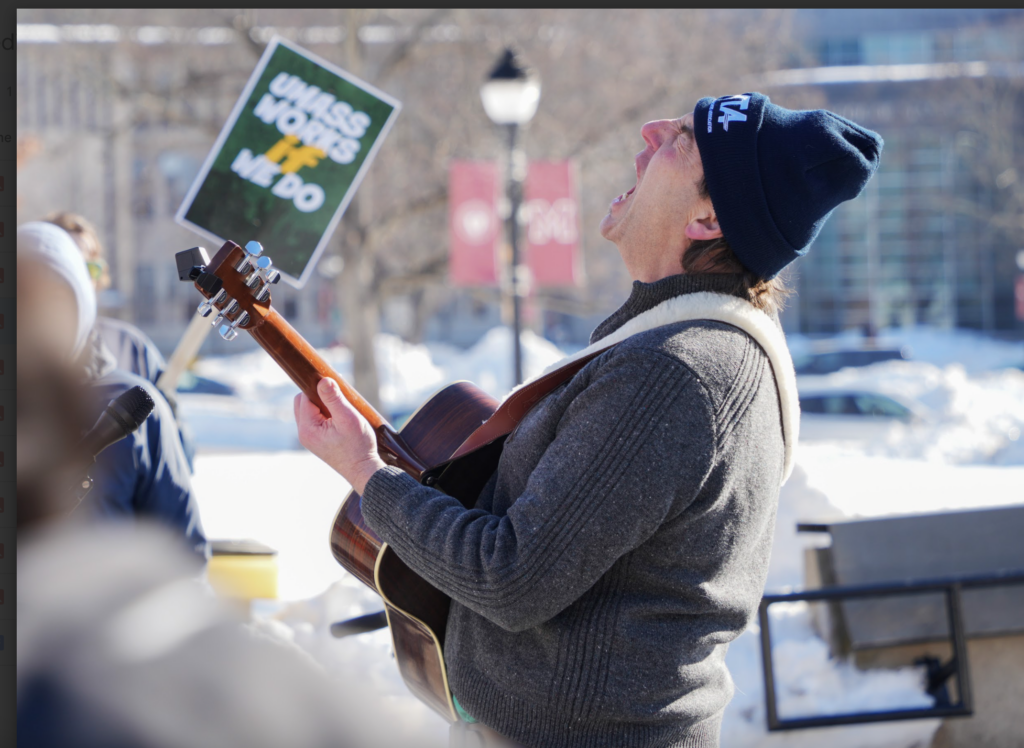
“Over the last 18 or so months, we have built incredible power within our union,” says Aliza Micelotta, PSU Amherst’s organizing chair. “With every action, more members are plugging in to help with planning, getting their colleagues to participate, giving speeches, and taking action. This type of grassroots organizing is how change is made.”
There was a palpable sense of injustice among PSU members, many of whom hold second jobs to help make ends meet, skip meals, ration medical care, or put off major life decisions—like having children—because a UMass Amherst salary is too low. Chancellor Reyes, on the other hand, lives rent-free in a taxpayer-funded mansion on campus and, according to CTHRU, the state’s open payroll database, brought home $731,685 in 2025—18 times what the lowest-paid PSU staff member made.
“This is why we are also bargaining to raise the salary floor for our lowest-paid members,” said Gorry. “We shouldn’t have to fight so hard for something so basic.” The union is negotiating for a $60,000 floor for members on both the Boston and Amherst campuses.
“UMass knows that it cannot attract enough staff to keep the university running smoothly in its mission of supporting the education, health, and well-being of its students,” says Taylor. “Our working conditions are our students’ learning conditions, and we simply cannot give them what they deserve when the chancellor is helping himself to our paychecks. We call on Chancellor Reyes to settle a fair contract immediately.”
Resources
Solidarity from a fellow MTA member and former GEO member. Reyes is a toxic force to organized labor at UMass and in the Valley. I hope you all at PSU will win and finally end his anti-union actions at UMass.