
State Reps Seek to Equalize Aid to Western Mass, Prioritizing Education, Health, and Climate
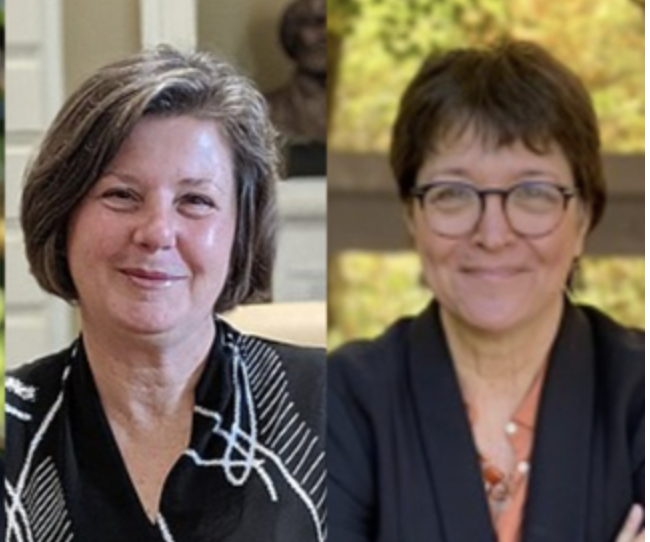
State Senator Jo Comerford (L) and State Representative Mindy Domb (R). Photo: umass.edu
Report on the Meeting of the Amherst Town Council, February 2, 2026, Part 1
Read Part 2 of this report here.
This was a hybrid meeting, held in person in theTown Room of Town Hall and on Zoom. It was recorded.
Present
Mandi Jo Hanneke (President, at large), Jill Brevik and Cathy Schoen (District 1), Amber Cano-Martin and Lynn Griesemer (District 2), Hala Lord and George Ryan (District 3), Pam Rooney and Jennifer Taub (District 4), Ana Devlin Gauthier and Sam MacLeod (District 5), and Andy Churchill and Ellisha Walker (at large).
Staff: Paul Bockelman (Town Manager) and Athena O’Keeffe (Council Clerk)
Comerford and Domb Emphasize Inequity of State Funding
State Senator Jo Comerford and State Representative Mindy Domb gave a presentation outlining their offices’ work in the state legislature. They stressed that Western Massachusetts is often shortchanged in funding and in representation on boards and commissions, and they are working to address this. They cited the formulas for funding schools and roads as not accounting for the challenges of towns with smaller populations but larger areas.
They noted that public advocacy, especially from elected officials, greatly bolsters their efforts, and since COVID all state legislative hearings have allowed virtual participation, so it is no longer necessary for constituents to travel into Boston. Also, written comments are accepted by committees after a hearing until the bill leaves the committee.
The legislature is now starting the budget process. The governor just released her budget. The House will hold hearings and suggest changes, which will then go to the Senate in April. The Senate will make its recommendations, and hopefully a unified budget will be approved by July.
Comerford noted that the governor’s budget has tried to shield Massachusetts from the recent federal cuts to Medicaid and Supplemental Nutrition Aid Program (SNAP) that could mean a loss of $665 million to the state. Domb stressed: “Your advocacy becomes our advocacy. We need to know what’s most important to Amherst so we can advocate. We may not win, but we can try; but our trying is tied to what we hear from you.”
Amherst has three home rule petitions pending. Home rule petitions are proposals that require the state’s permission to enact. Amherst has petitioned for ranked choice voting, a real estate transfer fee on high-end property sales, and extending voting rights in local elections to lawful permanent residents. Domb thought that ranked choice voting and voting rights extension had little chance to advance out of the House. Comerford has introduced a bill that would allow municipalities to make their own decisions on the real estate transfer tax, so that has a better chance of approval.. Both representatives emphasized that several towns with shared interests banding together to work on initiatives leads to more success.
Comerford and Domb said they are both concentrating on matters of health, education, and climate. Domb is sponsoring bills for continuing the program allowing people to use their SNAP benefits to purchase fresh produce from farmers, to support food pantries, and to get livable wages for human service workers. Both also support college affordability and public transportation, especially the creation of an East-West rail line.
Most relevant for Amherst is reforming the formula for Payment In Lieu Of Taxes (PILOT) by non-profit entities, which Comerford stated was “wildly inequitable” for Western Massachusetts communities. She said, “It’s wrong in two ways. One is it basically compares our land value to the land value of Nantucket, and it penalizes us for not having land value that’s growing at the same rate as the state average. It’s silent on ecosystem services, which is the work our land is doing here—our streams, our forests, our farms.” To correct these inequities, the governor has set up a PILOT commission, and Comerford has a seat on it.
Comerford and Domb are also active in protecting immigrants from Immigration and Customs Enforcement (ICE). There are several bills pending, such as the Protect Act, which bars ICE officers from entering schools, churches, the courts, or medical facilities without a judicial warrant. There is also a provision that would require the Governor’s consent for deployment of out-of-state National Guard troops. However, Comerford cautioned that a challenge was having these protections go into effect immediately, which would occur through an executive order rather than through the slow legislative process.
Comerford summed up, “The status quo is getting shaken up. We’ve come together with colleagues directly with the Governor and Lieutenant Governor. We’re naming problems with formula funding that disproportionately does not see a smaller population and resource it equitably. We’re naming barriers to having competitive advantages with grant formulas. We’re naming the lack of voice from Western Massachusetts on boards and commissions, the vacancies in our courts, and the lack of access to some services. If the Healey-Driscoll administration says it wants to govern 351 cities and towns, we have to help them.”
Councilors Voice Their Priorities and Concerns
Cathy Schoen commented on the financing formula for charter schools, under which the student’s home district must pay the full cost of the charter school’s tuition. Jill Brevik asked whether more funds from the Fair Share Amendment could be allocated to K-12 education, rather than just to community colleges and pre-K. Domb stated that some progress is being made in reforming the charter school formula. She also noted that the Fair Share Amendment funded the school lunch program, and Comerford noted that Amherst received $3 million in “Hold Harmless” funds from the Fair Share Act, which compensated the town for declining school enrollment. However, both Domb and Comerford agreed that Chapter 70, which funds the schools, needs to be reformed.
Andy Churchill asked about any initiatives that would increase taxable housing to grow Amherst’s tax base. Both legislators said they have been working with the UMass Chancellor, who is interested in potentially building workforce housing on university-owned land. But they were unsure if that housing would be taxable.
In public comment, UMass student Daniel Shapiro, a representative of the Sunrise Movement, an activist and advocacy movement for social and environmental justice, spoke in favor of urging UMass to create more housing for students on campus to remove pressure on the local housing market. He said that UMass has plans to use public-private partnerships to renovate dorms and construct new housing, such as the Fieldstone Apartments on Massachusetts Avenue. Those apartments, he said, cost $1,630 per month, $46 a month more than last year. He concluded, “We are hoping as a movement to get the town to put pressure on our school, because it would give us a further mandate to make sure that our school actually pulls its weight in this community.”
Lynn Griesemer noted that over 25% of the land in Amherst is owned by higher-education institutions that do not pay local taxes. She would like to see large non-profits, such as medical facilities and private universities be taxed at some rate. Jennifer Taub stated that Connecticut has a PILOT formula that calculates how much tax revenue is lost from land owned by public and private nonprofit institutions and pays the communities that host them about 40% of what those institutions would have paid in taxes.
Public Comment: Parents and Educators Continue to Plead for School Funding
Thirteen of the 17 public comments advocated for adequate funding for the schools. Both the regional and elementary schools are facing multi-million-dollar shortfalls in their FY27 budgets, necessitating staff layoffs, including teachers.
Those who spoke noted the decrease in quality of Amherst schools over the years due to lack of funding, with more people opting for charter or private schools. Several urged spending the budget surplus on education or for allocating the percentage of increase for all departments according to need, rather than specifying an equal increase as has been Amherst’s practice in recent years.
Angelica Bernal pointed to the cuts in Special Education over the past four years. Instead of being the number one priority, she said, it is first on the chopping block. Bilingual teacher Lissa Pierce Bonifaz stated that every year teachers are asked to do more, due to the increasing needs of the students and the declining number of staff.
Cathleen Mitchell pointed out that even if students choice-out of the Amherst schools, we still end up paying for them. She encouraged the town to look for efficiencies between the schools and the town to see where services could be shared.
Ellen Jedry Guidera lamented the “dire financial situation” facing the schools. She urged the town to use some of its surplus cash for “investment in our future, our children’s future, and the future of our country.”
Local Support for Protecting Immigrants
Councilor George Ryan said he was heartened to hear of the governor and state legislature’s measures to protect immigrants from ICE, and asked what the council could do locally. Brevik and Amber Cano Martin voiced similar concerns for Amherst’s immigrant population.
Domb replied that we must be careful not to put our immigrant neighbors at risk by our actions. She felt that “the most important weapons we have is unity and caring for each other, and the council has an opportunity to model both and to be active on both.” She also recommended the LUCE training being held at various churches in town, which talks about how to be a witness and how to be an observer to ICE activities. “I think that’s a good opportunity for all of us to do something proactive to be ready to support our neighbors and show them that we care about them without putting them at risk,” she said. She added that food drives are another way to support people, as is accompanying people to the Survival Center if they are uncomfortable.
“ICE feeds on division and hate. So, our weapons of choice are unity and love,” she concluded. Comerford noted that no community in Western Massachusetts has a 287g agreement with ICE, and Governor Healey’s executive order this month restricted any state agency from entering into a cooperative agreement with ICE.
In public comment, Josna Rege pointed to a resolution that will be coming before the council, calling for federal immigration agents to be held accountable for violations of Massachusetts criminal law. The resoltion also calls upon the state Attorney General, our county District Attorney, and our town police chief to take steps to protect the residents of the Commonwealth, Hampshire County, and Amherst from the unlawful actions of ICE. She said, “The resolution will give Amherst an opportunity to do something actionable, not merely symbolic, in calling upon the town to give teeth to their promises to protect us.” The resolution will be reviewed by the Governance, Organization, and Legislation Committee( of the Town Council GOL) at its February 10 meeting.
Rege’s concern for providing safety for immigrants was echoed by District 1 resident Vince O’Connor.
Health Insurance Increase Much Less Than Anticipated
In his report, Town Manager Paul Bockelman stated that the estimated increase in health insurance costs for the town was 8.3%, not the 18% that had been anticipated. Part of this decrease was due to the fact that the insurance will no longer cover GLP1 drugs for weight loss. The lower-than-anticipated cost of insurance should release some money for other needed resources, he said. It should also help ease the deficit in the school budgets.
Bockelman praised the DPW for their round-the-clock work during the recent snowstorm. He noted that the crews cleared 110 miles of roads and many sidewalks during the storms. This week they will be clearing snow from intersections and parking lots. He warned of the potholes that will appear when the snow melts. These cannot be filled until the roads are dry.
DPW Workers Do Not Have a Contract
There was some irony in Bockelman’s praise for the DPW. During public comment, Andrew Brace, President of the DPW union, stated that the union contract had expired seven months ago. He said that negotiations with the town began over a year ago. After eight sessions, the town’s legal counsel suggested mediation, but the fourth and final mediation meeting is scheduled for next week. He stated that the town’s personnel manual says that the town “seeks to provide a friendly, respectful, healthy, and rewarding place to work for its employees, while maintaining employment practices that create a safe, fair, equitable, and positive environment for staff to achieve workplace goals. We take pride in assembling and retaining high-performing and motivated individuals, and we continually strive to be the public employer of choice in Western Massachusetts.”
Brace continued, “Unfortunately, our experience in negotiations does not reflect the town’s stated values. DPW staff provide essential services that keep the town running every day. There are numerous challenges that the DPW has faced for several years, including an ongoing high level of turnover, difficulty retaining staff, regular vacancies and understaffing. Lengthy negotiations contribute to uncertainty and make it hard to retain employees. These issues affect staff morale and impact service delivery. We are not asking for special treatment, but for a fair and respectful contract that reflects the work that we do and aligns with the town’s stated values.”