
Views on Views: Incidentals in Our Landscapes
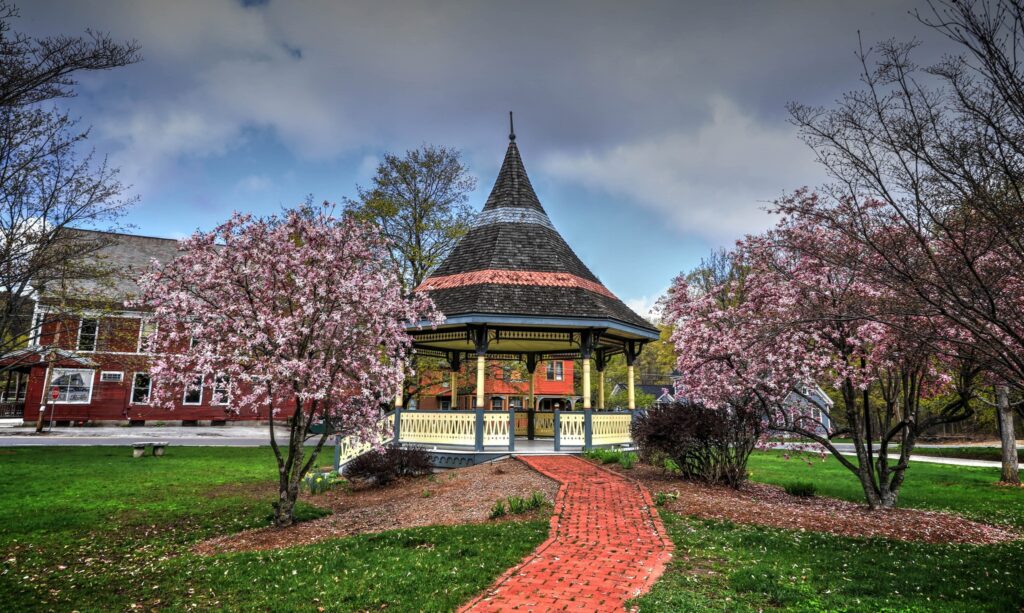
Bandstand, New Boston, NH. Photo: William H Dexter.
By Hetty Startup
This is the ninth column in a ten-part series. View the previous articles in the series here.
I’m going to venture that there are two broad historic traditions within landscape design history: 1) a romantic approach where it might seem that nature could reclaim whatever we have planned for us at any moment and 2) a rational approach suggesting order or formality.
Landscape architects and designers might shrink from these cursory characterizations; my point is that both traditions can, and over time, have created places of merit, of recreation, beauty and visual delight. These approaches, at their core, derive from an ancient love of the land. Other ancient and sustainable ideas about the natural world that are lived out today include indigenous approaches to landscape that offer intentional, alternative visions of how to work with the earth as a living presence.
Two Landscape Design Traditions
The non-indigenous traditions in landscape design are rooted in knowledge of shared formal elements of design—the use of line, color, form, texture, and the like. Whether romantic or formal, the effect of these different landscape traditions may be a sense of wonder and mystery, or, in the case of more formal landscape design, suggestive of a sense of measured certitude via strong contrasts of natural light, shade, and/or drama.
One way to identify different historic landscapes in terms of their style is to look at what I’m calling incidentals in any designed landscape. A “romantic” landscape of rolling hills might include broad sweeps of plantings such as perennials or wildflowers while a more formal landscape might include a focal point (even a little building like a folly, that is, is a building constructed primarily for decoration, but suggesting through its appearance some other purpose, or of such extravagant appearance that it transcends the range of usual garden buildings) on top of the highest of the hills, perhaps with a flagstone path, or hardscape, to the summit.
Specifically, I invite you to search out some of these incidentals with what Wendell Berry called your “living eyes.” Some examples might include gazebos, pergolas or bandstands. Some of these are easier to see than others in terms of what is in the public view or viewshed. Some of them are worth a second look. I was at Historic Northampton the other day, and boom, in their gardens, there was both a bandstand and a pergola on the lawn.
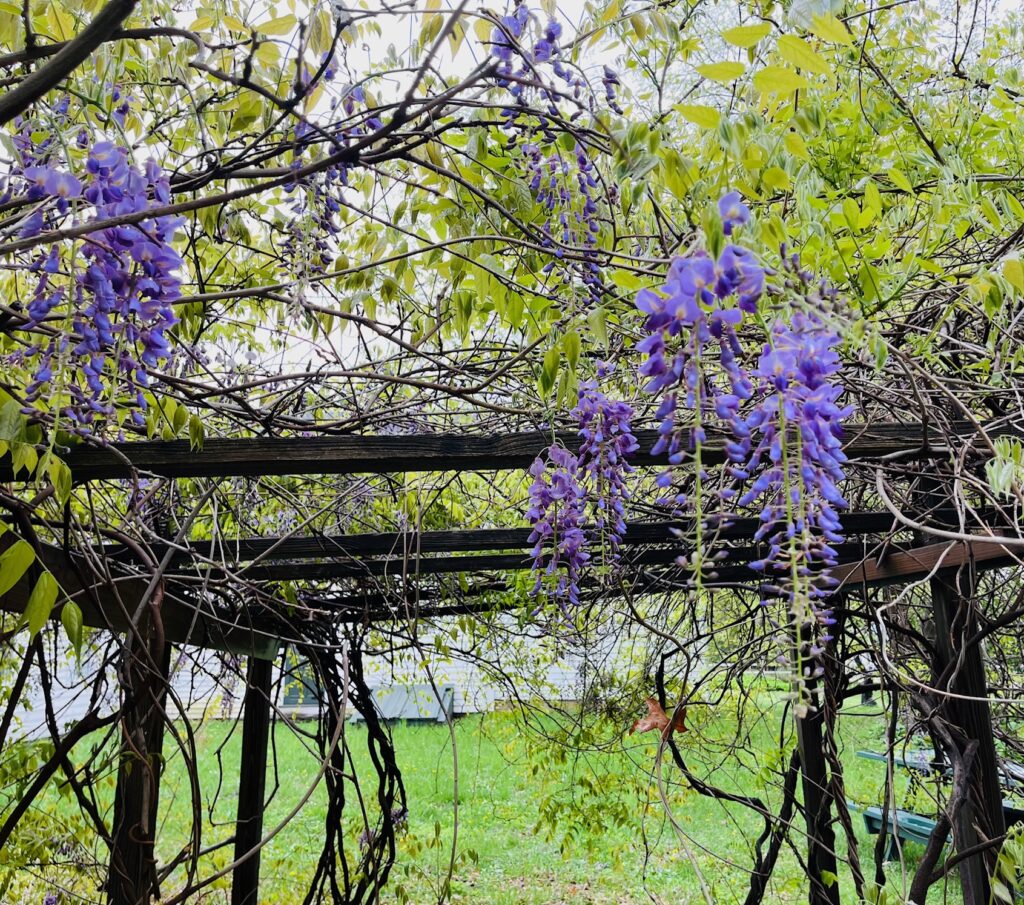
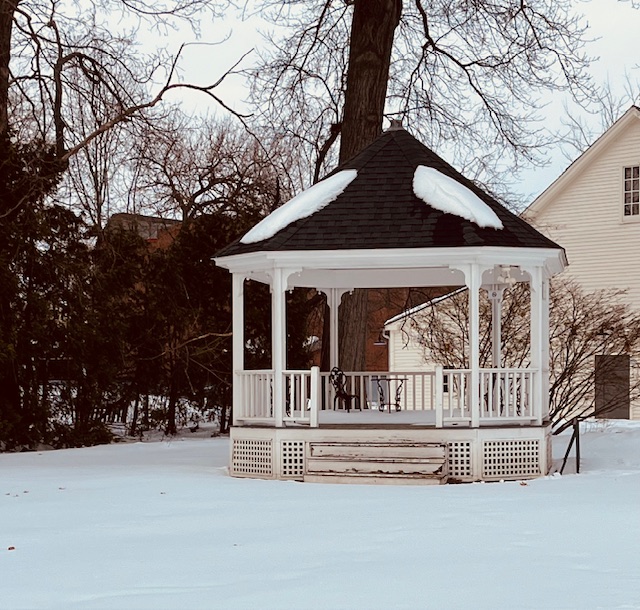
Are there any herb knot gardens or garden “follies” near where you live or work?
A knot garden is a garden style popularized in 16th-century England and now considered an element of the formal English garden. A knot garden consists of a variety of aromatic and culinary herbs, or low hedges such as box, planted in lines to create an intertwining pattern that is set within a square frame and laid on a level substrate.
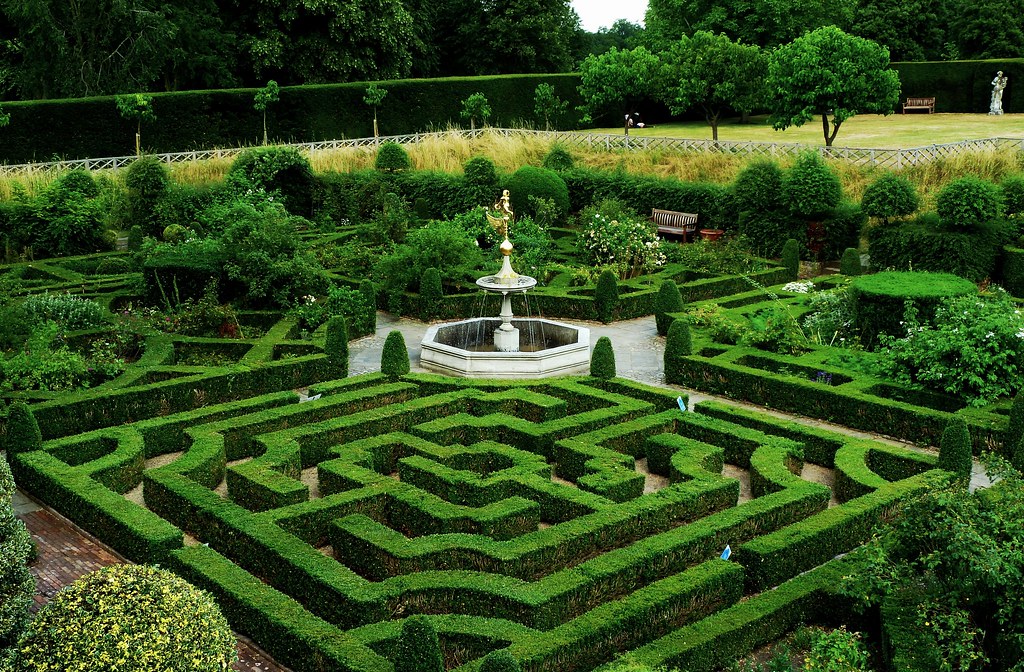
One of the delights of a knot garden is its visual appeal, its geometry laid out on the ground, bordered by hedges of box; another would be the fact that the herbs themselves have ornamental, medicinal and sensory properties that offer a more universally accessible sense of one’s surroundings. In contrast, follies can be tricky to define! They can form one of several incidents in a guided walk through a landscape or appear on a physical summit like a small mountain or hill. A folly can be something that is frivolous and/or a waste of money (in some people’s minds) or something that is ornamental or decorative which might have an implied function. This function, historically, often alluded to ancient myths and legends….so literary associations were often present. Two public follies in Massachusetts are the ‘castle’ in Salisbury Park in Worcester, and a small round tower/pretend castle in Scituate, MA. An example of a functional folly might be seen just over the state line at Barrett House (1800), in what is now New Ipswich, NH, where a Gothic Revival-style summerhouse – set above a Federal-style mansion and carriage barns, offers views over the land owned by Charles Barrett Sr. and his family.
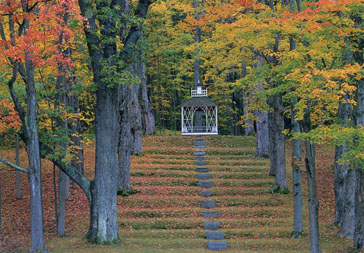
Barrett was a mill owner in nearby Bank Village, where his textile factory was set alongside the ancient Souhegan River, named by the Abenaki as a “watching place” for abundant fish at certain times of the season. Barrett’s summer house sits at the top of an allee of trees behind the grand house he commissioned for his son on the occasion of his marriage.
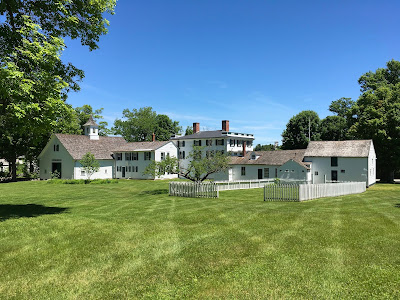
historicnewengland.org
The house -along with several other Historic New England properties – appeared in the 1979 movie based on the 1878 book by Henry James called “The Europeans.” While this folly requires the price of admission, I am now going to focus on bandstands that are mostly free and in public view.
Bandstands
Bandstands almost always serve a clear and practical function, providing shelter from the elements for public concerts, historically in Europe and North America. Other kinds of elaborate viewing stands and bandstands have had their place in cities and towns in Asia and South America often present as part of displays of imperial power. From my youth, I remember the bandstand that stands in Kensington Gardens (now a public park) by Round Pond and the famous Peter Pan statue. Kensington Palace is nearby. Apparently, when Queen Victoria gave permission for music to be played in the gardens, the Archbishop of Canterbury said it would be ‘unseemly,’ but this mood shifted later on and concerts were allowed. The current structure is in the neo-Regency style (the English equivalent to the American Colonial Revival style) built in 1931, by an architect who worked within a government design department. This bandstand has an ogee, or S-shaped, roof that was thought to improve the acoustics.
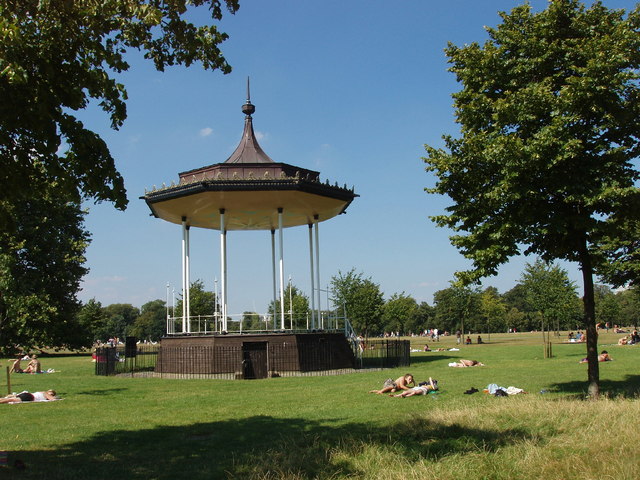
Brass band concerts were offered most holidays and Sunday afternoons within earshot of the pond where families brought model boats to sail. Today most bandstands are a focal point of a New England public park or town common.
I’ve written elsewhere about Belchertown’s bandstand, which was an important addition to the town common, and when living in New Hampshire, I remember a charming one in the Queen Anne style in New Boston, which was located on a lawn by Town Hall, that serves as a gathering point for summer concerts to this day. Closer to home, there’s a bandstand in Wendell where artwork, agitprop (banners from rallies and marches), and memorials are all cherished and protected from the elements under one roof.
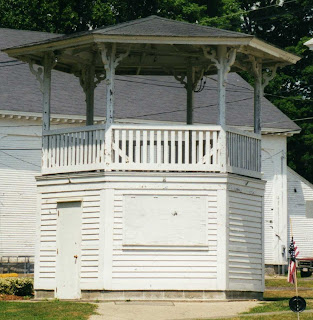
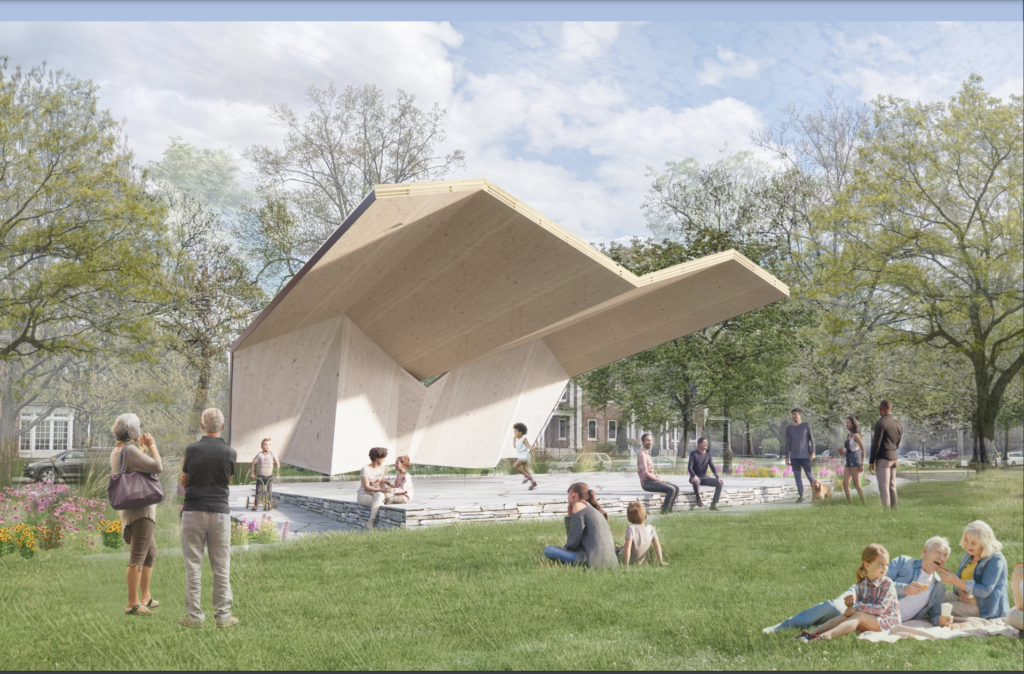
In the 1800s and early 1900s, bandstands were as pervasive as farmers markets are now on town commons across New England today. Frederick Law Olmsted included a bandstand in his sketch for Amherst’s town common, and it seems that one existed there for a couple of years in the 1870s and again around 1905 but these were both removed, perhaps due to damage. There are currently plans for a new one and one hopes that this may come up for public consideration in a future year after the potholes are fixed!
Protection and Preservation
Throughout this series, I have wanted to convey that, essentially, landscape design can offer us a way to connect with larger ideas and even ideals about our surroundings, our buildings, and even our national or local identities. That’s not to say that architecture and buildings by themselves don’t play a similar role. These aspects of our built environment are interrelated and it goes without saying that there are a number of ways in which gardens and designed landscapes can be protected at the local, municipal and state levels. More needs to be done to return stewardship of lands to our indigenous peoples (mostly the Nipmuc) across central and western MA.
Historic landscapes across our state are inventoried as significant resources. They are documented as part of MACRIS (Massachusetts Cultural Resource Information System) and include things like agricultural fields, cemeteries, boathouses, parkways and boulevards, farms, lighthouses, orchards, observation towers, parks, quarries, zoological gardens, and the Civilian Conservation Corps camps created in the 1930s at the height of the Great Depression by FDR’s administration, with an eye to preparedness for World War II. At the municipal level, a number of town departments in Amherst work to preserve our shared natural environment, including the DPW, our Tree Warden, the Historical Commission, the Shade Tree Committee and the Conservation Commission.
Community Gardens
I learned a few years ago while volunteering for a climate justice group that the Town of Amherst has community gardens located by the Fort River and that these are used by individuals, families and organizations. These need to be distinguished from those at the Amethyst Brook Conservation area. The town-owned site is off of Route 9, on Belchertown Road, has lovely views, ample parking, water on site (via a pump) and simple gardening tools to share. At a Town Council meeting last week, town Sustainability Director Stephanie Ciccarelli offered the following about this great resource in town: “We started with 10 gardeners the first year, and we now have over 40 plots, and I think there’s a waiting list. But it needs a solid water source. We have a pump, but we’re going to need to put in some kind of cistern.” She added that the garden supports people from several nearby housing complexes.
As far as I know, community gardens, and children’s playgrounds are not documented in existing surveys although offerings such as these are often exactly what some people consider quality of life issues when choosing where to live and/or work. While some incidentals in our townscape are functional and practical in nature others less so. But they all might enhance residents experience of living in Amherst.
The last column in this series will review the history of Amherst’s Conservation Commission.
I appreciate your on-going reminder of the relationship between our natural and our built environments, and the aesthetic character of both the visual and the “felt” apprehension of our landscapes, streetscapes and skyscapes. I wish our various Master Plans and Long-range plans had included these “scapes” in adjacency to the density and in-fill policies
they established for Amherst.
Hetty well documents the long-standing universality of the bandstand tradition in town parks and other open spaces, but I confess to mixed feelings about the proposed plans for a shell on the town commons. On the one hand, an acoustically-designed shell would provide a welcome public performance space, hopefully without the need for amplification. On the other hand, the angularity of the proposed structure seems to interfere with the perfection of the Commons and its frames on three sides sweeping up to the Octagon at Amherst College. I suppose that new structures are frequently felt as jarring intrusions into familiar spaces, so the question is whether a performance shell will age gracefully as an element of that perfection?
Thank you for these pieces, Hetty. More than once you’ve inspired me to take my family on a weekend adventure to seek out some gems.
I agree with Michael about the jarring look of the proposed bandstand on the common. This was the first time I had seen a rendering of it. We already have what is in my view an overbuilt north part of the town common with far too much concrete. I feel strongly that the large expanse of open space to the south should be kept as is–open. Is there going to be an opportunity for more public input into the bandstand plan, or is it being considered a done deal?
It has been shown in the last few years that we don’t need a performance shell on the common. The BID has done an amazing job with summer concerts on the common using a huge temporary bandstand that can accommodate any size musical performance. I have enjoyed going to many concerts and love the ambiance, often with dancing and kids playing along side families picnicking or just hanging out and listening. These concerts draw huge crowds. Using temporary bandstands saves the town money and headaches around maintaining a performance center throughout our 6 cold months, preventing vandalism, etc. Let’s do what makes sense and save.
Aesthetics notwithstanding, is the architect a civil engineer?
Unless there are substantial (presumably hidden in this image) tension and compression elements in this design, with a massive base extending below the performance space, just a few feet of wet, late-winter snow (perhaps followed by heavy, early-spring rain?) would topple it — or at least render it unsafe to use.
Acoustically-active surfaces can be fashioned from many materials, and it wouldn’t surprise me if some clever folks in the valley could come up with an inflatable shell that would do the trick when needed, disappear into a trunk when the performance is over, and be a lot less costly economically, environmentally, aesthetically….