
Opinion: ICE is the Most Watched Show in America
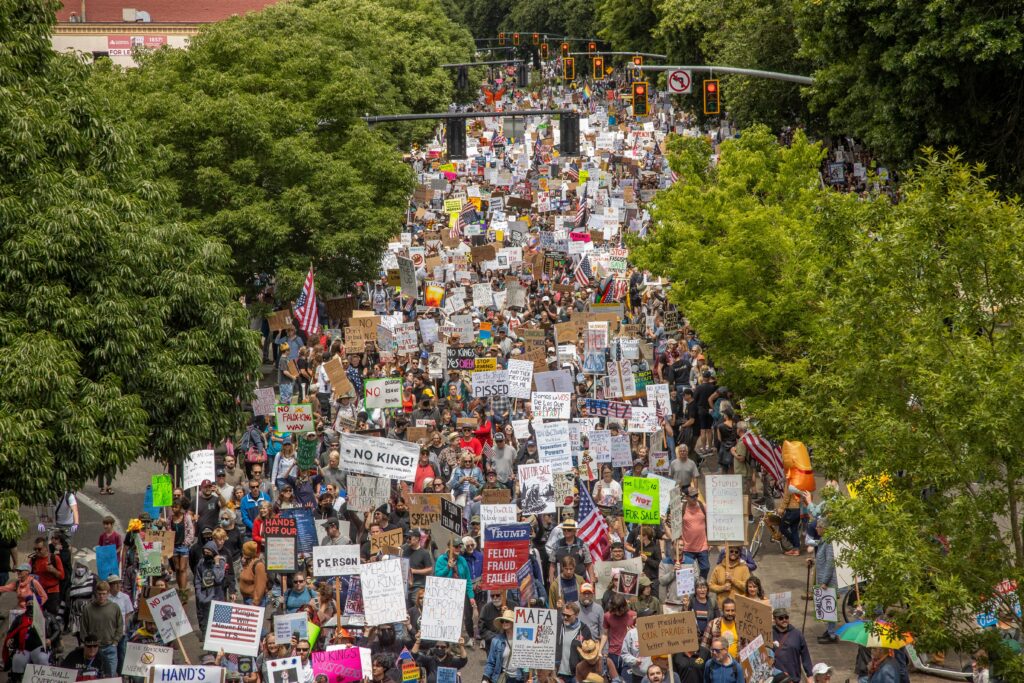
No Kings protest, June 14, 2025, Portland, OR. Photo: Citizen Cepler c/o Shutterstock
Social Injustice Goes Global

We grew up on reality TV. On Survivor, people schemed for a million dollars, on American Idol, someone’s shaky high note could change their life and even on The Bachelor, heartbreak came with commercial breaks.
But now the most watched show in America doesn’t air at 8 p.m. It drops in real time. No theme music or host but just shaky phone footage, flashing lights, and federal jackets with three letters on the back: ICE.
And we watch.
We scroll past body-cam fragments and livestreams the way we used to scroll past celebrity gossip. Minneapolis. Texas. Somewhere in between. The algorithm feeds us tension, outrage, adrenaline. It’s not that we’re numb but that we are saturated.
There’s a difference between watching greatness and watching harm.
When Lindsey Vonn launches out of a gate at the Olympics, she risks everything for a finish line she chose and when she crashes into a cloud of snow, we gasp — but we understand the contract. Risk for glory and effort for possibility.
When federal agents move through neighborhoods and someone’s life unravels in seconds, that’s not chosen risk. That’s power meeting vulnerability. And the rest of us are just witnesses with Wi-Fi.
Millennials were promised participation trophies and safe spaces. What we inherited instead were endless feedback forms and unstable systems.
“How did we do today?”
“Rate your experience.”
Accountability is automated — unless it’s about state power.
Now in Massachusetts, legislators are talking about the PROTECT Act, a bill filed by the Black and Latino Legislative Caucus. Representatives like Mindy Domb are hosting public forums. Written testimony is being accepted. The state is trying, in its careful, bureaucratic way, to draw lines around federal authority — to say: if you operate here, there will be guardrails.
Meanwhile, our nervous systems are frayed.
I don’t know how everyone else is doing, but I’ve been struggling — watching and waiting for the next bad thing to happen. To our kids or parents, our towns, our country and to the planet. The neuroscientist Lisa Feldman Barrett puts it plainly: “Vigilance is metabolically expensive.” It burns through stamina and taxes the body like a constant sprint.
We were not built for permanent red alerts.
Despite the understandable desire to tune out — I watch, read, and listen to half as much commentary as I used to — staying informed is Step 1 of citizenship. Ignorance doesn’t calm the body; it just delays the shock.
So how do we counterbalance the drain of tracking each new outrage because outrage alone won’t draft language. Frantic vigilance won’t secure a majority vote, and adrenaline is not a governance strategy.
We seek out moments of wonder that sound soft, but it isn’t. If you missed the Games this weekend, let your mouth hang open at the moxie of Chloe Kim, competing in the halfpipe despite a torn labrum earlier this season. Watch how she rises out of the pipe and gravity seems briefly negotiable. Notice the amplitude, the control, the almost improbable softness of her landings. Hear the scrape of steel edge on ice as she carves from wall to wall like a bright, determined marble.
This isn’t escapism but recalibration. Beholding takes — and causes — a smallness of self. When you become an agenda less intake machine, even briefly, your nervous system downshifts. The ego loosens its grip. The body remembers that not every spike of attention requires a spike of cortisol.
That’s not softness, that’s discipline. Wonder is a nervous system exhaling, snow falling quietly on Amherst Common, neighbors drafting testimony together at a kitchen table.
It’s students organizing a rally outside Town Hall before a council meeting and realizing that democracy — slow, procedural, imperfect — is still alive enough to require your presence.
Outrage narrows, wonder widens. Outrage spikes and mobilizes while wonder steadies and sustains.
We need both but we cannot live on spikes. If civic engagement is an endurance sport, then wonder is recovery. Ice bath for the soul and breath between sets. The pause that keeps you from tearing something essential and democracy requires stamina.
Millennials live in the tension between spectacles and systems. We are fluent in both, can quote memes and legislative clauses and know how to make a reel go viral and how to upload a PDF testimony before midnight and are tired of watching cruelty as entertainment.
We crave something sturdier — connection and relationships. Positive thinking, which includes gratitude and a sense of control in your life.
Control word hums as we don’t control federal policy drafted in marble buildings in Washington, D.C. which clip goes viral or whose worst day becomes the next headline and the machinery of U.S. Immigration and Customs Enforcement. But we do control proximity.
We can submit testimony and insist that our local resolutions mean something and can move the needle where our hands actually reach.
In Amherst, Massachusetts, showing up — in person, on Zoom, in writing looks like supporting the Town Council’s resolution not because it fixes everything, but because it signals who we are when it counts.
Millennials understand the limits of power and came of age watching institutions fail upward. So, our activism isn’t naïve but layered. Local pressure, state advocacy and federal awareness, all at once.
We can: Show up to forums in Amherst — even when we’re tired. Ask our churches, mosques, synagogues, and nonprofits where they stand — and listen closely to the answer. Sign on as community sponsors — turning “thoughts and prayers” into rent checks and grocery cards. Attend a rally from 5:30 to 6:30, then log into a 6:30 meeting — toggling between street and screen like the multitaskers we were trained to be. Forward an email. Then another and then follow up. Control, at the local level, is cumulative.
It’s quorum, public comment and a paper trail that says: we noticed. We can’t control who becomes the next headline, but we can control whether their name echoes alone. And that’s what meaningful action looks like in 2026: not the illusion of total power, but the discipline of small, repeated, visible choices. Participation regulates helplessness and that’s the generational shift.
Our parents trusted institutions, Gen X distrusted them and we livestream them. We don’t look away and that’s our strength and our curse.
We screenshot, archive, thread timelines and compare press releases to body cam footage. We grew up watching wars narrated in real time, policy debated in comment sections, and local meetings uploaded before the chairs are stacked. Transparency isn’t radical to us but a default.
There are also serious, ongoing debates about how U.S. law enforcement and federal agencies train, exchange tactics, and share surveillance technologies with international partners, including Israel. Programs and conferences have brought officials from the U.S. Department of Homeland Security into dialogue with Israeli security counterparts, including entities connected to the Israel Defense Forces.
Critics argue that certain crowd-control methods, surveillance tools, and militarized approaches to policing migrate across borders through these exchanges. Supporters say such cooperation focuses on counterterrorism and emergency response.
What’s true is this: security policy is increasingly transnational. Tactics Travel. Technology travels. Narratives travel. And in a livestreamed world, images from Gaza Strip and images from American cities can end up on the same feed, collapsing distance and accelerating moral comparison.
That compression is disorienting as we are constantly holding two realities at once: global conflict and local zoning votes; international law and school committee meetings. We are aware — painfully so — of how rhetoric about “security” can shape everyday life in neighborhoods thousands of miles away from where those strategies were first tested.
But awareness alone isn’t strategy. There’s something almost Olympic about civic engagement — less glamorous, more grueling. No medals, or endorsement deals but just the long discipline of insisting that laws reflect the communities they govern.
Imagine training not for a podium, but for a quorum, conditioning not your hamstrings, but your patience and repetition: public comment, follow-up email, coalition meeting, draft revision. Again. Again. Again.
It’s slow, procedural and rarely trends yet like any endurance sport, the gains compound invisibly at first. A policy amended, a contract reconsidered, a resolution passed and a budget line item scrutinized. Not cinematic but structural.
We live stream institutions not just to expose them, but to remind them they are being watched. Beholding, again. Attention as accountability.
No medals. No anthem. Just the stubborn belief that democracy, like athletic training, is built on repetition, recovery, and showing up when no one is clapping.
Watching Lindsey Vonn fly down a mountain is thrilling because she is chasing excellence. Watching state power unfold without accountability is exhausting because no one asked for that race.
The question for our generation isn’t whether ICE will trend again next week. It will.
The question is whether we remain an audience — metabolically drained, refreshing the feed — or whether we lean into the slow, untelevised work of shaping policy: drafting bills, submitting comments, building coalitions, protecting neighbors.
Reality TV made us think drama was the point. Adulthood might be realizing the boring stuff — the forums, the footnotes, the written testimony uploaded as a Word document at 11:58 p.m. is where the plot actually changes. Stay informed, seek wonder replenish your stamina and then participate. That’s the show worth watching or better yet — participating in.
Rizwana Khan is a writer, educator, and human rights advocate in the Town of Amherst.