
Town Council Calls for ICE Accountability. Recommends Repair of Entire Middle School Roof
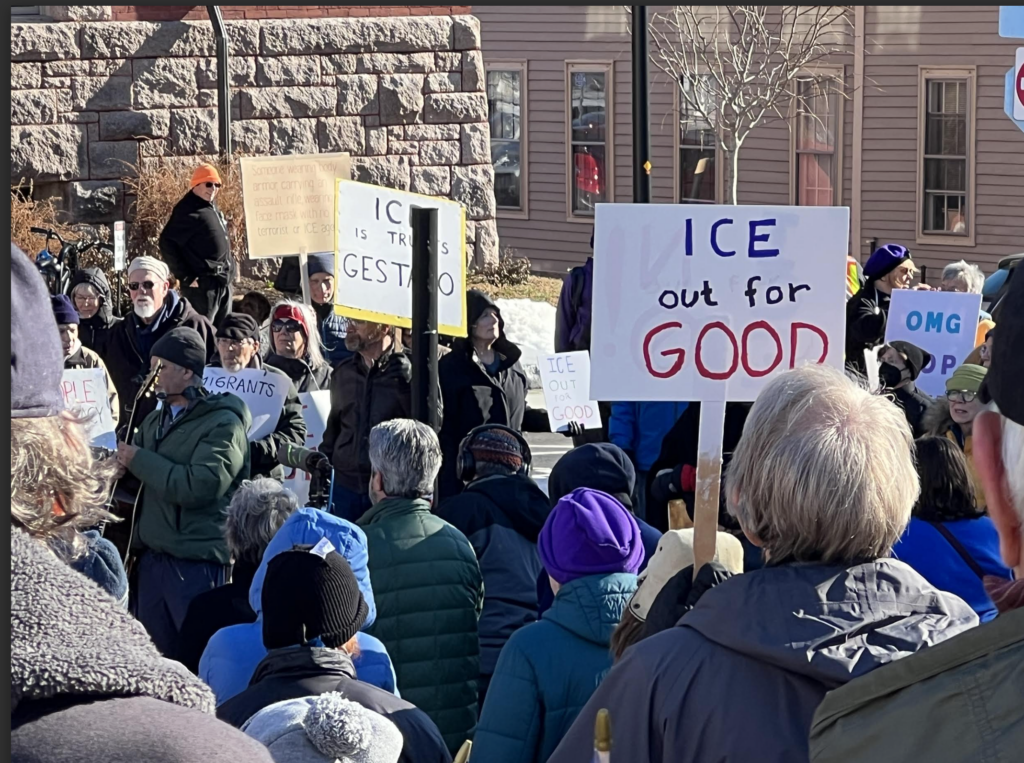
ICE Out for Good protest on the Amherst Town Common, January 11, 2026. Photo; Peggy Matthews-Nilsen
Report on the Meeting of the Amherst Town Council February 23, 2026, Part 1
This meeting was held exclusive over Zoom due to the blizzard conditions and was recorded.
Present
Mandi Jo Hanneke (President, at large), Jill Brevik and Cathy Schoen (District 1), Amber Cano-Martin and Lynn Griesemer (District 2), Hala Lord and George Ryan (District 3), Pam Rooney and Jennifer Taub (District 4), Ana Devlin Gauthier and Sam MacLeod (District 5), and Andy Churchill and Ellisha Walker (at large). Griesemer joined at 7:50 p.m. and Schoen left at 9:15 p.m.
Staff: Paul Bockelman (Town Manager) and Athena O’Keeffe (Council Clerk)
56 people attended on Zoom.
Resolution to Hold ICE Accountable for Violating State Laws
Amherst became the first municipality in the country to pass a resolution urging state and local officials to hold accountable federal officers, including federal Immigration and Customs Enforcement (ICE) agents, when they violate Massachusetts criminal law. The vote was 9-0-2. Mandi Jo Hanneke and George Ryan abstained, and Lynn Griesemer was absent. Sam MacLeod lost internet connectivity just prior to the vote.
The resolution, titled “Calling for Federal Immigration Agents to Be Held Accountable for Violations of Massachusetts Criminal Law,” calls on Attorney General Andrea Campbell and the Commonwealth’s district attorneys to open criminal investigations into unlawful actions by federal immigration agents operating in Massachusetts. The measure also urges Governor Maura Healey to cease cooperation agreements with ICE, including any pending agreements involving the Department of Corrections. It also calls on the Massachusetts Attorney General and Northwestern District Attorney to issue guidelines to local law enforcement about documenting and dealing with criminal acts by federal agents.
Councilor sponsors were Jill Brevik, Amber Cano-Martin, Ana Devlin Gauthier, Jennifer Taub, and Ellisha Walker. Community sponsors were John Bonifaz, Free Speech for People, Jeff Conant, Allegra Clark, and Andrew Melnechuk. Over 300 more town residents signed onto the letter as community sponsors, along with 15 local organizations.
Brevik said, “I’m really honored to introduce this resolution. I was contacted by many people in the community almost immediately after being sworn in, who urged the council to do something meaningful within our power to respond to Immigration and Customs Enforcement (ICE)’s human rights abuses nationally and in Massachusetts. Being a federal agent does not give someone immunity from state criminal law. If the U.S. Department of Justice will not investigate federal misconduct, then Massachusetts still has both the authority and the responsibility to enforce its own criminal laws.”
In stating his reasons for abstaining, Ryan said, “There are two things that guide me. One is the principle of not doing harm, and the other is the principle of maintaining solidarity. I very much appreciate the efforts of the sponsors, but for me, the larger question remains: To what degree does this resolution make the most vulnerable among us safer? My concern remains not with the sentiment, which I heartily endorse, but the fact that it will only serve to draw attention to our community and invite harm to those who are most vulnerable.”
This sentiment was not shared by other members of the council. Hala Lord, Jennifer Taub, and Cano-Martin spoke passionately for the resolution. Andy Churchill said that he, John Bonifaz, and Brevik had met with Amherst Police Chief Gabe Ting to discuss some of Ting’s misgivings about an earlier draft of the resolution and added some clarity to the role of the APD through an amendment. After the meeting with Ting, Churchill said he would be happy to join as a co-sponsor.
In public comment, 12 members of the public, including several immigrants and family members of immigrants, expressed strong support for the resolution. The resolution will be submitted to Governor Maura Healey, Lieutenant Governor Kim Driscoll, Attorney General Andrea Campbell, Hampshire County District Attorney David E. Sullivan, and Amherst Police Chief Gabriel Ting.
Councilors Support Using Free Cash to Fund Replacement of Middle School Auditorium Roof
The Regional School District was awarded a grant from the Massachusetts School Building Authority (MSBA) this year to replace the leaking roof at the Amherst Regional Middle School (ARMS), but the auditorium roof, which is leaking badly, was several years too young to qualify for the grant. Although the Regional School Committee agreed that the auditorium roof urgently needed replacement, representatives of the smaller towns in the region stated that they did not think they could handle another financial obligation from the region, and also that the timing of their spring town meetings was after the mid-March date when the bids needed to be received in order for the work to be completed over the summer. When some Amherst Town Councilors suggested that Amherst pay the full $1.6 million cost of the auditorium roof from free cash in order to complete the work when roofers and equipment are on the site, the region sent a formal request to the Town Council for the funds.
Eight residents spoke for the urgency of the auditorium roof replacement during public comment.
Amherst has $5,170, 507 in certified free cash (unspent funds) from FY2025. Town Manager Paul Bockelman proposed spending $4.3 million from free cash on an accelerated road and sidewalk repair plan, as was stipulated in his Town Manager goals by the Town Council. The five-year plan aims to prevent Amherst’s roads from deteriorating further by spending an average of $5 million a year, as opposed to the usual $1.5 million or so.
There was a motion to reduce the spending on roads and sidewalks to $2.7 million, and use $1.6 million to repair the middle school auditorium roof. Bockelman pointed out that reducing the share for the roads will mean that fewer roads will be repaved. “The goal for this year is to invest in some of the major roads, but also start getting into neighborhood roads and try to address some of those long-term needs, “he said. He also reminded the council that the regional school system has its own funds for capital repairs and that there are three other towns in the region that should also be contributing to building repair.
Councilors Cathy Schoen and Cano-Martin pointed out that there are other sources of funding for roads, such as an increase in Chapter 90 (state) funds this year and the $500,000 from capital expenses invested each year. Also, there are funds available from the Complete Streets Program and Safe Streets to School that the town could apply for.
School Finance Director Shannon Bernacchia informed councilors that the region’s capital stabilization fund currently contains only $400,000, and using it to fulfill the smaller towns’ $320,000 share of the repair would mean the schools would be unable to deal with any emergency repairs during the year. However, she reiterated that waiting for other town’s town meetings to approve the extra expense for the roof would preclude having the work done over the summer.
As far as the suggestion to wait until the auditorium roof would be eligible for an MSBA grant, Schoen noted that the original estimate for the full middle school roof in 2015 was $3 million, but the cost estimate when the grant was awarded was almost $11 million, so, even if the school could obtain a timely grant, it would be unlikely to save Amherst money. Shutesbury’s representative to the Regional School Committee Anna Heard noted that the MSBA qualifications for its repair grants keep changing, “The idea that we will be able to get MSBA funding in a few years for the auditorium roof, I think is overly optimistic,” she said. She added that in the meantime there will be ongoing repairs that are only temporary.
Bernacchia also noted that every repair involves asbestos abatement because there is asbestos in the roof, and the constant leaks are damaging the floor of the auditorium. Several residents also commented on the smell of mold in the auditorium, which makes it unsafe.
Most of the arguments against Amherst paying the entire cost of the auditorium roof centered on setting a precedent for the town covering more than its share. Schoen pointed out that the town added $900,000 to cover the cost of the renovated track and field, and that Amherst uses the auditorium for school concerts and other programs for which Bernacchia said the town is not charged rent. For example, he Town Council held a hearing on the Gaza Ceasefire resolution at the auditorium in 2024.
Brevik added, “I do not think we should be accepting these conditions for our children, our educators, and the staff at the school. It’s our responsibility to right this wrong. I understand the urgency around the roads, but even if we do dedicate this $1.6 million, we would still have close to $5 million [for roads] from free cash, Chapter 90, capital improvement funds, and additional sources. This needs to be schools AND roads, not schools versus roads.”
Ryan said that he understood the urgency of the roof project, but felt that his responsibility was to the taxpayers of Amherst who are being asked to pay more than their share of the project. He and Churchill said they hoped the other three towns would vote later to contribute to the repair.
Hanneke was more forceful, saying, “It is a building owned by four towns. We had facilities managers saying it was critically deteriorated and it was a high capital priority, yet it didn’t make their capital priority request list for the upcoming fiscal year. And given our critical need for roads and sidewalks, I struggle with a gift that we wouldn’t ask the Regional School Committee or the other towns to contribute the other 20% to.” She proposed an amendment to the $1.6 million allocation stating that Amherst would gift the funds initially and then ask for a reimbursement from the towns or the regions. However, her amendment did not pass, with only Hanneke, Ryan, and Lynn Griesemer supporting it.
Both the appropriations for the $2.7 million for roads and $1.6 million for the ARMS auditorium roof were unanimously referred to the Finance Committee and will be brought back to the whole council for approval. Finance Director Sean Mangano assured councilors that if the auditorium roof replacement came in under budget, the difference would come back to Amherst and not to the region.
Tibet Day Will Be March 10
The council passed the proclamation declaring March 10 as Tibet Day as part of the Consent Agenda. The proclamation was sponsored by councilors Cano-Martin, Devlin Gauthier, and Lord and the Regional Tibetan Association of Massachusetts. March 10, 2026, is the 67th anniversary of the Tibetan National Uprising against the annexation of Tibet by China, a struggle in which more than one million Tibetans lost their lives.
The Tibetan national flag will fly in front of Town Hall from March 10 to March 17 after a flag-raising ceremony at 9 a.m. on March 10, after which local Tibetans will march from Amherst to Northampton. Copies of the proclamation will be sent to President Donald Trump, Senators Edward Markey and Elizabeth Warren, Representative Jim McGovern, Representative Richard Neal, Governor Maura Healey, and Penpa Tsering, the Sikyong of the Central Tibetan Administration.
Charter Review
The meeting concluded with a discussion of recommended modifications to the town charter. Those discussions are covered in a separate article which can be found here.