
Views on Views: Amherst’s Conservation Commission
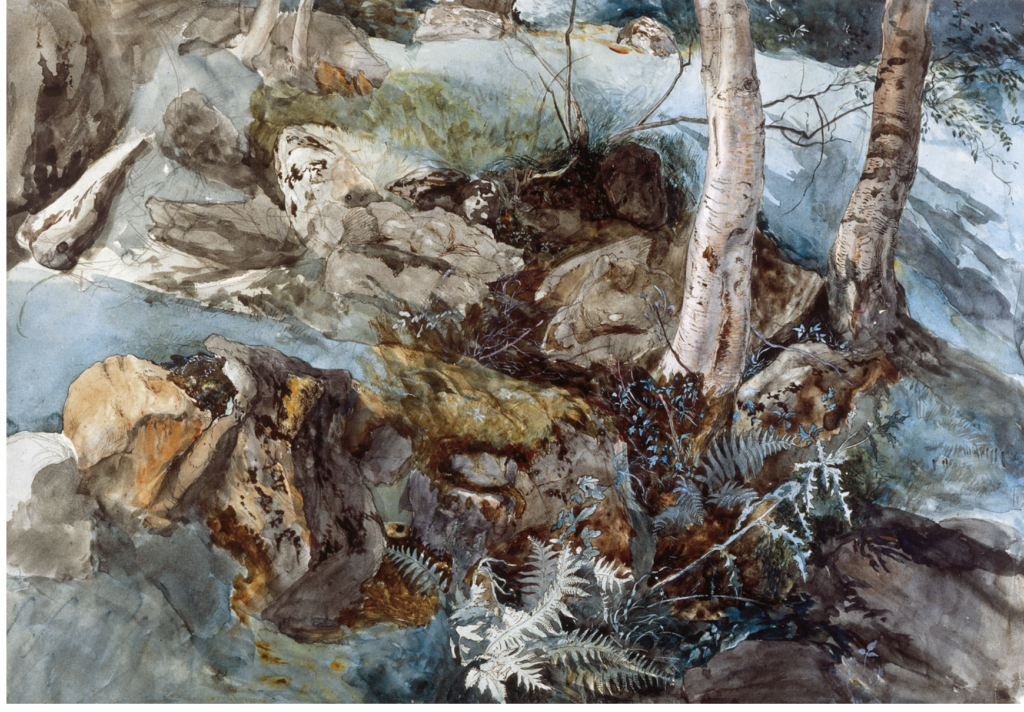
John Ruskin, Rocks and Ferns in a Wood at Crossmount, Perthshire, 1847, Pen and ink, watercolour and bodycolour on paper. Photo: lakelandarts.org
This is the final column in a ten-part series. View the previous articles in the series here.
The reason we have a Conservation Commission in Amherst is principally due to the passage in 1972 of the Massachusetts Wetlands Protection Act (M.G.L. c. 131, § 40.) Most people now agree that wetlands are valuable natural resources that can serve as important habitats for wildlife whilst also having a capacity to purify drinking water supplies and other waters. In other words, the act serves the public interest. My reading of the act suggests an interrelationship–an interbeing–between humans and the rest of the natural world so that all can be healthy and thrive. The 1972 act did some other useful things too, combining and modernizing earlier state legislation, including the 1963 Coastal Wetlands Act and the 1965 Inland Wetlands Act. Protections were further extended in the 1980s and again in 1996, with the passing of the Rivers Protection Act.
Amherst’s Conservation Commission, is charged with administering and enforcing the State’s Conservation Commission Act (M.G.L. c, 40, § 8C) for open space protection and the 1972 Wetlands Protection Act for wetlands and waterways; it also enforces the home rule provisions of the state constitution for non-zoning wetlands bylaws. Amherst also has a Wetlands Protection Bylaw that means we are responsible via the Conservation Commission, for reviewing and permitting projects within the act’s jurisdiction, including wetlands, water bodies, floodplains, riverfront, and buffer zones. The commission also works closely with the Conservation Department, managing town conservation land, including over 80 miles of trails, and establishing environmental policy (i.e., updating the Open Space and Recreation Plan). Even if you are someone who doubts the importance of our town’s wetlands, you may be a fan of Amherst’s extensive system of public trails. This bylaw protects both.
The Beginnings of Conservation as a Movement
Arguably, the discipline of conservation and environmental protection dates back to the early to mid-1800s, when a minority in Western European and North American countries began to question the recently gained advantages of the Industrial Revolution. Changes to the land were not the first abuses noted; rather, it was the employment of children that critics of industrialization were often concerned with. Industrial profits had in fact become global in scope for Western economies, which were fueled to a great extent by earlier profits from the sugar industry and the triangular trade (the 16th -19th century trade system connecting Africa, Europe, and the Americas). The earliest detractors, who argued for the preservation of natural resources adversely affected by industrial change, were writers and social reformers. Maybe you have heard of John Ruskin, a British art critic who was concerned that England’s industrial revolution was damaging not only to nature but to all forms of human creative endeavor, or one of the key people he in turn influenced, the designer/socialist William Morris, who founded an “ Anti-Scrape” society that became the Society for the Protection of Ancient Buildings. Also critical to the growth of the conservation movement was the work of Octavia Hill, the woman who founded the British National Trust, which inspired the U.S. National Trust for Historic Preservation. A closer Massachusetts equivalent would be The Trustees of Reservations.
Another important Massachusetts organization involved in conservation is Mass Audubon, founded in 1896 by Harriet Lawrence Hemenway and Minna B. Hall, who persuaded ladies of fashion to stop wearing hats that were adorned with cruelly harvested plumage often pilfered from birds that were ceremonial to indigenous tribes in Central and South America. These women brought the movement closer to home, and today Mass Audubon protects 36,500 acres of land throughout the Commonwealth, saving birds and other wildlife, and making nature accessible to all. As Massachusetts’ largest nature conservation nonprofit, it is also a nationally respected leader in environmental education.
Careers in Conservation
Today, if you want a career in conservation for a municipality or the state, you have to have professional qualifications and probably a proven commitment to sustainability. You might be interested in specific natural resources such as timber, water, and animals, or in planning for passive recreation or public health. You might want to change the world so as to better protect our shared natural resources. You might want to argue for more radical adjustments to how we think about land and land use. In terms of your other talents or skills, you probably like environmental science, particularly biology or botany, or want to work outside. You might want to take care of endangered species, or wetlands, or practice permaculture. You might be drawn to the Ents (sentient tree-like beings that protect the forest in The Lord of the Rings).

A Conservation Commission (often referred to as ConCom in Amherst) usually has between five and seven members and a paid staff liaison person. The Massachusetts Conservation Commission Act states that the Conservation Commission “shall…impose such conditions as will contribute to the protection of the interests” set forth in the Act and requires that all work should be done in agreement with the permit conditions. If you want to do any construction work near wetlands, you must apply to the ConCom for permission. (see below at the end of this article for some examples.) Floodplains and vernal pools may be at risk or require specific review.
Vernal Pools
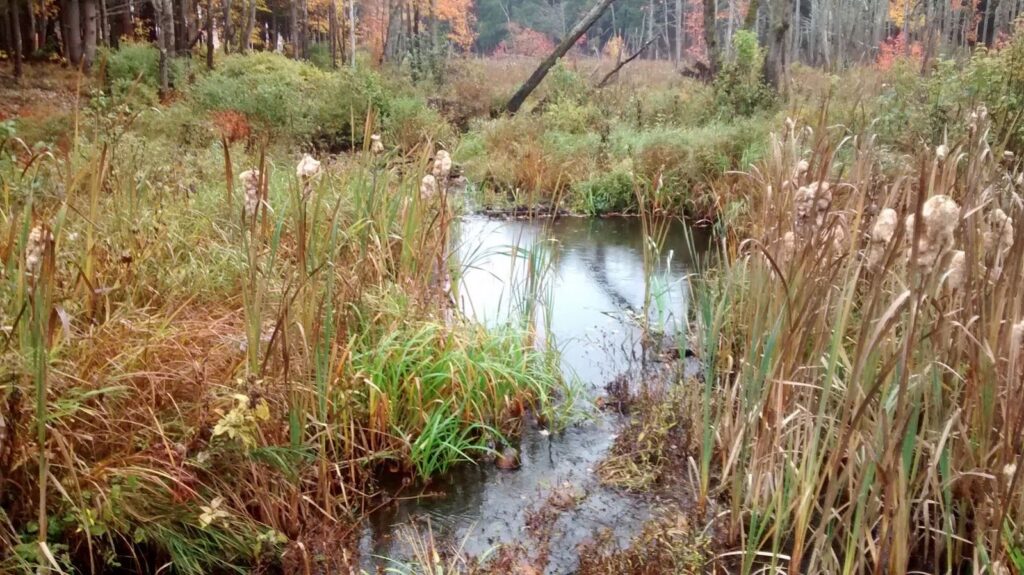
Vernal pools need to be protected. In winter and spring these wondrous bodies of water become important amphibian habitats. The pools fill with winter snowmelt and spring rains and then dry up over the summer so they cannot support populations of fish. And it turns out, according to the Massachusetts Association of Conservation Commissions, it is the absence of fish preying on the smaller creatures that makes vernal pools “the safest, and often the only, viable maternity wards for a highly specialized group of amphibians.”
Big Night
Local news watchers may already be familiar with the special nights designated for looking after salamanders as they cross Henry Street, in North Amherst. Spotted Salamanders (Ambystoma maculatum) are striking, eight-inch-long amphibians that are sometimes called “mole salamanders,” as they spend much of their lives hidden underground in the woods. But, according to the amphibian monitoring programs of the U.S. Geological Survey (USGS) and the National Park Service (NPS), their entire reproductive cycle relies on being able to access vernal pools, and using their ancient homing instinct called site fidelity.
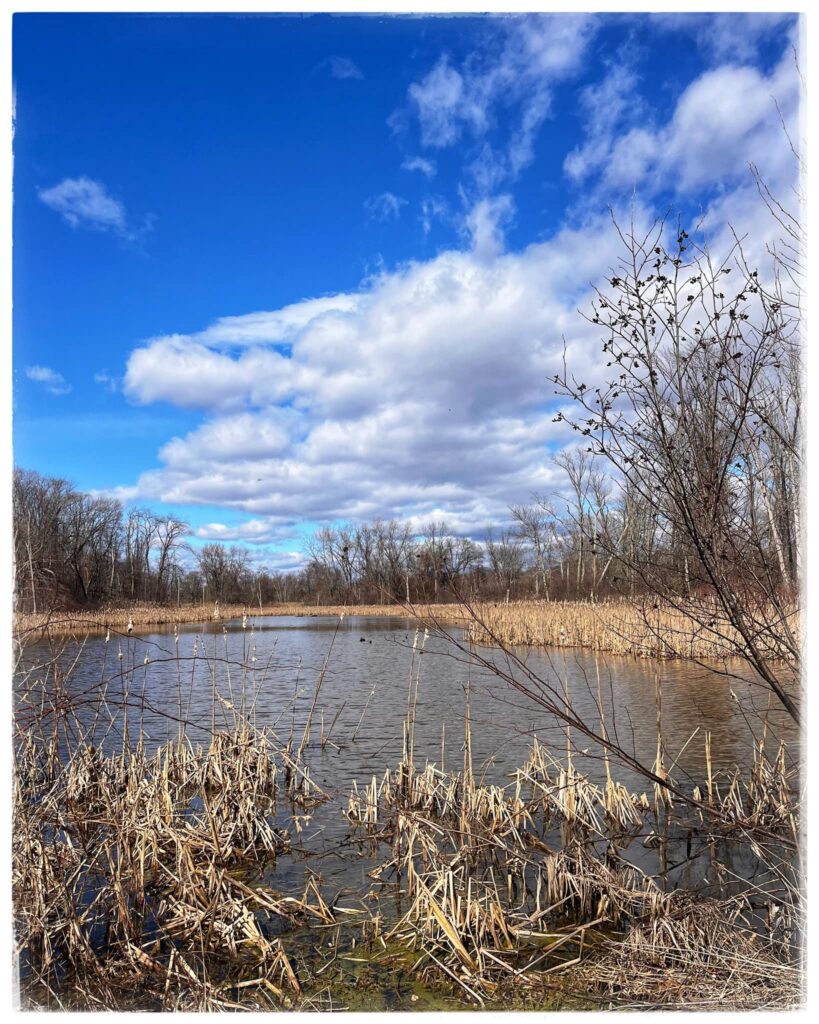
The Amherst Conservation Commission
The Conservation Commission in our town meets on the 2nd and 4th Wednesdays of the month, online. Currently, commission members are working on offering a report on drought conditions, reviewing land use updates and discussing the final draft of the Conservation and Land Management Policy and Regulations. In recent years, the ConCom denied the construction of The Eruptor Project, a tech incubator proposed for North Amherst, in 2021, due to wetlands encroachment.

In 2025, ConCom declined to grant a permit to a proposed development at Atkins Corner because of wetlands encroachment.

As with the other town bodies that work to preserve our natural world and our place in it for the future, I am grateful for the Conservation Commission’s work in protecting precious resources. The next meeting of the Commission is on Wednesday, March 24, 2026.
Glossary of Useful Terms:
abutters: (in this case) people who live next door to the wetland and applicant.
bylaw: 1. Law made by a city or town for the control of its own affairs.
2. A secondary law or rule, not one of the main rules.
criteria: A rule or standard for making a judgment.
estuary: A broad mouth of a river, into which the tide flows.
floodplain: An area of land bordering a river and made of sediment carried by the stream and deposited during floods.
indicators: things that show or are a sign of….
inundated: Flooded
intermittent: stopping and beginning again. (Streams are often intermittent seasonally, running during the spring as snow melts, drying up in the summer.)
magnitude: Great importance and effect
mitigate: Make less severe
ordinance: A rule or law, especially one adopted and enforced by a local authority.
statutory interests: public interests protected by a law or “statute”, in the case of wetlands, the eight reasons people value wetlands.
vernal pools: Temporary ponds that fill up with water in the spring as a result of snowmelt and the spring rains and then dry up in the summer. They are important amphibian habitat.
zoning: The restrictions on building in an area of a city or town.
Brava, Hetty!
Information we need,
In a place we can find
[suggested bike/canoe sticker, with a nod to The Montague Book Mill]
Just for the record, the Conservation Commission did not deny the Eruptor project. The project was withdrawn during an ANRAD peer review. Nor did the Commission deny the Hampshire Housing project. It was also withdrawn by the applicant.
Thank you for highlighting the Conservation Commission!
Thanks for the corrections, Erin. If I understand it correctly the ANRAD is a legal hearing adjudicating issues based on wetlands encroachment. I am linking readers to the Indy’s article about this project (see below).
And having followed the Hampshire housing project at each hearing of the Con Comm my impression as a lay person was that the Con Comm was crucial in terms of the outcome but I bow to the experts to accept your verdict as final. Based on past issues with the Tan Brook in town, and the current project of the ACLT at 174 Amity Street that I am involved in, it seems to me that support or evidence for determinations gets more and more detailed and specific as time goes by. I tip my hat to you for the incredible work you do for our town.
https://www.amherstindy.org/2021/12/10/wetlands-boundaries-disputed-at-site-of-the-proposed-eruptor-project-in-north-amherst/