Town Council Raises Concerns over More CPA Funding for the Jones Library, Requests Increased School Funding from Legislature
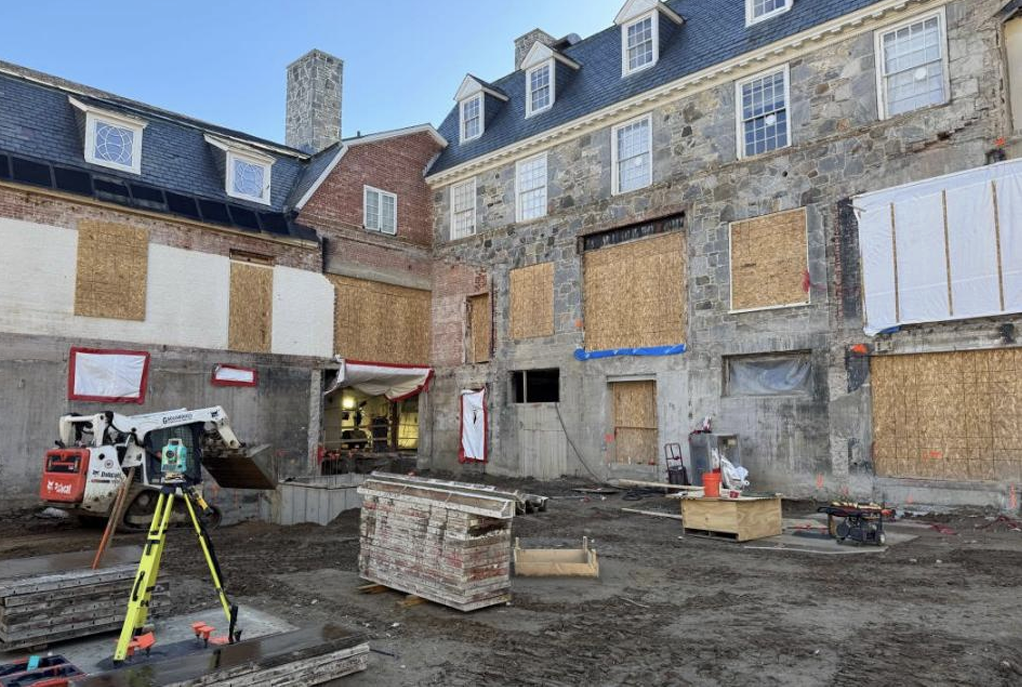
Rear of Jones Library following the demolition of the 1993 addition. Photo: amherstma.gov
Report on the Meeting of the Town Council, March 23, 2026
This meeting was held in a hybrid format in the Town Room at Town Hall. It wasrecorded.
Present
Mandi Jo Hanneke (President, at large), Jill Brevik and Cathy Schoen (District 1), Amber Cano-Martin and Lynn Griesemer (District 2), Hala Lord and George Ryan (District 3), Pam Rooney and Jennifer Taub (District 4), Ana Devlin Gauthier and Sam MacLeod (District 5), and Andy Churchill and Ellisha Walker (at large).
Staff: Paul Bockelman (Town Manager) and Athena O’Keeffe (Council Clerk)
Questions About More CPA Funds for Jones Library Project
The recommendations of the Community Preservation Act (CPA) Committee have been referred to the Finance Committee for discussion. Nevertheless, some councilors raised questions about the committee recommending another $477,000 for “Historic Preservation and Restoration of the Jones Library.” This is in addition to the $1 million in CPA funds awarded the library for improvement to the Special Collections area granted in 2021.
Councilor Jill Brevik noted that, while most of the CPA committee’s recommendations were unanimous, there was some disagreement over the appropriation for the Jones Library, though the final vote was 5-1 to award the funds. She wanted to know what some of the controversial issues were.
CPA committee Chair Katie Zobel first stated that the CPA committee received an “enormous outpouring of support for the Jones expansion project, with well over a hundred written comments.” However, she added, some members of the public and some members of the committee noted that the Town Council had voted not to provide any further town funding to the library. Some committee members pointed out that the majority (over three-quarters) of CPA money comes from a three-percent property tax surcharge, and only one-quarter from the state. While Zobel argued that there was some confusion over whether windows slated to be replaced could be considered “historic preservation”, the Amherst Historical Commission clearly stated that they should not be regarded as historic preservation and should not be funded with money designated for preservation work.
Zobel added that the question of whether the CPA money would be considered “supplanting” funds already allocated by the town’s borrowing of the full amount for the project was answered by an opinion from KP Law which stated that since the money had not yet been borrowed, it was not supplanting. Supplanting is not allowed in CPA appropriations.
Councilor Pam Rooney was concerned that the library was requesting CPA funding for items that were included in the construction contract for the project, such as preservation of the Philippine mahogany woodwork. She noted that the cost of the woodwork preservation in the bid was estimated to be between $25,000 and $75,000, which is much less than the $477,000 awarded in CPA funds. She asked what the additional money is to be used for.
Zobel could not answer that question. She referred councilors to the project application (which requested $1.3 million for the woodwork, exterior trim, and windows).
Cathy Schoen also asked what exactly the appropriation would be used for. She noted that CPA funds could only be used for work done after July 1, 2026. It could not be used for work that has already commenced.
Amber Cano-Martin pointed out that the project violates several of the Secretary of the Interior’s standards for preservation of historic buildings, which would also disqualify it for CPA funds for historic preservation. Zobel thought that, although the “Jones Library project didn’t meet every national standard,” the parts of the project for which funding was requested do meet the standards; however, she did not offer support for this contention. Finance Director Sean Mangano added that the KP Law statement recommended that the town get an opinion on the matter from a historic preservationist.
Andy Churchill supported the award, saying, “The community hasn’t raised all the money yet, so to use these funds to help close that gap as they would with any other grant seems appropriate to me.”
There will be a public forum on the CPA appropriations on April 6, and the Finance Committee will hold its discussion on April 7. The council vote will most likely occur on April 27. A simple majority of councilors must approve each appropriation that does not involve borrowing. The only project recommended for bonding was for the War Memorial Pool’s bathhouse ($1.5 million was requested). That appropriation will require a 2/3 approval from the council.
Three councilors noted possible conflicts of interest regarding decisions on the CPA funds. Lynn Griesemer said her husband was part of the District One Neighborhood Association (DONA) that requested funding for the Industrial History of the Mill River and Cathy Schoen’s husband is the treasurer for DONA. Neither of them recused themselves from voting on the other proposals. However, Hala Lord did recuse herself from even voting to refer the CPA recommendations to the Finance Committee, because she sits on the board of another applicant, the Goodwin Church, for which CPA money was reserved to repair the roof.
If any of the projects are not approved for funding, the allocated funds will be available for projects in future years or in FY27 if the CPA committee held additional meetings to reallocate the funds.
More Information on How the Town Will Deal with Possible ICE Activity
In the public comment period, Vincent O’Connor blasted Town Manager Paul Bockelman’s Executive Order intending to protect Amherst residents from unlawful activity by federal immigration agents. O’Connor stated that the order “does not answer the question of what an Amherst resident can expect as a response if they call 911 to report that unidentified, armed, masked men are attempting to break into their car, seize their U.S. citizen children or other relatives, or are attempting to break into their homes without displaying a warrant signed by a judge. Failing to even address the 911 inquiry question, much less answer it, constitutes an open invitation to ICE. In fact, the executive order commits the Amherst Police Department to protect ICE.” He called for residents to work with neighbors and friends to identify places where vulnerable individuals can “essentially disappear and avoid ICE as long as they’re around.”
In his Town Manager’s report Bockelman referred to a well-attended presentation that Police Chief Gabe Ting gave at Applewood on how the town will interact with federal agents. The presentation is posted on the town website, and Bockelman urged concerned citizens to refer to it.
Three members of the Human Rights Commission requested a report on past federal immigration officer activity in town. The opportunity to request such data is provided in the Sanctuary Community Bylaw. Bockelman’s report states that in 2025 no individuals were detained, or transferred to ICE custody, or received requests for certification of U visas in Amherst.
Council Passes Three Proclamations
As part of the consent agenda, the council unanimously approved three proclamations. The first was“Town of Amherst Proclamation Declaring Amherst a Purple Heart Community,” which honors residents of Amherst who have been awarded a purple heart after being wounded or killed in action against an enemy force while serving in the U.S. armed forces. August 7 will be recognized as “Purple Heart Day” nationally and locally.
The second proclamation recognizes April 2026 as Arbor Month. The Public Shade Tree Committee has planned several activities in April to celebrate the role trees play in the environment. There will be tree plantings on April 11 and on April 24, the day that Arbor Day is celebrated around the world. The committee will also have educational materials and free saplings to distribute at the Sustainability Festival on April 25.
The third proclamation recognizes April 11, 2026 as Amherst Global Village Festival Day, to “honor the diversity that strengthens our community and seek to inspire all residents to continue fostering understanding and respect across cultures.” The Global Village Festival will take place from 10 a.m. to 5 p.m. on April 11, at the Amherst Regional High School.
DPW Building Committee Has Begun Meeting
Rooney reported that the seven-member DPW Building Committee has had two meetings. They are working on specifying the requirements to hire an Owner’s Project Manager (OPM), since they must have an OPM before they can choose a designer. The committee next meets on April 8 at 2 p.m.
Council Continues to Deal with Recommendations of Charter Review Committee
The Council continued its discussion of the 22 recommended revisions to the Amherst Home Rule Charter in the Charter Review Committee’s final report. They also began discussion of the issues in the “Beyond the Charter” section of the committee report.
As noted in the February 23 meeting, recommended changes could be referred to the State Attorney General and be approved by the legislature as special acts, go before the voters in the 43b provision, be referred to a council committee, or be tabled indefinitely.
Hanneke incorporated straw polls taken at that meeting into a motion to refer recommendations and recommended that suggestions 1, 2, 3, 7, 9, 10, 12, 13, 20, 22 be referred through the Town Manager to the Town Attorney, who would prepare language for a Special Act to amend the Charter. Suggestions 5, 6, 8, 11, 14, 15, 16, 21 were to be referred to the Governance, Organization, and Legislation (GOL) committee for further discussion. Suggestion 19 was to be tabled. None were recommended to be put to a vote of residents.
In the discussion that followed Hanneke’s proposed motion, Ryan expressed reservations about suggestion 9, which allowed nonvoting residents to serve on all council committees, and wanted to refer it to GOL for further discussion. Councilor Jennifer Taub and Schoen spoke in favor of having residents serve on council committees. In the end, all but Hanneke voted to refer the measure to GOL
Cano-Martin, Brevik, Churchill, Hala Lord, and Ellisha Walker voted for a motion to refer suggestion 4, limiting terms for council officers to three consecutive years, for a Special Act, but the measure lost 5-8 and remains on the GOL slate. Recommendation 7, requiring that there be an opportunity for public comment at all regular council meetings and committee meetings, was tabled at Hanneke’s suggestion, because it is already in the council’s rules of procedure.
After the above modifications, Hanneke’s motion passed unanimously.
Regarding the section of the Charter Review Committee’s report entitled “Beyond the Charter,” several recommendations dealing with transparency and outreach were referred to the Transportation, Service, and Outreach (TSO) Committee, which no longer has to evaluate many transportation issues that the new Transportation and Parking Commission will handle. Foremost among the charter committee’s concerns was making the application and appointment process for town committees more public.
The town has already filed requests with the State Legislature to institute voting in local elections for non-citizen permanent residents, participatory budgeting, and ranked choice voting (RCV), but no action has been taken on two of the three for several years. Participatory budgeting is now allowed, but the town has instead permitted residents to submit proposals to the CPA committee and the Joint Capital Planning Committee.
Because of the legislature’s inaction on non-citizen voting and ranked choice voting, Councilor Ana Devlin Gauthier suggested that the town take a different tack, maybe incorporating RCV into the charter as Easthampton has done.
Hanneke Drafts Written Testimony for Joint Ways and Means Committee
Council President Mandi Jo Hanneke was requested by Amherst’s state legislators, Representative Mindy Domb and Senator Jo Comerford, to submit testimony on the town’s behalf for the meeting of the Joint Ways and Means Committee on March 30. Hannek drafted a memo stating Amherst’s priorities for future funding and asked for input from other councilors.
School funding was highest on the list, including increased aid to rural schools, revision of the charter school reimbursement formula, more funds for transportation, and increased “circuit breaker” funds to help deal with costly special education placements. Schoen emphasized the need for more funds from the Fair Share Amendment to go to K-12 schools and to fixing roads. She said most of the transportation funds are now slated to go to the MBTA.
The Massachusetts Municipal Association recommended a new system for collecting outstanding excise taxes and parking fees at the time of driver’s license renewal, but councilors were not clear about how the change would work and worried that low-income residents would be the most adversely affected. The vote to retain the paragraph referring to excise taxes from the testimony was defeated by a vote of 3-8-1 (Hanneke, Griesemer, and Ryan voted to retain it, and MacLeod abstained).
Hanneke will try to incorporate councilors’ suggestions into the testimony, to best reflect the priorities of the council. She noted that councilors are also welcome to give individual testimony, written or oral, to the committee.
Council Approves Purchase of 54 Acres in Pelham for Watershed Protection
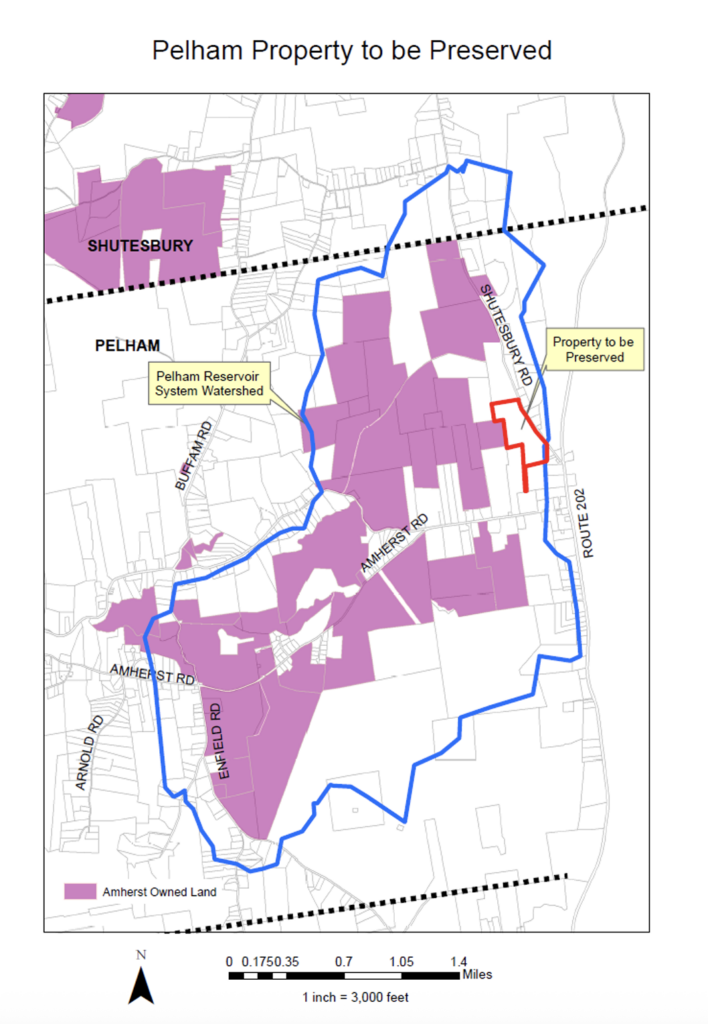
Prior to the regular Town Council meeting, there was a public forum regarding appropriating $55,000 of excess earnings from the water fund to purchase the Aaron family property along Shutesbury Road in Pelham, which abuts other Amherst-owned land in the reservoir system that feeds the Centennial Water Treatment Facility.
The purchase price of the 54 acres of undeveloped, forested land is $364,700, of which $90,800 will come from a grant from the Audubon Catalyst Fund and $213,000 from a Massachusetts Energy and Environmental Affairs Drinking Water Supply grant. The Finance Committee unanimously recommended the purchase. The Kestrel Land Trust will help maintain the property, which will remain undeveloped.
In public comment, Vincent O’Connor opined that the budget surplus from FY25 should not be used for capital, but rather should go to the school operating budget. However, Bockelman explained that the money for purchasing this property was from the water fund, not the surplus from the general budget, and needed to go to items related to drinking water.
The purchase of the property was approved unanimously on the consent agenda.