
Show Up! Sing Out! Singing for Peace and Justice in the Pioneer Valley
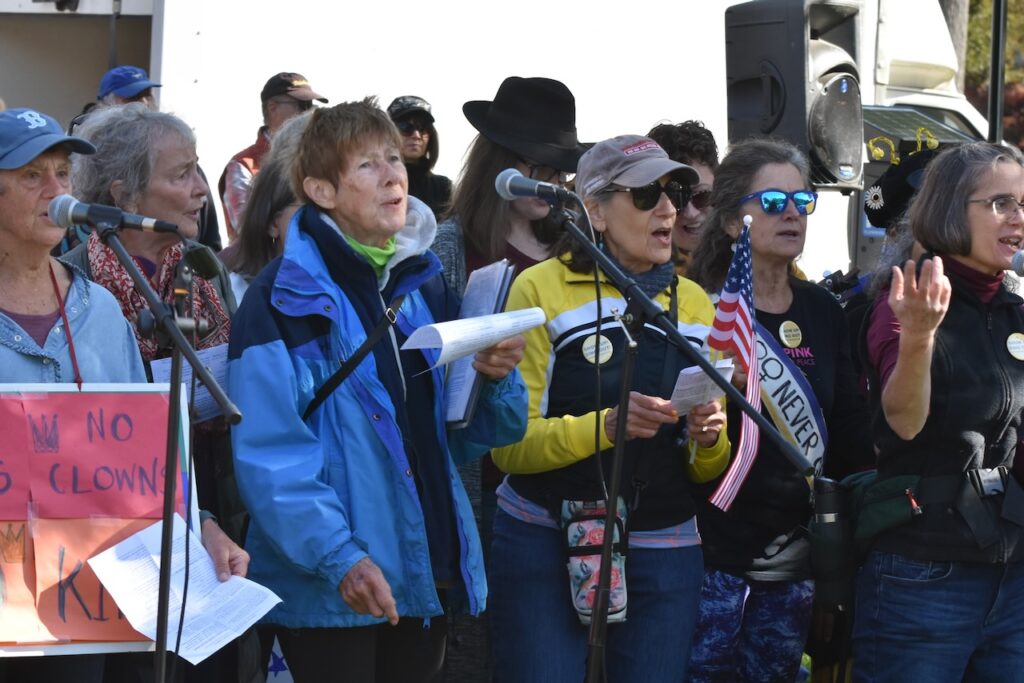
The Show Up and Sing Out! Singers opened and concluded the Amherst No Kings 2.0 rally on October 18, 2025. Photo: Art Keene
In these times of violent repression at home and abroad it is easy to become scattered and despairing. Things only get worse. The fog of war pervades not only the countries that the United States and its partner Israel have invaded, occupied, or bombed, but the streets of our cities and the very workings of our minds. Living as we do in the belly of the beast we are aware that we have the responsibility to act, but all too often find ourselves frantic on the one hand and paralyzed on the other.
Talking on the phone late at night with my friend Sartaz, we shared these feelings. She said that she was attending protest rallies, writing letters to her elected representatives, working with friends on postcard campaigns, feverishly keeping up with the news, but all the while, just going through the motions. “Inside, I feel numb.”
Thank goodness for the power of song! Singing opens our hearts as well as our lungs. Singing together, we feel the living web that encircles and enfolds us, giving us renewed strength and purpose. Singing has always nurtured community, and at this time in the U.S. there is a new spirit afoot, drawing strength from the recent resistance to the occupation of Minneapolis by Immigration and Customs Enforcement (ICE). This spirit of collective resistance began to take root in the Pioneer Valley over the long, cold winter and now, just in time for spring, it can be seen and heard everywhere.
Human beings have always sung as they worked, struggled, mourned, resisted oppression, strove to create a better world. Here in the U.S., enslaved people sang of freedom, and songs powered and united the Progressive and Labor Movements, Civil Rights, anti-colonial, and anti-Vietnam war movements, the Women’s and LGBTQ+ movements, anti-nuclear, environmental, and anti-Apartheid movements. At the turn of the 21st century there was the Anti-WTO and later, the Occupy Movement, Black Lives Matter, and most recently, Abolish ICE. Each of these has given rise to songs, many of which have been adopted and adapted from the anthems of older struggles.
So many singers, musicians, and songwriters and whole genres of music—blues, folk, gospel, rock, reggae, punk. Paul Robeson, Woody Guthrie, Pete Seeger (here, accompanying Judy Collins; and again, here, with Sonny Terry and Brownie McGee), The Weavers, Phil Ochs, Bob Dylan, Harry Belafonte, Odetta, Joan Baez, Richie Havens, Buffy Sainte-Marie, Arlo Guthrie, Miriam Makeba, Bob Marley and the Wailers, Peter Tosh, The Clash, The Specials, Billy Bragg, Sweet Honey in the Rock, Holly Near, Bruce Springsteen, Patti Smith, Rhiannon Giddens, Emma’s Revolution, all carry on traditions of resistance singing.
Rise Up in Song and RUSH
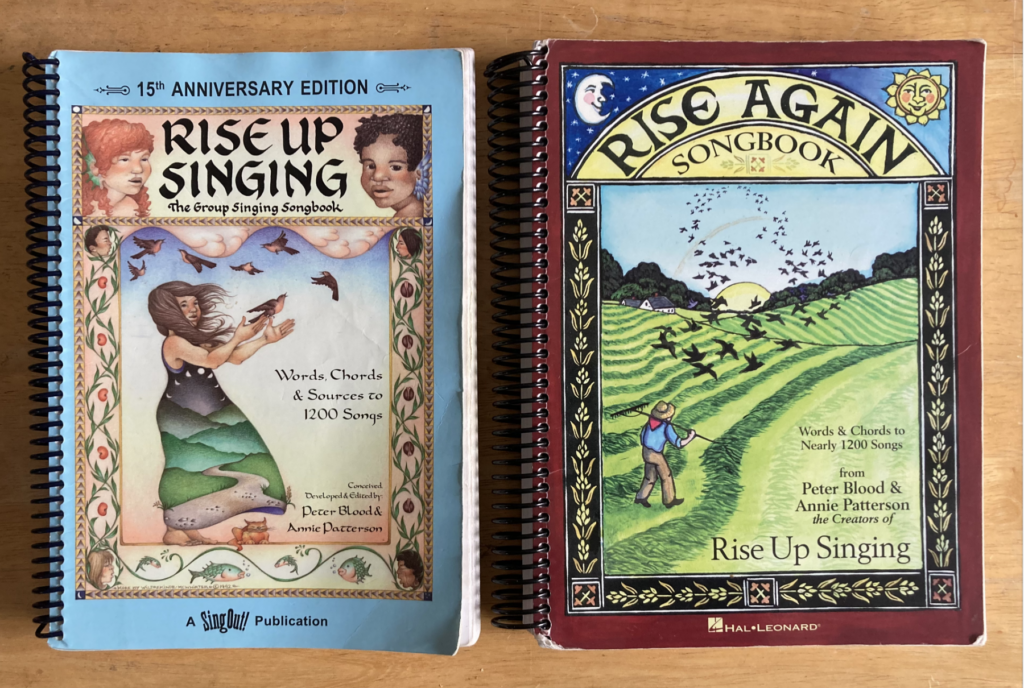
Here in Amherst, back in 1979, Peter Blood and Annie Patterson created Rise Up Singing, a book containing the lyrics and chords of 1200 songs; and in 2015 they completed a sequel, Rise Again, with another 1200. They have traveled around the country and indeed, the world, helping people set up collective singalong groups. A loose, welcoming, Pelham-based group, Rise Up Singing in Harmony (RUSH), has been meeting every month for nigh on 30 years, singing mostly from the two books and bringing in new songs from time to time. It is the custom, as we go round the circle, to choose songs to suit the moment, whether sober or celebratory, personal or political. I have been attending RUSH for 15 years (and have written about it here, here, and here) and it has sustained me through difficult times. For some 18 years, the indefatigable Roger Conant led the monthly sings and circulated a newsletter filled with listings of music in the Valley; in 2017, Roger passed the baton to Dan Grubbs and Nancy Slator, who still carry it faithfully.
To Nancy, singing is something that comes as naturally as breathing: “I’m the kind of person who is always humming something or whistling. Singing raises my spirits.” Dan speaks to the power of coming together in song: “I like singing. Recorded music, despite being great to listen to, has taken something from us. Not too long ago, if you wanted music, you had to make it yourself. It was a social event and still is in many cultures. In many places, everyone comes together, from young children to old folks, to sing and dance. We need more of that. I wish we held RUSH outside where random strangers and kids could join in.”
While the Rise Up Singing groups seek primarily to revive the joyful tradition of singing together, and are not narrowly defined as resistance groups, the books draw heavily from movement songs, in particular the tradition of Pete Seeger, who was a friend of Peter and Annie. Introducing themselves on their website, they say that their “mission is to foster hope and work for justice through song.” Their page, Songs for the Resistance, includes links to songs on a range of social justice topics, as well as to The Poor People’s Campaign Songbook and the Singing Resistance.
When Pete Seeger died in 2014, Peter and Annie and other singers in the region organized in Amherst, a celebration of his life. The First Congregational Church in Amherst was packed to bursting with people singing their hearts out. Since then, there has been a Pete Seeger singalong every year in one of the surrounding towns, featuring young singer-songwriters who not only sing his songs but also carry forward his activist tradition by writing and sharing their own.
What is distinctive about Pete Seeger’s singing, as well as the folk and popular traditions that the Rise Up songbooks carry forward, is that the songs are meant to be sung together, not performed to a passive audience. Like the caller in an African call and response, Pete taught the songs to his audiences line by line. The songs of the Civil Rights movement drew on this tradition, as did freedom songs from apartheid-era South Africa. Here in the Connecticut River Valley and the Five-College Area, we were part of a global movement of solidarity that eventually made the apartheid state a pariah. In 1990, soon after Nelson Mandela had been released from 27 years in prison, the Amandla Chorus from Greenfield traveled to Boston to sing for him. The Amherst Area Gospel Choir, directed by Jacqueline Wallace, continues to sing these songs of freedom at events throughout the Valley. Here they are in 2017, singing at Prayers for the Planet, an interfaith climate action event in Northampton.
Singing Resistance
The federal government crackdown in Minnesota has sparked a whole new wave of group singing, led mostly by women. Singing Resistance was born out of the three-month ICE surge in Minneapolis, an operation so aggressive that it was more like an occupation. Schools ran remotely as immigrants and refugees were too afraid to venture outdoors. Masked ICE agents roamed the streets, dragging people from their homes. The surge resulted in more than 3,000 arrests, detentions, and deportations, and deaths at the hands of federal agents. But the city that had erupted in outrage after the police killing of George Floyd in 2020 was a match for them. The people of Minneapolis turned out to support each other, marching day after day in their tens of thousands to demand, ICE Out! And as they marched in the sub-zero winter temperatures, they sang, to overcome fear and build their community spirit. As ICE retreated from Minneapolis and moved on to other cities, so did the songs.
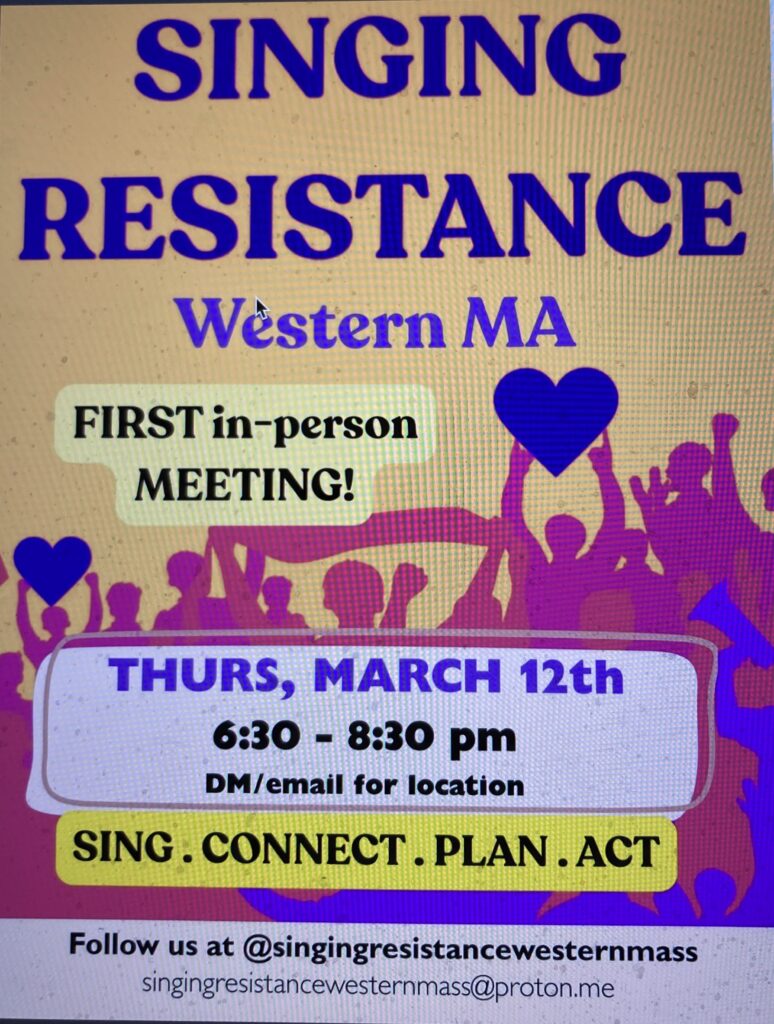
Singing Resistance describe themselves as:
“. . .building a mass movement of singers to protect and care for our communities in the face of rising authoritarianism. We are grounded in love, nonviolence, and solidarity. In the context of escalating violence towards our communities and federal invasions of our cities and towns, we sing because song is an antidote to fear, song helps us connect to each other, and through song we can name and protect what we hold sacred. We sing publicly in the streets for the sake of solace, strength, solidarity, to voice our dissent, and to refuse cooperation with oppressive and autocratic forces.”
They have created an online songbook along with an organizing toolkit with a statement of their goals and core alignments. Some of their songs are drawn from established protest traditions, but many of them—like This is For Our Neighbors, by Lu Aya of the Peace Poets, or We Belong to Each Other, by Annie Schlaefer—are new, chantlike and electrifying, especially when sung by large numbers of people.
The Singing Resistance model has spread like wildfire, with established and new groups across the country learning and teaching the songs. Here are members of the Resistance Revival Chorus and the Jerriese Johnson Gospel Choir in New York City, February, 2026, teaching songs from the Civil Rights Movement, like Ain’t Gonna Let Nobody Turn Me Around, songs from the Poor People’s Movement, like Somebody’s Hurting My Brother and We Get There Together, and new songs of resistance to ICE, like It’s Okay to Change Your Mind by Annie Schlaefer, learned from the front lines in Minnesota and Hold On by Heidi Wilson from closer to home, in Plainfield, Vermont. As of March 19th, 2026, more than 230 Singing Resistance groups have been formed across the country, including the new Singing Resistance Western Mass, which drew more than one hundred people to its first in-person meeting in Northampton on March 12.
Show Up! Sing Out!
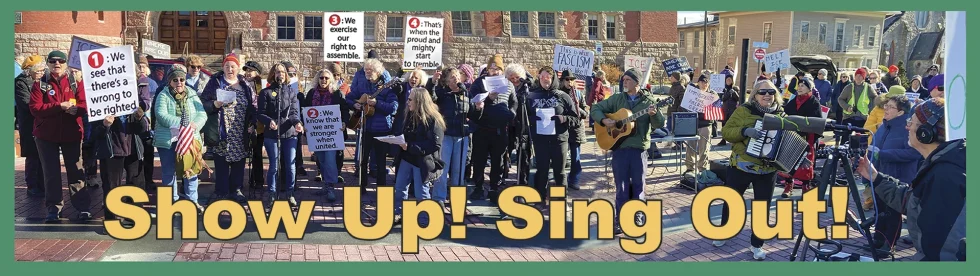
Another new homegrown group in the resistance tradition is Show Up! Sing Out!, formed in August, 2025. Co-founder Anne Louise White, a retired Amherst elementary school music teacher and director of the Leverett Community Chorus and the Caravan Chorus, says, “We are currently facing a time in this country when many people are deeply afraid. If ever there was a time to build community through song, it is now.” She cites the importance of singing in the Civil Rights Movement: “Lara Shepard Blue and I teamed up together last August out of our shared belief that music can play a vital role in the movement to resist fascism. As a choral director and music teacher, I have studied the role of singing in the civil rights movement of the 50s and 60s. My father was a Freedom Rider who went down to the south by bus to test the Jim Crow laws. The activists on those buses knew that they were facing possible serious danger. Singing together on the bus was a way to get to know one another, to remind themselves of why they were doing this work, and to strengthen their resolve.”

Show Up! Sing Out! will be at the No Kings rally in Amherst on Saturday, March 28, leading people in song. You can visit the website here, to find chord charts and lyrics for a number of their songs and to join, in order to receive notices of rehearsals and upcoming events. In addition to new songs from Minnesota, old favorites include the beloved protest anthem No Nos Moverán (In English, We Shall Not Be Moved),It Isn’t Nice by Malvina Reynolds, Step by Step sung by Pete Seeger (adapting an Irish tune and using lyrics from the 1864 constitution of the American Miners’ Association), Woody Guthrie’s rousing All You Fascists Bound to Lose, and Elizabeth Alexander’s This is What Democracy Looks Like (based on a call-and-response slogan first popularized during the 1999 anti-WTO protests in Seattle, Washington).
In a small group meeting at friends’ houses, we have been singing Melanie DeMore’s Lead With Love:
Chorus You gotta put one foot in front of the other
And lead with love.
I know you’re scared
I’m scared too
But here I am
Right next to you.
Chorus
Don’t give up hope
You’re not alone
Don’t you give up,
Keep movin’ on.
Chorus
And we spent a whole meeting playing with Elizabeth Bengson’s Don’t Numb to This:
Don’t numb to this, don’t numb it out
Let it all flow in and out
You’re strong enough to feel it all,
And keep your heart alive.
Stay Soft to this, don’t numb it out
Let yourself breathe in and out
You’re strong enough to feel it all,
And keep your heart alive.
Don’t numb to this, don’t block it out
Let it all flow in and out
You’re strong enough to feel it all—and it’ll
Keep your heart alive.
I must share these last two songs with my friend. Together, they provide an antidote to our angst.
We must always remember the ones who are at the receiving end of the bombs—U.S. bombs.