
Get Them Out of That Building Now. Councilors Demand Safe Workplace for DPW
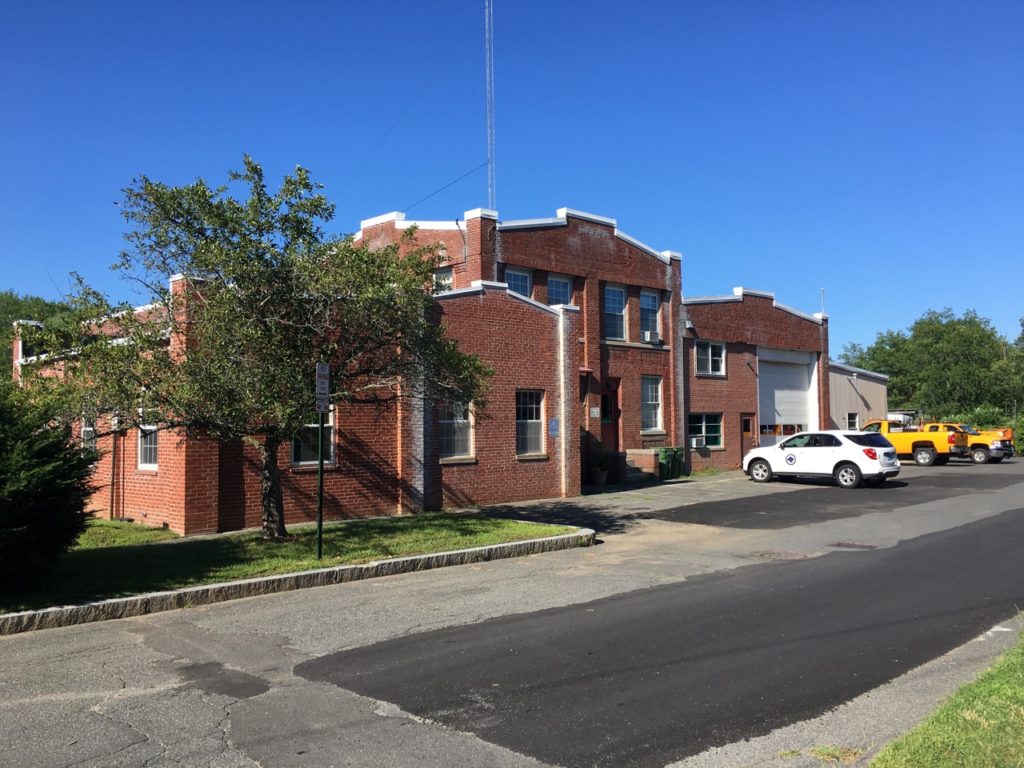
The building housing the Amherst Department of Public Works is a 100 year old former trolly barn. Photo: Stephen Braun
Report on the Special Town Council Meeting, March 30, 2026This was a hybrid meeting held in the Town Room and was recorded.
Present
Mandi Jo Hanneke (President, at large), Jill Brevik and Cathy Schoen (District 1), Amber Cano-Martin and Lynn Griesemer (District 2), Hala Lord and George Ryan (District 3), Pam Rooney and Jennifer Taub (District 4), Ana Devlin Gauthier and Sam MacLeod (District 5), and Andy Churchill and Ellisha Walker (at large).
Staff: Paul Bockelman (Town Manager) and Athena O’Keeffe (Clerk of Council)
This special Town Council meeting was called at the request of Town Councilors Ellisha Walker, Amber Cano-Martin, Jennifer Taub, and Jill Brevik to discuss the prolonged and unproductive contract negotiations between the DPW workers’ union and the town. The first attempt at a special meeting for DPW workers to state their case to the council was derailed on March 2 when Council President Mandi Jo Hanneke listed the entire meeting as an executive session with no public comment. When the vote to enter executive session failed, the meeting adjourned but an informal conversation took place between DPW workers and some town councilors.
The testimony and discussion for this second attempt at a special meeting are quoted in full.
Councilors Walker and Cano-Martin expressed frustration at the limitations placed by Council President Mandi Jo Hanneke on what could be discussed at this meeting. There was general agreement that the DPW workers need to be moved out of their failing building as soon as possible. The council took no formal action on the matter, but trusted that the Town Manager would take necessary action to address the problem.
Hanneke Lays Out Ground Rules for the Meeting
Hanneke announced at the beginning of the meeting that the executive session listed on the agenda would not be held. She said that it had been requested by Town Manager Paul Bockelman, but that he had notified her earlier in the day that he wanted it removed.
With no executive session, Hanneke restricted what the council could discuss in public, stating, “This is a presentation and discussion time as requested by the Charter Section 2.6, to explore possible solutions that are within the purview of the council to enact. This is under ‘presentations and discussions’, so no motions will be made tonight, because any motions need to come under ‘action items’, which we do not have tonight. Topics that cannot be discussed include anything that is a mandatory bargaining issue. That includes salaries, benefits, working conditions, questions of wages, hours and other terms and conditions of employment, standards of productivity and performance, and any other terms and conditions of employment.”
She continued, “Topics that can be discussed as a potential general list of things that are within the purview of the council [are] the overall DPW budget, levels of services, expenditures on capital equipment, expenditures on safety equipment, water and sewer billing structures, potential swing space for use of a new DPW building, timing of a new DPW building. Obviously, neither list that I just raised is complete.”
Walker and Cano-Martin Question Limitations on Meeting
Walker, who is Council Vice President, objected to not being allowed to propose a motion at this meeting. She also expressed frustration about the effort it took for her and three other councilors to make this meeting happen. She stated, “It was my understanding in agenda-setting for meetings that we would have the ability to present a motion tonight. I had explicitly asked for that to be the case, and so I’m feeling a little blindsided. I understand that that is completely the decision of the Council President, but I wanted to voice my frustration because I had a motion ready to go for tonight.” She noted how difficult it is to have conversations as a council outside of meetings because of Open Meeting Law: “It [tonight’s agenda exclusions] feels like another unnecessary barrier to figuring out what we can do as a council.”
Walker had been planning to direct the town manager to provide an accounting of the water and sewer enterprise funds to determine if the water and sewer rates were sufficient to support adequate staffing and adequate funding of the water and sewer departments in the long term.
Hanneke said, “I would request a memo be written with a proposed motion and sent to the agenda-setting team, myself and you, in general.”
Amber Cano-Martin added, “Understaffing and lack of people who have the ability to run our wastewater and/or water treatment plants and other equipment in town is a health and safety risk for our entire community, including Amherst College and UMass. So, I reject the idea that that shouldn’t be addressed in open session. And also, I don’t understand why the executive session was taken off [the agenda], because we were going to have an executive session where we could talk about these issues with Paul [Bockelman].”
DPW Workers Plead Their Case for Better Working Conditions
DPW Workers, who were not allowed to speak at the Special Town Council Meeting on March 2, were given the opportunity to do so at the start of this meeting. Five DPW employees spoke, emphasizing poor working conditions, inadequate pay and staffing, and the town’s lack of sincerity in bargaining with the union, using lawyers to stonewall the union’s demands.
Andrew Brace, president of the Amherst DPW Association and Chief Operator at the Wastewater Treatment Plant, said, “My division is responsible for the sewage treatment plant, which treats approximately four million gallons of sewage a day. We operate and maintain 22 pump stations around town and are responsible for 123 miles of sewer pipes, some dating back to the early 1900’s. We operate as a public utility with staffing required 365 days a year and on-call coverage every day for after-hours emergencies. I’m on call right now, so if I get a call, I need to leave this room and respond.
“Currently, only three of us have the required wastewater license to cover the plant. That means we have to split the 365-day coverage. For the past several years, we have had near-constant, numerous vacancies. We always hire people with no experience, train them, and watch them leave for more money, often to work at a less complex system. At Wastewater, we have lost 26 staff in the last 10 years. There have long been issues with low wages, understaffing, high turnover, and low retention, and these are not isolated to the wastewater division.
“I would like to provide some updates on where we are with negotiations. We have had eight negotiating meetings, four mediation sessions, and three meetings this March in which the Town Manager has been present. This Wednesday will mark nine months of working under an expired contract. The last meeting on March 18 I feel was very productive, and we received the town’s finalized written offer on Tuesday, March 24, and we needed some time for us and our attorney to review the details. We feel we’re very close to an agreement that will act as a stepping stone to addressing many long-standing issues with the DPW in future contracts.”
Michael Perez, a DPW mechanic, spoke about the conditions at the DPW building. “I’m going to try to quickly run down a list of some of the major things that I don’t know if everyone is aware of, starting with the collapsing roof. We have a collapsed roof over one of the active workspaces that we use on a daily basis. Most of the [upper level] offices cannot be used because the ceilings have collapsed and the walls have been torn out. The floors are spongy when it rains and water just comes up between the floor tiles. We have water that comes in through active light fixtures in the main bay, which is where we park most of our equipment. It could be a fire hazard. We still have mold in the main bay and in the mechanic shop where I work. The engineering department has water that comes in over some of their equipment and storage cabinets. Over time, it has ruined a lot of our inventory for parts. So that is a waste of money.”
“The ventilation in the shop is poor. There are times where we have two fans. One of them is on its way out. One of them only works until it overheats and shuts down. There are times where if we’re welding, or we’re using a plasma cutter or painting, the fumes get so poisonous that we have to open the doors and just leave to give ourselves a break from the fumes. So you’re losing productivity from use, because we’ve got to take time from our jobs just so we can take a breath outside.
“We have loose boards on the façade on the front of the building over the walkways, malfunctioning garage doors, water leaks in the water department. I know three minutes wasn’t enough time to spiel my whole thing here. I’d be happy to give people tours.”
John Foster, Drinking Water Treatment Supervisor, said, “Over one year ago, I was elected by the union to participate in the current ongoing negotiation process. We prepared diligently and worked hard to develop our argument, created a handout full of supporting evidence, printed current job postings from similar towns. I went to our first meeting and what I discovered was that none of it mattered. None of the preparation mattered, because the town’s representatives had been told they were not authorized to go above their initial offer. What proceeded in the months after those first couple meetings has been union busting and stall tactics from the town. I also realized from the beginning that the town’s consultant is there for one purpose, and that’s to do the town’s dirty work. It is clear to me and the rest of the committee that the consultant fee and the money the town pays for their lawyers to fight our union is to shut us up and shut real negotiations down.“
“My message to the town is to please stop lawyering this self-run union to death. It feels like we’re fighting some huge corporation with deep pockets and not the town of Amherst.
“There’s also the current DPW building. A Wesson and Sampson Company report on the building in 2016 deemed it outdated, undersized, and functionally deficient. That was 10 years ago. About eight years ago, the Town Manager held a DPW-wide meeting where he told us that the town was moving forward with plans and that we were getting a new building. He never spoke to us about it again. Is it our responsibility to ask for a safe working environment? The problem is that we are all so desensitized to this treatment that we expect it. And up until now, we accepted it. Up until now.”
Patrick (PJ) McNeil, a mechanic at the Wastewater Treatment Plant, said, “I’m part of the next generation of the DPW. I’m here today because I see firsthand that our DPW looks after our infrastructure, and that the DPW that we rely on so greatly is being left behind by the town of Amherst. The DPW building has been left to rot and crumble. Our roads are wasting away. Our water-piping infrastructure is bursting at the seams.”
“The second reason I’ve come is that I’m 24, and though I am lucky enough to have two very loving mothers that allow me to live with them, I am looking to move out soon. I’m not sure if I’ll be able to afford a house or the ability to start a family in or anywhere near this town that I enjoy so much. Please consider your DPW employees when you think of the future of this town.”
The last DPW speaker was Director of Trees and Grounds Alan Snow. After thanking the council and Town Manager for holding this meeting, he said, “In my opinion in 15 years of working for the town, we have a maintenance issue. We do not fund maintenance. In Trees and Grounds, we have tried for years to get funding to properly just maintain athletic fields or street trees. We put in requests for money and we generally are told we can’t do that. Sometimes, if there’s a major incident, money will magically appear and it will get fixed.
“Recently, the town gave the school system $150,000 to maintain the new athletic fields for two years. We simply are asking for $20,000 to do the exact same thing with town staff—not paying some contractor prevailing wage to do it. So, why does the money appear when a crisis happens.”
“This goes on with all of our infrastructure, whether it’s the police department, Bangs Community Center, DPW building. You are in control of the budgets. The money is there if it is a priority. DPW’s not a priority. Staff’s not a priority. You just gave money out of the road projects to the regional school to fix a roof that has been leaking for quite a long time. I don’t understand why we can’t fund maintenance. Other communities do it. We’re like third or sixth from the bottom in the state in general fund spending on DPW. We’re up at the top in libraries. Let’s try to fix it. I live here, you live here. We all drive on the same roads. We all love the same clean drinking water. Let’s see what we can do to fix it.”
This [unsafe workplace] has been known for years. You think you’re going to avoid liability? You should talk to your town counsel, because there’s absolutely liability in that building, and you are responsible for making decisions about when that gets repaired.”
– Michael Brown, Amherst Resident
General Public Comment
Four members of the public spoke at the meeting. Michael Brown was the most vociferous. He stated, “I hoped to be speaking here without feeling embarrassed and disappointed. But here I am, embarrassed and disappointed. I don’t understand it. I don’t understand the relationship between this group and our Town Manager. To sit here and hear that the strategies he’s employing are stiff-arming and bullying is what it sounds like to me. It doesn’t represent me. Shouldn’t represent you. And if it does, you shouldn’t be on this council. We’re asking these good people to endure the building. For me as a resident, what are we waiting for? For them to sue us? For someone to get hurt, get sick, then what? This has been known for years. You think you’re going to avoid liability? You should talk to your town counsel, because there’s absolutely liability in that building, and you are responsible for making decisions about when that gets repaired.”
Maria Kopicki added, “Listen to the DPW, please. Stop messing around with them. Give them the working conditions and the support that they need to make our lives healthy. Please stop having weird priorities.”
Vincent O’Connor expressed regret that he did not file a complaint regarding the condition about the DPW building.
Jerry Levinsky lamented, “We are a community that always stood for things that we were always very proud of. Somebody used the term disappointed. I think it’s beyond that. I think it’s outrageous. Busting unions, destroying workers’ lives, unsafe conditions, toxic workplaces, mold, respiratory problems. Putting aside the legal liability, it’s all par for the course in the country that we’re living in right now. But in Amherst? Having a town management that is more committed to spending money on high-priced, union-busting lawyers than in working with these folks, who are the hardest working people this town has, that keep this town going on a daily basis. And money is being spent and authorized by this council to thwart their ability to get a fair contract. You guys need to think this over.”
Councilor Discussion
Hanneke noted that the town attorney was present online for the discussion and reminded councilors that they could not discuss wages, benefits, or terms of employment.
Cathy Schoen asked why it has taken so long to put together a DPW building committee when it was listed as a priority a few years ago when it was decided that the current DPW site would be used for the new building. “There does not seem to be a sense of urgency. We, as a town council, last year said ‘get ready to put a shovel in the ground with a full plan by the end of 2026.’ That doesn’t look like it’s going to happen. I don’t know why. I chaired the school building committee, and we moved so much faster, and we had a more complicated decision on what we were going to do, because we had about six different options,” Schoen said. She added that at the one meeting of the DPW Building Committee that she attended, another possible site was brought up, but the decision to keep the DPW at its current site has already been made “and I don’t think anybody should be on that committee who’s not adhering to that decision, or we won’t move forward.”
Amber Cano-Martin lamented that there could be no motions at the meeting, but she “would like to see a pathway forward on a few things. The first thing would be swing space for DPW workers. She said, “We had spoken informally at the last meeting about possibly using the North Amherst School as temporary space for the DPW workers. I just feel like it’s unconscionable to have them in that building even one more day.” She also wondered about the possibility of raising water and sewer rates to generate more revenue and help increase wages for DPW workers. Hanneke said that the water and sewer rates would be on the council agenda in late April or early May.
Jennifer Taub noted that when she was sworn in as a councilor in 2022, all newly elected councilors were invited to visit the DPW and Central Fire Station and to understand the urgency of needing a new building, especially in the case of the DPW. “Aside from this building committee being formed and meeting for the first time in 2026, really nothing tangible happened in the four years,” she said. “In 2016, a report was issued that the building was unsafe and in poor condition. I’m sure that committee fully expected that by 2026 there would be a new building. It’s not fair or healthy to the DPW department, and it’s a liability for the town. We need to do something to ensure that our workers are not continuing to spend their days in an unhealthy building. We have to put the funds aside to ensure that when students are in the auditorium, they’re not being rained on, and that our DPW workers don’t need to go outside so they can breathe.”
Taub continued, “Have we spoken to UMass and Amherst College? Their students are more than half the residents of the town. They must assume that we have a reasonably sound infrastructure, and we have clean water, and a fully staffed and well-compensated DPW. If we don’t have the budget through our small base of taxpayers for the town to work, then I think our institutions of higher learning have to understand how urgent our situation is.”
Much of the councilor discussion revolved around finding space for the DPW to move into temporarily until a new building is constructed. Several town-owned buildings were suggested, and it was noted that the Wildwood School would eventually be vacated, but not until September 2026..
Andy Churchill and Lynn Griesemer stressed the tight budgets that the town has had recently and the necessity to make difficult choices about what to fund. Griesemer said, “The people in the town of Amherst need to understand the trade-offs. Some people want this, some people want something different.” Churchill stated, “I think we need to have revenue goals for what it would take where we have some sustainability—developing more housing, more economic activity is a key way of doing that.”
I don’t think there’s any money issue that justifies putting the health and safety of workers in danger, ever.
– Amber Cano-Martin, Town Councilor, District 2
Cano-Martin agreed with Churchill but stated, “I don’t think there’s any money issue that justifies putting the health and safety of workers in danger, ever.” She continued, “The issue of the turnover rate with these jobs and the fact that we’re constantly having new people coming in and being trained in Amherst and then leaving for other jobs where they can make more money. And that in turn is causing understaffing that is a health and safety risk for our entire community.”
Taub added, “We all agree that economic development and bringing more business to Amherst is a top priority for any number of reasons. In the last 10 years we have added hundreds of units of apartments, and thousands of off-campus beds primarily for students, and that has not helped us get any closer to paving our roads and building a DPW building and a myriad of other needs that we have. So that [more housing] is not the answer to our problems. UMass and Amherst College need to step up, and that’s something that could happen a lot quicker than building hundreds and thousands of off-campus student beds.”
Devlin Gauthier pointed out that the town has added new departments and programs [e.g. DEI and CRESS] and purchased new land that has taken budget dollars. “The council hasn’t always asked the right questions,” she said, and suggested that new priorities be incorporated into next year’s budget guidelines, but that the top priority should be keeping our staff safe. She also noted that, unlike the elementary school and Jones Library, there is no state aid for a new DPW building—the town would need to fund it entirely. She noted that a state fund for municipal buildings has been before the legislature for several years, but has not advanced.
Town Manager Responds to Residents’ and Councilors’ Concerns
Bockelman thanked his DPW workers for attending the meeting and for being “really clear about what the needs of the department are.”
He noted that Amherst College offered a large property on Stanley Street for a DPW site, but the neighbors objected. Griesemer added, “People felt that we were picking on lower-income people and putting a dump in their backyard.”
As far as swing space for the DPW, Bockelman stated that the South Amherst school was not usable. The North Amherst school has four available classrooms, but has no Wi-Fi and is not on the town intranet. The Wildwood school would not be available until September at the earliest. There may be some space to build at Ruxton in North Amherst, but he acknowledged that an existing building is easier to access quickly.
“We’re going to tear down the current DPW and build a new structure there. It’s not the ideal site, but it’s the site that has the fewest barriers to success. The neighbors already have a DPW there,” he added. He then stated, “The funding opportunities [for the school and library] is what drove the prioritization. And I think all of us would agree that the priorities would be different if the fundings weren’t there. Also, I’ll be honest, you know, the delays in these major capital projects in the library and in the school have cost tens of millions of dollars, and there are people who oppose things and instead of a $68 million school, we have a $100 million school. Instead of a $35 million library, we have a $46 million library. That’s a true cost in terms of when people advocate for something different than what the council has voted, it becomes a real cost to the town.”
Councilor George Ryan suggested that Bockelman should decide on the matter of swing space with consultation from the Superintendent of DPW, and that the council does not need to pass a motion to that effect. “I think we need to let him do his job. I think he hears very clearly our concern,” Ryan said.
DPW Building Committee Faces Challenges
Pam Rooney is the council’s representative to the DPW Building Committee. She said she was focused on getting the project done as quickly as possible. The council created the charge for the committee last July. It first met in January and has met again in February to hear from consultants from Weston and Sampson about changes in building code and energy and ventilation requirements since their 2016 report. The report included an evaluation of the DPW site.
The consultants will also do an inspection of the Ruxton site, and one of the committee members suggested an evaluation of the Wildwood School site as well. “However,” Rooney reported, “it was noted by me that a great deal of information already exists about the elementary school site, because of the exploration that was done when it might have become the actual [new] school site.”
Now the committee is finalizing requests for qualifications for an owner’s project manager (OPM), who must be hired before hiring a designer. In parallel, the committee is drafting a request for qualifications for design services, so contracts for both the OPM and designer are
“ready to go, hopefully by the end of June.”
Rooney invited emails regarding potential swing space during construction.
Griesemer said that she had attended two of the building committee meetings with other councilors, “And we all specifically expressed strong opposition to the idea of even bringing in the Wildwood site [for a new DPW]. I hope we’re done with that discussion, because it’s only causing delay.” She also pointed out that there is no need for the entire DPW to be at one location.
The building committee will meet in person at 2 p.m. on Wednesdays, April 8, 15, and 29 and May 13 and 27. Locations will vary, but will be listed on the town website.
.
I disagree with the town manager’s analysis that “people who oppose things” are why instead of a “$68 million school, we have a $100 million school. Instead of a $35 million library, we have a $46 million library.” Instead of the cause being “people advocate for something different than what the council has voted” I would instead explain those price spikes as the true cost of not achieving a public consensus, resulting in wastes of time and money. In both cases (in my opinion) had the Powers That Be (9 people, usually supporting a PAC push) been more collaborative, we would not have had the price rises, nor the extravagant library price tag we are all now burdened with.
Delays in building projects have many causes, so let’s stop attributing them to those who “oppose things.” And let’s be very clear about the library. Delay of the library project cannot be blamed on the actions of residents. It was the direct result of the incompetence of the Trustees and town officials who ignored state and federal funding requirements for historic preservation review until it was drawn to their attention by interested residents. Our town officials should stop blaming others when the cause lies in their own failures.
The executive session was posted on the agenda for this meeting. It would have been a time for Town Councilors to be unmuzzled and have a frank and complete discussion with the Town Manager. But at the meeting, without any notice to her fellow Councilors, the Council President says that the Town Manager wanted it removed from the agenda and that just happens?!?
Since when is the Town Manager allowed to dictate unilaterally the agenda of Town Council meetings? The Town Council has authority over the Town Manager, not the other way around. Allowing the Town Manager to prevent an executive session that was duly posted is like telling your boss that you’ve canceled the meeting they scheduled to talk about your job performance issues.
Amherst needs to build the DPW and Fire facilities together either under one roof or two roofs now. How complicated can this be? These are not complex laboratory or R&D facilities. These are basic warehouses with some special infrastructure. Abington MA is currently building a joint DPW and Fire Center together on one campus. Easton MA is also building a co-located facility. Both towns have stated that building together now will save millions versus building one building at a time. The 586 South Pleasant Street location is 4 acres of land or 160,000 square feet. The 2016 DPW facility report calls for an 80,000 DPW facility? And the 2006 Fire Station Report offers many spatial options with none more than 30,000 square feet. The Northampton Fire Station building is 27,000 square feet. And the Amherst Fire Station can have multiple stories which decreases their ground footprint. Long story short is that Amherst can save millions by building both buildings now either together or on different sites. How complicated can this be? The 2006 Fire Station Report estimates the cost of construction at $14 million and today this fire facility may cost $24M to $30M. These delays cost taxpayers millions of dollars.
Thank you, Ira. I would add that if the Amherst Forward PAC hadn’t used Public Relations professionals who have been so successful in manipulating residents into supporting its elitist agenda, Amherst’s priorities would not be so out of whack now. All over town we have crumbling roads and sidewalks, a middle school with a leaking roof, town employees working in an unhealthy, mold-infested building, and a town struggling to come up with funds to cover a vanity project library expansion that will cost more than any of the library renovations in larger, wealthier towns near Boston. Thankfully, the Town Council voted to allocate funds to fix the middle school roof, but in general, the skewed priorities of this town resemble those of the guy tearing down the East Wing of the White House…not the progressive town that Amherst once aspired to be.
I certainly hope the new committee will consider Terry Masterson’s common sense suggestion to co-locate the buildings so that we can save money in the long run.