
Letter: Three Reasons Why the Jones Library is Ineligible for More CPA Dollars
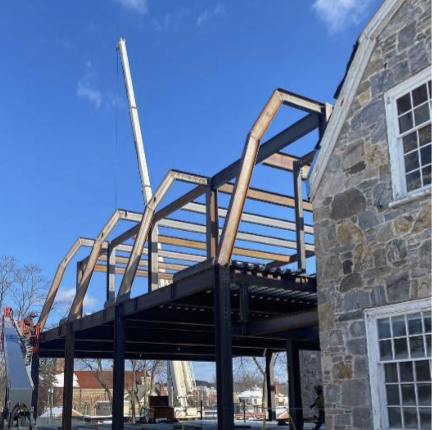
Jones Library addition under construction, February, 2026. Photo: amherstma.gov
The following letter was sent to the Amherst Town Council on April 2, 2026.
There are three primary reasons the Amherst Town Council should not authorize the requested Community Preservation Act (CPA) funds for the Jones Library building project, each of which stands on its own as sufficient cause to vote against the request.
- This project is ineligible for CPA funds by violating the Secretary of the Interior’s Standards for Historic Preservation and by attempting to supplant existing funding.
- Authorizing the use of Amherst CPA dollars would violate the verbal and written promises made by both town and library leaders against further commitments of town dollars to this project.
- This funding should be directed to other projects.
During its deliberations, the Amherst CPA Committee (CPAC) did not adequately investigate concerns raised about the project’s eligibility and declined to address the limitations on town contributions. It is, therefore, up to this Town Council to honor its own pledges, abide by the rules of the CPA, and vote against authorization of these funds.
Secretary of the Interior’s Standards Remain Violated, Prohibiting the Use of CPA funds for the Jones Building Project
The CPA prohibits funding of historical preservation projects that are not in compliance with the Secretary of the Interior’s Standards for the Treatment of Historic Properties. Had the CPAC consulted the information provided by the Community Preservation Coalition, they would have learned that:
“with respect to historic resources, ‘rehabilitation’ shall comply with the Standards for Rehabilitation stated in the United States Secretary of the Interior’s Standards for the Treatment of Historic Properties codified in 36 C.F.R. Part 68” (Text of CPA Legislation | Community Preservation Coalition)
The language here is clear and unequivocal: projects shall comply with the Standards. The Massachusetts Historic Commission (MHC) conducted a thorough assessment of the building project with respect to these Standards because Massachusetts Rehabilitation Tax Credit was sought for this project. This Tax Credit was rejected repeatedly precisely because it violates five of the ten Standards.
“Regrettably, the MHC is unable to assign second certification (830 CMR 68.38B.1(4)(b)) and allocate credit to your project (830 CMR 63.38R.1(3)(c) at this time because the proposed project does not meet the Secretary of the Interior’s Standards for the Rehabilitation of Historic Properties (830 CMR 63.38R.1(5)(b) and (f)) as presented.”
The findings of the MHC are instructional and incontrovertible.
“Two sets of historic wood stairs in the original 1928 building are proposed to be removed, changing the circulation of the historic 1928 building. Additionally, other floor plan modifications will be made, causing the removal and loss of historic fabric. The reconfiguration of the historic 1928 building circulation patterns and the removal and loss of historic fabric does not meet the Standards (Standards 2 and 5).”
The referenced Standards are as follows:
2 “The historic character of a property will be retained and preserved. The removal of distinctive materials or alteration of features, spaces, and spatial relationships that characterize a property will be avoided.”
5 “Distinctive materials, features, finishes, and construction techniques or examples of craftsmanship that characterize a property will be preserved.”
(bold mine – approximately 20% of the original Philippine Mahogany has already been removed and the spatial relationships that characterized this property have been eliminated)
The assessment of the MHC is a crystal clear determination by the most authoritative state source on historic preservation that this project did and does violate the Standards. One need not rely, as did the CPAC, on the opinion of the applicant, a member of the project’s Capital Campaign, that these standards are mere suggestions.
Further, the project team conflates the results of the Section 106 process with the CPA requirements with respect to the Standards. The Section 106 process occurred precisely because the project violates the Standards causing adverse effect on the historic Jones Library. The MOA that emerged included stipulations as “mitigation measures for the adverse effects” (MHC 1.7.25), but the violations remain, including the removal of distinctive features, alteration of features, spaces, and spatial relationships that characterize this property. Additionally, the Section 106 process was conducted to address the viability of two federal grants (NEH and HUD) that are governed by 36 CFR 800:
“(a) Purposes of the section 106 process. Section 106 of the National Historic Preservation Act requires Federal agencies to take into account the effects of their undertakings on historic properties and afford the Council a reasonable opportunity to comment on such undertakings. The procedures in this part define how Federal agencies meet these statutory responsibilities.”
This is distinct from the rules governing CPA funding and state regulations.
Importantly, even with the mitigation measures included in the Section 106 MOA, the project still violates the Standards with respect to both the items included in the CPA application and the project as a whole. As noted above, a great deal of historic fabric and the original building circulation patterns are already gone. Standards 2 and 5 are already violated and this cannot be undone. The project team was aware of these issues, but decided to proceed because if they had altered their plan to comport with the Standards, they risked losing the funding from the Massachusetts Board of Library Commissioners (MBLC) as documented in communications from that agency:
“It has come to my attention that existing interior walls and conditions within the Jones Library in Amherst have been flagged to remain to retain historic elements of the building. As the Library Building Specialist for this project project, I can unequivocally state that such retention will seriously alter the functional integrity of the building and jeopardize State funding, as no other reductions to programmatic space are allowed.” – Andrea Bono-Bunker, February 8, 2023
“I have reviewed the comments of the Massachusetts Historical Commission (MHC) regarding the proposed Jones Library project in their letter dated November 22, 2023 and understand that there are ongoing concerns regarding the elimination of certain existing interior walls and conditions within the building. As the Library Building Consultant for this project, I can unequivocally state that retention of these elements will seriously alter the functional integrity of the building and jeopardize State funding, as no other reductions to programmatic space are allowed.” – Andrea Bono-Bunker, January 24, 2024
The project leaders made the decision to abandon adherence to historic preservation standards in order to secure the state funding. Whatever one thinks about that decision, it had the consequence of making this project ineligible for both Massachusetts Rehabilitation Tax Credit and for CPA funding as these funding sources adhere strictly to compliance with the Standards. One cannot have it both ways.
CPA Funds Are Not to Be Used to Supplant Previous Funding
The CPA prohibits allocating CPA funds to projects that have already been fully funded and budgeted. The $46.1 million library project budget was authorized by the Town Council on December 18, 2023 and it has not changed since that time. The modifications to the project subsequent to the Section 106 process and MOU did not alter the amount of the construction contract (all items in the application are included in the contract and budget) and the project team continues to insist that the total project cost will not be exceeded.
The law firm that answers to the Town Manager may have offered an opinion that this prohibition is not applicable, but it is nothing more than that – an opinion, and one which is not necessarily shared by other legal minds. The guidance of the MA Department of Local Revenue, Division of Local Services clearly prohibits the authorization of CPA funds at this point in the project.
“Once a community authorizes a borrowing with another financing source for debt service, it cannot amend or change the financing source to a community preservation fund financing source. This is prohibited under the “non-supplanting” provision of the CPA. G.L. c. 44B, § 6.”
We Were Promised that No More Town Money Would Go Toward This Project
When the Town Council was asked to authorize an additional $9 million in the fall of 2023, it was assured that the town would not pay one penny more. This was even memorialized in the second amended MOU with the Library:
“The Library also understands that the town will not pay more than its Town Share committed by this agreement and the previous Agreements.”
When the Town Council reconsidered its decision to proceed with the project in the spring of 2025, promises were again made in a memorandum from the Town Manager:
“The Library Trustees have committed to raising the remainder through federal and state grants and private fundraising.”
There is no denying that Amherst CPA funds are town money, the overwhelming source being a surcharge on Amherst property owners. This is neither state money nor private fundraising, and if the Town Council votes to spend more Amherst tax dollars on this project, it will do so without the consent of the people of Amherst.
The Funding Can/Should Be Reallocated Toward Other Projects
When the CPAC ranked all the applications for this year, the Jones building project was second from the bottom, earning an average score of 2.6 (on a 1-5 scale) with the majority of votes cast being the lowest possible (1s and 2s). It defies justification, then, that it was recommended for the second highest amount of CPA funds (excluding the $1.5 million debt for the War Memorial Bathhouse). The $477,000 recommended by the CPAC for the library building project can and should be redirected to other projects. If the Town Council does not authorize it for the Jones project, that money will remain in the CPA budget and the CPAC can recommend it for another use at any point. It could fund the pickleball project that has been trying to get off the ground for many years and may whither and die if not funded this year. It could decrease the debt service for the bathhouse, saving significant money in interest. It could earn interest over the next year and be put toward some other worthy project in the future.
The Town Council’s Authorization Decision Has No Bearing on the Completion of the Project
The Jones Library building project is obviously already happening and will continue. The items in the CPA application will be completed regardless of this vote. How you or anyone else feels about the project is immaterial.
The only relevant question for the Town Council to address is whether the commitment of Amherst CPA funds is compatible with regulations and with promises made by this body. Voting against this authorization simply allows you to keep your word and allow nearly half million dollars to be put to different uses in town.
Sincerely,
Maria Kopicki
Maria Kopicki is a resident of Amherst’s District 5