
It’s Not Too Late to Save Hampshire College. Here’s Why
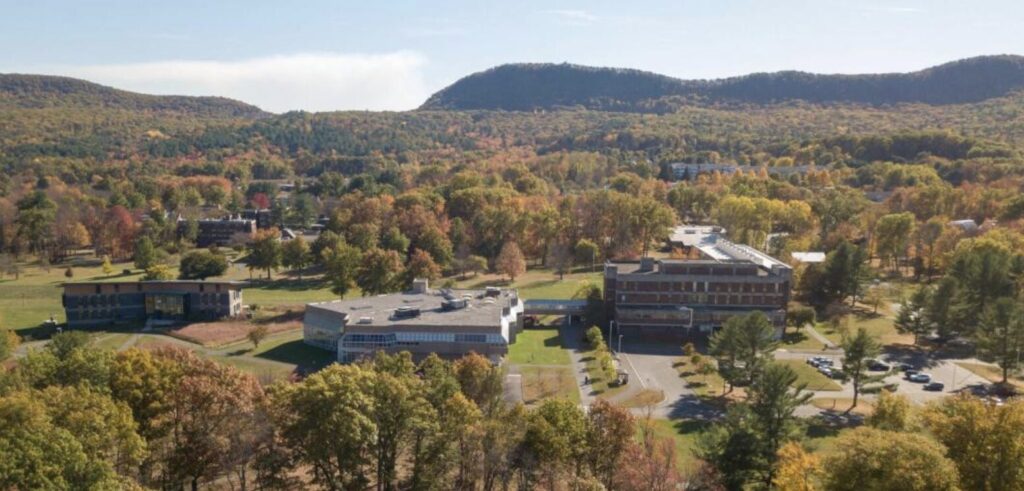
Hampshire College. Photo: hampshire.edu
Hampshire College is facing problems in part because sensationalist news articles paint an erroneously hopeless picture. Unfortunately, a highly influential Boston Globe article originally titled, “Dying, Sputtering” fits into that category. Hampshire’s accreditor, The New England Commission on Higher Education (NECHE), has its home office in Boston, and the Globe is a prominent publication that likely gets its attention.
NECHE has been closely monitoring Hampshire’s finances and turnaround plan for years, but less than a month after the Globe article, NECHE announced at their annual review of Hampshire in June that the college must show cause, meaning that it’s possible that Hampshire could be put on probation or lose accreditation because of insufficient institutional resources.
However, the good news for Hampshire and its stakeholders is that the Globe didn’t present the full picture. The more progress that can be shown by June, the better chance of avoiding probation, so this article will delve into solutions that can stave off the immediate crisis and create a sustainable recovery:
- Alumni can increase donations to retain accreditation, as Guilford College recently did.
- Alumni and the Five College Consortium can invest in Hampshire’s bonds.
- Hampshire can improve marketing and repeal the cuts of admissions staff to restore enrollment over time.
- Hampshire can revive the sale of the college’s land behind Atkins Farms Country Market. The land sale was paused when the developer withdrew after they failed to get necessary permissions from the Conservation Commission because of their inability to produce a design that complied with the town’s Wetlands Bylaw. Hampshire can quickly assemble an all-star committee of alumni experienced in housing, real estate, and ecology to work with the community and town committees and find an excellent developer.
I went back to Michael Horn and Larry Ladd, two higher education experts who were briefly quoted in the Globe piece. They see Hampshire’s value to the higher education ecosystem, but they have serious concerns about enrollment declines, the endowment, and other issues. It turns out that their views on Hampshire are actually more nuanced than the selective sound bite quotes in the original article.
Enrollment Issues
Larry Ladd, a former Harvard administrator and former Grant Thornton consultant, now works for the Association of Governing Boards of Universities and Colleges. Ladd told me that many of his past clients had financial problems like Hampshire. “Some of those closed, and many of them did not close because it’s not all about the numbers,” he said. Other factors, such as leadership quality and stakeholder organizing, can also play a role.
Ladd feels more emotionally connected with Hampshire than with other colleges. He first visited in the 1970s, when he was a student in an alternative program at the University of Massachusetts Amherst called Project 10. Ladd points out that location is a big advantage. “They are there in the Five College area. What a great place to be, as most of these colleges that have closed are isolated.” Setting and culture made a difference when his daughter looked at Hampshire and later enrolled. “She looked around and said, ‘These are my people.’ Great. And that magic has to happen with just enough people to fill that class every year.”
While fundraising has increased in the last year, and the college has continued to make budget cuts, other factors need to change to balance the budget.
I asked Ladd what it would take for him to adjust his take on Hampshire’s prognosis: “A change in the first year enrollment… enrollment begins to pick up. That’s it. That’s the whole ball of wax.”
In the next sections, I will discuss how Hampshire can turn around its marketing and enrollment.
Marketing Issues
Michael Horn is a higher education futurist, co-host of FutureU Podcast, and co-founder of Clayton Christenson Institute. “The mission that they have is fundamentally a nice one to have in the higher education tapestry…the fact that it differentiates itself, to me, is a good thing,” he said.
I wrote in: “To Succeed, Hampshire Must Get a Lot Weirder”, a variety of ways that Hampshire can extrapolate from its history of innovation and collaboration to further promote its distinctiveness by highlighting its innovative use of educational collaborations and using marketing that is simple, bold, and polarizing.
Ladd and Horn agree that most people attend colleges near them, but Hampshire could do better at reaching people who live farther away. Ladd states that Hampshire has, “A niche that they can take advantage of” because of its location, community, and unique program.
Michael Horn describes some alignment between Hampshire’s offerings and what students are facing today, but suggests that the college could explain it better: “This is what a Hampshire student can expect from their experience, why it’s valuable, why it’s exciting for you, and put it in the language of a high school student. I don’t get the sense that they have adequately nailed that in the reinvention…the young people I talk to, I find them incredibly impressive, but I also think they’re sort of looking for meaning in many cases and trying to figure it out.”
“If you put yourself in their shoes, AI is here. You’re hearing a constant drumbeat of: ‘It’s going to destroy the working world. It’s going to change everything. What does that mean for me? What am I going to do? How do I plug in? How do I contribute?’ I think these are some of the big questions that they’re asking. And I think a lot of what I understand of Hampshire’s design is actually, well-positioned to answer a lot of those questions.” Hampshire College had the first undergraduate cognitive science program (1972), and Hampshire graduates include Gary Marcus, a leader in the study of the ethical implications of AI. Hampshire has always been ahead of the curve and a thought leader, influential in several industries and fields.
Enrollment Pivot
Hampshire had a 79% increase in enrollment from 2021 to 2024, and its 2025 enrollment downturn is reversible. In: “Thrive or Perish: Transforming Admissions Will Dictate Whether Hampshire College Prospers”, I explain how staffing reductions played a big role in the 2025 enrollment downturn. In: “Hampshire College’s Enrollment Dilemma is a Solvable Problem”, I describe how that was compounded by a flawed implementation of direct admissions. Here are powerful steps Hampshire could take right now:
- Rehire staff. Staff reductions in admissions simply don’t work, as I’ve written about in the articles mentioned above.
- Launch an “institutional application” (an enrollment application hosted on Hampshire College’s website). Students who choose to apply this way would be putting in a little more effort than those who use the Common Application (a single website for applying to multiple colleges). This would provide Hampshire with additional insight into which students are most interested, enabling more effective outreach.
Not Too Late: Hampshire Can Refinance
Hampshire’s auditor warned about bonds that Hampshire hasn’t been able to refinance. However, the banks have continued to give extensions, Hampshire has continued to make payments, and Hampshire received $4.5 million in new financing, which shows some investor confidence and ostensibly gives Hampshire more cash on hand to extend its runway while it fixes enrollment issues. I’ve written about how the five colleges can refinance the bonds while enhancing the consortium, or how alumni could do it.
“It’s not too late to save Hampshire College” consists of two letters published by the Globe in response to their recent article. The first letter is from four college presidents explaining Hampshire’s importance to the consortium and higher education nationally.
Five College Consortium
Warren Gorlick is a Hampshire alum, former trustee of the college, and former Deputy Director of the U.S. Treasury. He responded with a letter published in the Globe with “Instead of boosterism, Hampshire could use a fiscal boost”. Along similar lines, I explain how the Five College Consortium members could refinance Hampshire’s debt (not a gift) and launch a Future of Higher Education Center.
Bequests
In his MassLive article, “Here are ways to forge a sustainable future for Hampshire College”, Gorlick suggests increasing the endowment by leveraging alumni volunteers’ expertise in planned giving. One of his key points is that Hampshire needs enrollment increases to rebuild confidence and unlock the generational wealth that would otherwise finally come to Hampshire.
Interest on the endowment eventually helps enrollment by subsidizing tuition. Gorlick explains that, “Over the long term, Hampshire’s endowment is likely to grow, as significant giving often comes later in alumni lives or through bequests. Hampshire’s first class entered in 1970, so its alumni base is still relatively young, but with the oldest now in their seventies, bequests and major gifts should increase in the coming years.”
Conclusion
Though I’m suggesting steps to avoid being put on probation, some colleges can even recover from that. Last year, I wrote about a possible turnaround for Guilford College, and by the end of the year, probation was lifted. Guilford launched a fundraising campaign to retain accreditation; they raised $5 million by the end of June last year and millions more by the end of the calendar year. Hampshire should do the same, launching a campaign to raise $5 million by June 30 (the end of this fiscal year and around the time of NECHE’s meeting).
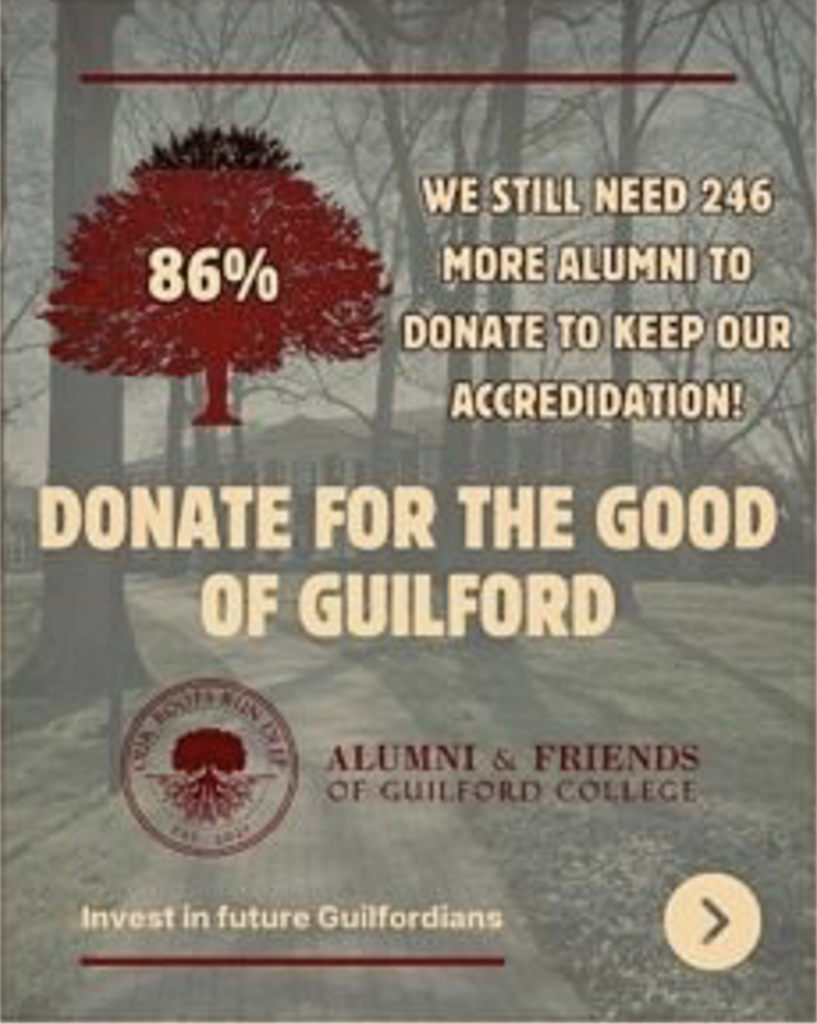
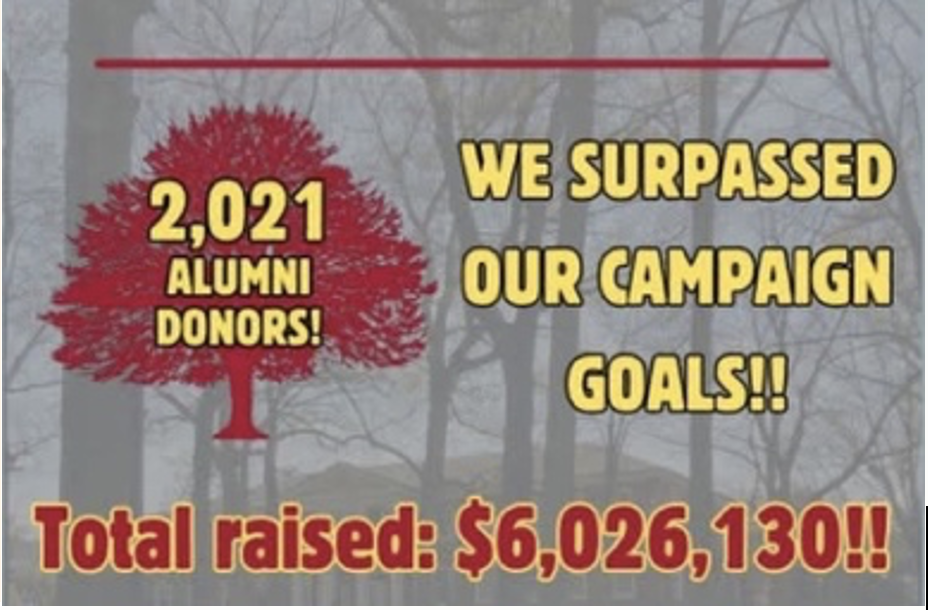
This campaign could restore confidence in two ways. The campaign should be explicitly designed to help balance the budget this fiscal year with less reliance on unusual endowment draws and repeal the cut to admissions staffing levels that led to the enrollment downturn. The college must take a leap of faith: commit to rebuilding admissions staffing levels – and unlock the greater level of giving that will engender plus revenue from future students. Hampshire has already proven that it can maintain an upward enrollment trajectory with its previous staffing level, but it declines without that staffing level.
As the Globe reported, Hampshire’s deadline for its current capital campaign has been pushed back by years. Some alumni who didn’t realize that the fundraising had been for operational funds were surprised by the NECHE announcement and by the decline in Hampshire’s endowment.
If launched, a fresh fundraising plan like this one would clarify the urgency and energize alumni to develop novel fundraising approaches, as was done successfully in 2019. It will also give a confidence boost to prospective students and families, interest the media in positive stories, and restore NECHE’s confidence in Hampshire’s recovery plan.
Take the Survey and Share Your Thoughts
A group of parents and alumni has been discussing Hampshire’s enrollment issues and may roll out working groups soon. We would welcome your input to further organize and amplify the voices of stakeholders in the service of volunteering for Hampshire College.
Please fill out our survey.
Jonathon Podolskyis a Hampshire alum, higher education journalist, and Boardsource Certified Non-Profit Board Consultant. More at www.Podolsky.cc