
UMass Professional Staff Union Protests Low Wages and Stalled Contract Negotiations in Leadup To No Confidence Vote in Chancellor Reyes
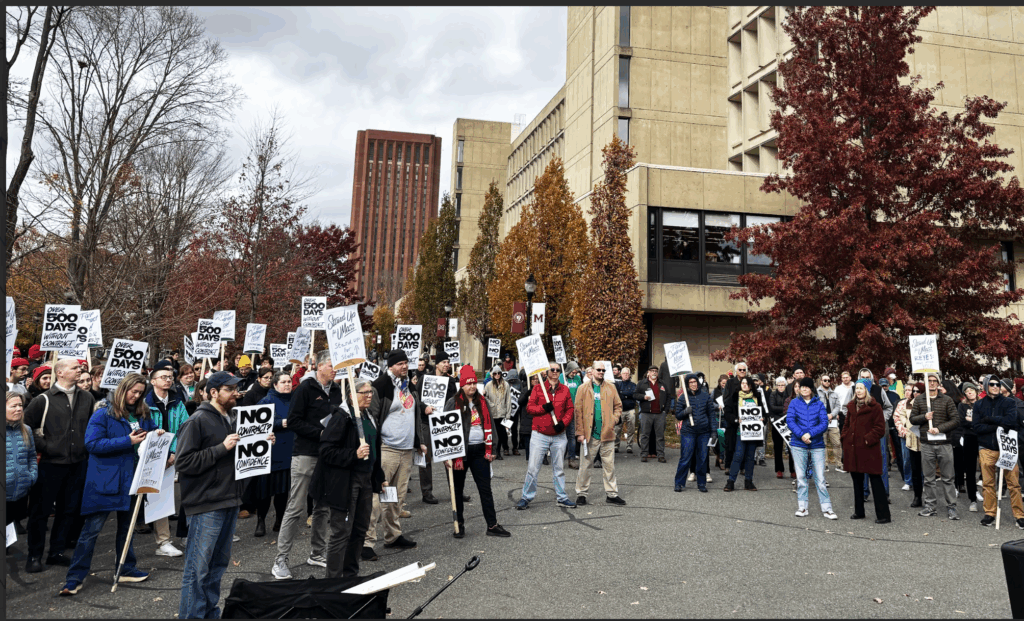
Professional Staff Union members and campus allies rallied at the Whitmore Administration Building at UMass on November 13 to protest lack of progress in contract negotiations. Photo: UMass Professional Staff Union
Source: UMass Professional Staff Union
It has been 500 days since staff members represented by the Professional Staff Union (PSU) at UMass Amherst and UMass Boston saw their last contract expire. On Thursday, November 13, protesting staff were joined by faculty and students at the No Contract, No Confidence Rally, which drew 300 participants. Staff rallied to demand that UMass Amherst’s Chancellor Javier Reyes, who is directing the university’s bargaining team, settle the contract, which has kept PSU’s 2400 members, including over 1600 members at UMass Amherst, from seeing the cost of living adjustments that have helped almost every other state worker in Massachusetts meet rising inflation.
The air around UMass’s Whitmore Hall, home to the university’s top administrators, reverberated with chants of “No contact? No confidence!” and “Reyes, Reyes, whaddya know? Fair contract or you gotta go!”
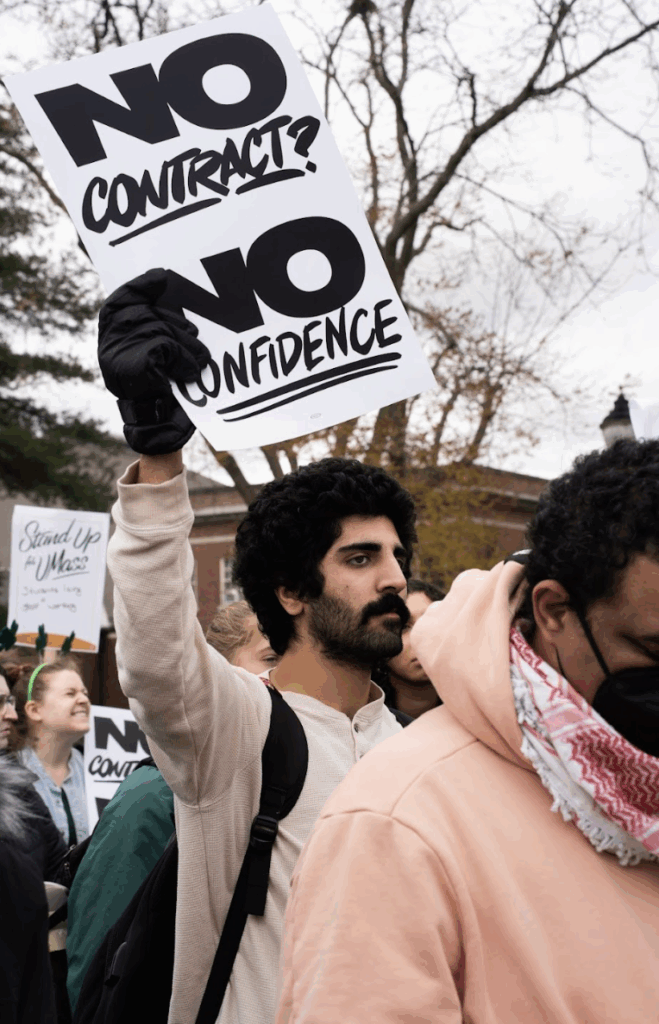
PSU’s chapter board, which is the union’s governing body passed a vote of no confidence in Chancellor Reyes’s leadership on Friday, November 7, noting in a list of grievances that “we believe that it is our collective responsibility to protect our students and our educational institution from further harm by detailing Reyes’s failings and calling for a member-wide vote of no confidence.”
The full membership will take a vote of no confidence on December 3 – 4.
At issue is the seventeen-month-long contract negotiation between the UMass administration and the campus’s largest staff union, and while the UMass administration’s bargaining team has shown some tentative willingness to negotiate, progress has been fraught with bad-faith bargaining—PSU has even had to file three charges with the Department of Labor Relations (DLR) against Reyes’ team.
Recently, Reyes instructed his bargainers to trigger their nuclear option by declaring impasse, a tool that management can use to circumvent bargaining and unilaterally impose the demands that they couldn’t otherwise win. If the DLR agrees with management that negotiations are at an impasse, management could potentially impose their terms unilaterally, depriving employees of their right to bargain, negotiate, or even vote on and approve management’s package of demands.
“Impasse has rarely been used by UMass’s bargaining teams in past negotiations,” says Nellie Taylor, PSU’s co-chair, “but it has become Chancellor Reyes’s favorite tool for breaking union bargaining efforts. The clerical and administrative staff union, the graduate workers union, the faculty and librarians union, and even the police union have all been threatened with impasse over the past two years.”
Why has Reyes dug in his heels?
“He wants to convert our cost-of-living adjustments (COLA), which we negotiate directly with and are guaranteed by the governor, into merit pay,” says Andrew Gorry, PSU’s other co-chair.
The sole purpose of COLA is to keep state employees’ salaries in line with inflation. It’s not a raise. “And yet,” says Gorry, “Chancellor Reyes is directing UMass’s bargaining team to replace one of PSU’s COLA with so-called ‘merit pay’: a system that could cut many members’ COLA effectively in half and allow a select few favorites to receive significantly more. This is a wage inequality proposal.”
Because there is a fixed COLA sum, for every employee who receives a raise above the COLA rate under “merit pay,” several employees will have their COLA cut. “We already have too many employees facing food insecurity, have trouble affording rent or a mortgage, are delaying medical care, and need to work second or third jobs on top of our full-time UMass jobs,” says Gorry.
In his short tenure at UMass Amherst, Reyes has succeeded in uniting the entire campus against his leadership. Graduate students, undergrads, and faculty all passed votes of no confidence following his disastrous handling of student protests in May, 2024, which resulted in 134 arrests and cost Massachusetts’s taxpayers more than $100,000.
“UMass itself knows that it cannot attract enough staff to keep the university running smoothly in its mission of supporting the education, health and well-being of its students,” says Taylor, “and yet Chancellor Reyes will bring home more than $750,000 this year and lives rent free in a taxpayer-subsidized mansion on campus. We call on him to settle a fair contract immediately.”