
Public Shows Interest in Creating East Amherst Historic District
Photo: amherstma.gov
Report on the Public Hearing of the Local Historic District Committee, January 12, 2026
This meeting was held over Zoom and was recorded.
Present
Nancy Ratner (Chair), Steve Bloom, Bruce Coldham, Nicole Miller, and Greta Wilcox
Staff: Walker Powell (Planner)
The Local Historic District Commission (LHDC) and public attendees heard a presentation by historic preservation consultant Chris Skelly at their January 12 public hearing about the benefits of creating Amherst’s third local historic district in East Amherst and also his efforts to develop a set of design guidelines for all three local historic districts. Members of the public attending expressed interest in creating the new district and wondered whether homeowners would be eligible for aid to maintain their historic structures.
Amherst’s other two local historic districts are the Sunset-Fearing Local Historic District and the Dickinson Local Historic District. Skelly noted that East Amherst has been on the National Register of Historic Places since 1986, but that is primarily an honorary designation through the National Park Service and is not very effective in protecting historic resources. Local Historic Districts, on the other hand, which are established through local governments, are effective because they review proposed alterations to the exterior of protected properties as well as assuring that new structures in the district are compatible. He stressed that the reviews only apply to changes visible from the public way and do not affect work on the interior of the buildings. Also, landscaping, routine maintenance, HVAC systems, and other changes are not subject to review.
LHDC Chair Nancy Ratner stated, “The purpose of the LHDC is to aid property owners and the town in preserving and protecting the distinctive characteristics and architecture of buildings and places significant in the history of Amherst.”
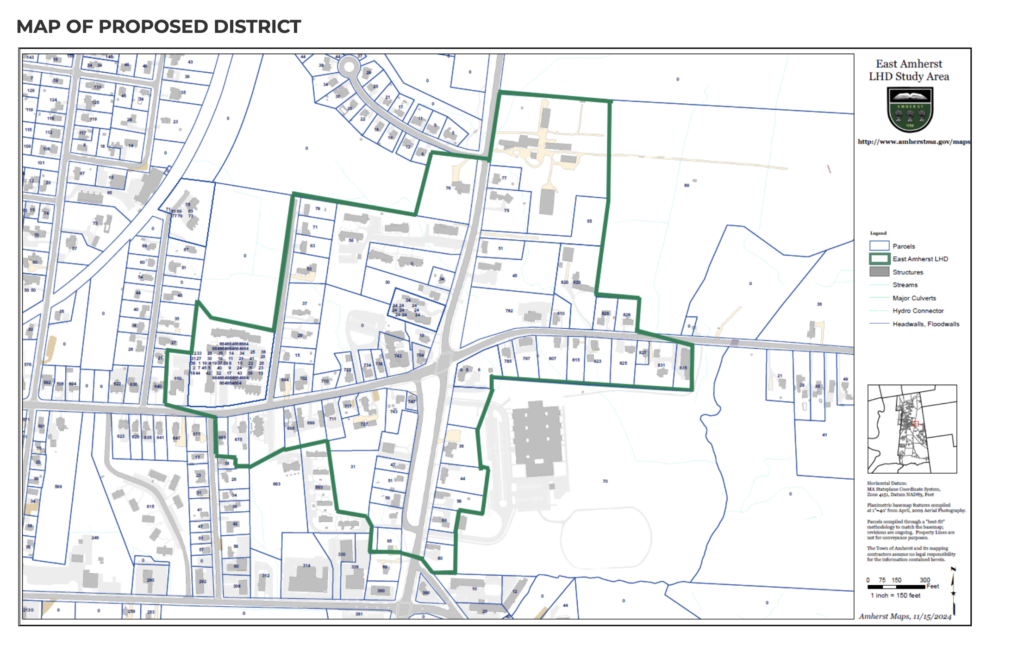
Skelly’s East Amherst study reviewed about 50 structures of historic importance in Amherst. He reviewed old maps, deeds, city directories, and archives in the Jones Library’s special collections to develop updated descriptions of each property. His work noted that East Amherst “contains many very early intact properties that do an amazing job of telling the early history of Amherst and its growth and development over time.”
He stated that the buildings in East Amherst reflect the commerce, occupations, and industries that took place in the 18th, 19th and 20th centuries. Many, such as the Noah Dickinson house at 743 Main Street, the Daniel Kellogg house at 76 North East Street, and the Baggs Tavern at 6 South East Street date from the earliest settlement of the town. In fact, East Amherst was the town’s institutional and residential hub prior to the coming of the railroad in the mid-1800’s.
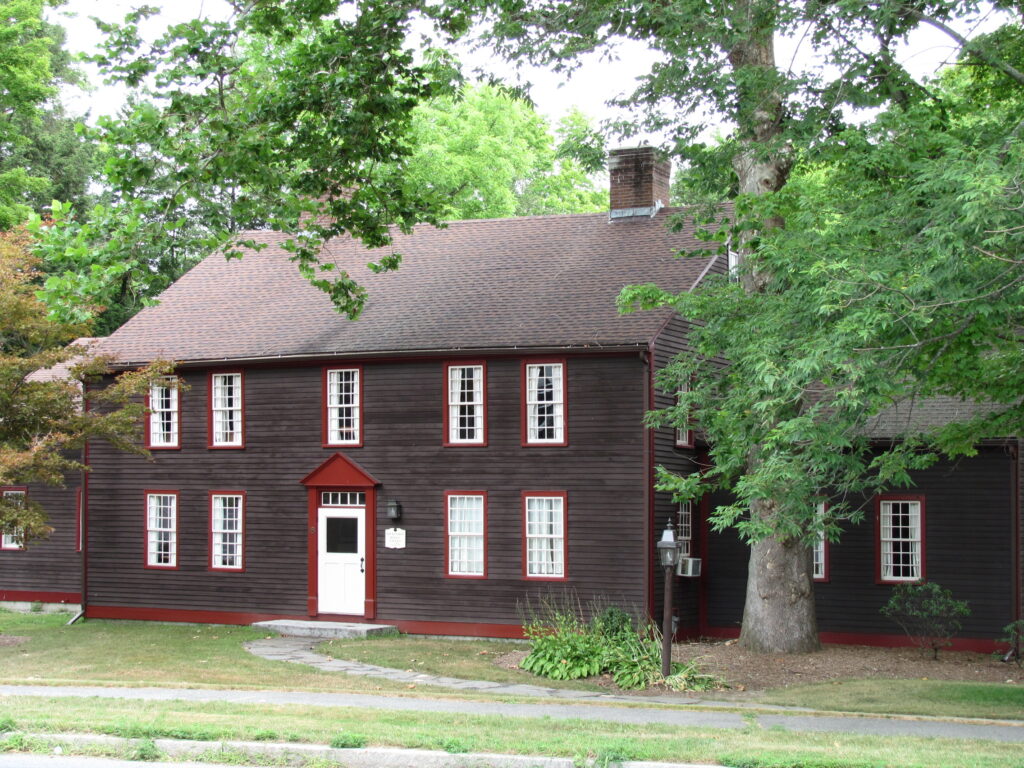
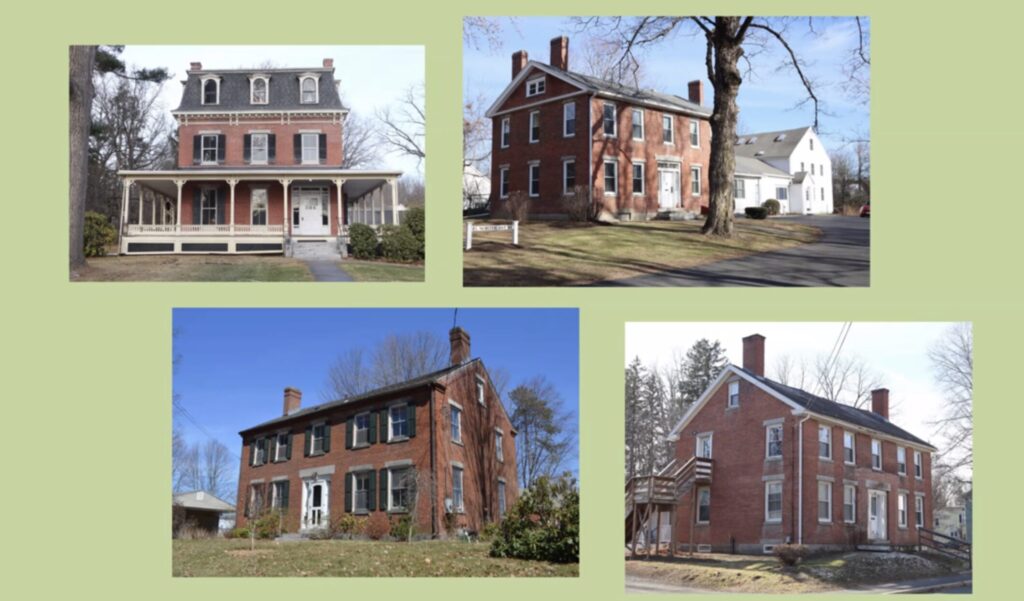
Ithamar Conkey-Stevens House (1840), 664 Main Street, H. Kellogg House (ca. 1840), 45 North East Street, James Kellogg House (1836), 807 Main Street, Rev. Charles Woodworth Hourse (ca. 1850), 75 Northeast Street. Photos: amherstma.gov
Attendee Lyle Denit asked whether property owners would be required to keep their properties up, or whether they would be allowed to degrade to the point that they were no longer salvageable. LHDC member Steve Bloom said that, unlike most towns in Massachusetts, Amherst does not have a “Demolition by Neglect” bylaw, which prohibits and penalizes those who do not keep up their properties. He added that he had worked on such a bylaw when he was on the Amherst Historic Commission and that, if implemented, it would apply to all properties, not just those in a local historic district.
Bloom pointed to the commission’s decision on a property at 68 McClellan Street which was deemed to be unsalvageable and was replaced with a new structure in a style compatible with the neighborhood. The replacement structure is a student rental, “so you know we’re not opposed to student housing. Also, this property is going to put up an accessory dwelling unit, which is allowed by right. So the LHDC is not anti-development, it’s pro-preservation,” he said.
Andrew Desiervo said he has owned the rental property at 10-12 North East Street since 2013. When he purchased it, it had been a rental for at least 70 years and had been poorly maintained with “the cheapest fix possible for several generations.” He stated that this area is not an affluent neighborhood; it has many rentals and that if “you want to have owners that really care about them as historical structures, not just as investment properties, I’m concerned about making that process of bringing them up to speed a whole lot more onerous.” He noted that he has spent more on upgrades to his property than he did on the purchase itself and learned too late of state loan programs for historic properties that don’t require repayment until the property is sold. He recommended that information about these programs be included on the LHDC website.
LHDC members Bruce Coldham and Nicole Miller stated that the commission makes recommendations on proposed alterations to best preserve the historic character of the district. Bloom also pointed out that the commission could issue a “Certificate of Hardship” when “construction or alteration is deemed not appropriate, yet the commission has determined that denial of a certificate will constitute a hardship, financial or otherwise, on the property owner.” Also, historic properties are eligible to apply for Community Preservation Act funds to aid in repairs, as the Jewish Community of Amherst and the Conklin House have done in the past.
Attendee Janet McGowan expressed her support for creating the local historic district, saying, “East Amherst is filled with interesting buildings. Historic buildings and neighborhoods create a sense of place that people want to live in and visit. The old buildings and neighborhoods tell a story of how they have changed in use over time, and when you lose the buildings, you lose the stories.”
A draft of the proposed East Amherst Local Historic District has been submitted to the Massachusetts Historic Commission (MHC) and has received preliminary support. The proposal must eventually be approved by the Town Council. Planner Walker Powell will compile public and MHC feedback to prepare a report for the council.
Design Guidelines for Local Historic Districts in Progress
Another project Skelly has been hired to work on for the town is developing design guidelines for local historic districts. He is basing the guidelines on work he has done for other municipalities, such as Fairfield, Connecticut. He stated that the guidelines would “provide a clear explanation of the process and of what is likely to be approved by the local historic district commission and what is not likely to be approved to make that process a lot more transparent” for property owners, contractors, commissioners, and town staff. “Every decision of the LHDC should go back to those design guidelines to base decisions on,” he said, adding that design guidelines are common throughout the country and have been for decades.
Skelly said the guidelines would open with an introduction to what a local historic district is, when Amherst’s districts were established, and the architectural styles and character-defining features that make them special. Then, there will be a section on the design review process and the certificates of appropriateness and hardship that the LHDC can issue, as well as what is reviewed and what is exempt, such as maintenance, or items not visible from the public way.
The design guidelines will be listed in alphabetical order for easy reference, starting with accessibility and architectural barriers, and including additions, alternative materials, art installations, awnings, chimneys, cornices, decks, demolition, doors, dormers, driveways, fences, foundations, gutters, etc. For instance, the guidelines recommend repair of windows whenever possible, and specify that if “you are going to replace a window, the window should still be the same size, that the trim should still be there, and that other ornamentation around the window should not be removed.” Also, if a window is added, it is best if it is not on the façade.
Skelly is looking for input from the LHDC and property owners as to what they would like included in the guidelines. When ready, a draft of the proposed guidelines will be made public for comments.
The next meeting of the LHDC is scheduled for February 2 at 3 p.m. on Zoom.