
Hampshire College’s Enrollment Dilemma is a Solvable Problem
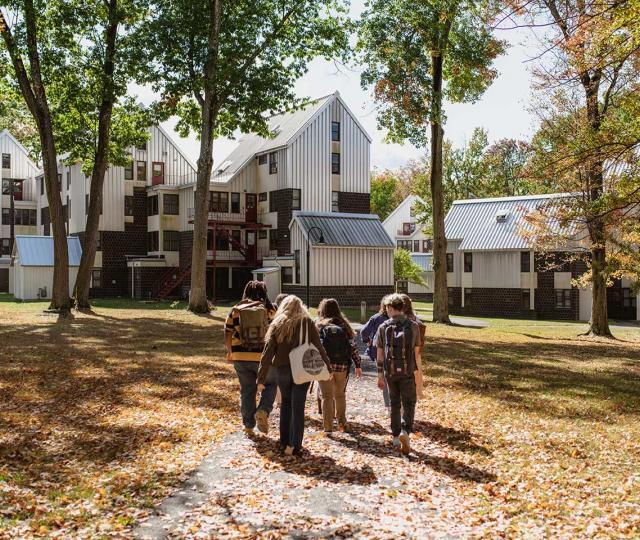
Photo: hampshire.edu
Hampshire College enrollment declined from 844 to 750 students (an 11% decrease) in Fall 2025, despite a 79% increase from 2021 to 2024. Hampshire missed its admission goal for that year by nearly half, enrolling only 168 students instead of the expected 300. What happened and why is this a solvable problem?
A recent article on Hampshire’s enrollment crisis in The Chronicle of Higher Education missed some key aspects of why enrollment suddenly declined and how it can be turned around. The Chronicle article included responses by Hampshire’s president, Jennifer Chrisler, pointing to factors affecting enrollment at various colleges and how Hampshire has implemented direct admissions in response to enrollment challenges.. Direct admissions is when a college, rather than waiting for students to learn about it and then apply, reaches out to students and proactively accepts them.
As costs and market pressures on liberal arts colleges increase, competition to attract new students has intensified. Colleges are responding with new tactics. One of the most tempting is direct admissions, due to its potential impact on application volume, but the reality of its impacts on the student recruitment process paints a more complicated picture.
The situation at Hampshire College dramatically illustrates this point: it missed its goal for incoming students by almost half after reducing admissions staffing, implementing direct admissions, and making other changes.
Recent articles in the Boston Globe and other publications have cited Hampshire’s enrollment decline and a warning issued by Hampshire’s auditor. But they left out some information on what’s solvable about the enrollment situation, which in turn would help the college’s finances. The Globe recently published a pair of letters in support of Hampshire titled: “It’s not too late to save Hampshire College.” One of the letters was by the other four college presidents of the Five College Consortium, citing Hampshire’s essential role in academic innovation locally and nationally. I’ll be writing another article for Indy soon about Hampshire’s potential that the media missed, but first, let’s focus on enrollment, because in my view, that’s the biggest lever for saving the college right now.
Hampshire Admissions History
My previous article in the Indy, Thrive or Perish: Transforming Admissions Will Dictate Whether Hampshire College Prospers, explained that Hampshire’s enrollment has been severely impacted three times since 2012 by questionable decisions, most recently:
- 2019: Laid off the admissions department.
- 2024: Eliminated ⅓ of the counselor positions. Admissions was folded into another department, and further counselor departures occurred.
Direct admissions, combined with staffing and other changes in 2024, were the main causes of the 2025 enrollment decrease. How did this happen, and how can it be turned around?
My Indy article included a statement from the college admitting that the staffing changes were part of the enrollment problem. The article cited a survey of colleges showing that only a small percentage of those that reduced admissions staff increased enrollment, and included a statement to me from the head of the National Association for College Admissions Counseling on the relationship between staff and enrollment.
President Chrisler told the Chronicle of Higher Education that the college realized it made a mistake by not monitoring the regular admissions and direct admissions streams separately, and that it is making other micro-operational adjustments. The next two sections show the interplay between staffing levels and the implementation of direct admissions.
Staff Reductions
Hampshire has been in financial recovery since 2019. A previous administration declined to admit an incoming class while pursuing a merger, but the community successfully pushed back, administrative leaders were replaced, and this iconic alternative college committed to remaining independent.
Staffing cuts were deemed necessary to close the budget deficit in the summer of 2024, but several publications writing about the crisis didn’t specify that this included admissions staff and therefore missed the interplay between that and a troubled implementation of direct admissions.
While it stopped short of a full merger in 2019, Hampshire has outsourced certain functions and departments, such as payroll and IT. Despite adding technology to compensate for staff reductions, the need to invest in the relationship side of admissions never goes away.
According to Caolon MacMahon, former college professor and parent of an incoming Hampshire student, her daughter, “Heard pretty much nothing from admissions since acceptance. Meanwhile, she is deluged with mailings from other schools. Admissions is the first experience that a student really has. I left a message with her admissions counselor weeks ago concerning some questions I had about admitted student dates, and some other things, and never heard back. For some, that can be off-putting.”
A well-staffed admissions department is especially critical for a college like this, which has a very unique program: written evaluations instead of grades, learning collaboratives instead of departments, and three levels culminating in a capstone project rather than a major. It’s located in the center of the Five College Consortium and is listed in Colleges that Change Lives.
What is Direct Admissions?
Hampshire implemented direct admissions in the last enrollment cycle. It’s unclear whether the possibility of implement direct admissions factored into the college’s decision to include admissions as part of its staff reduction in 2024 or whether implement direct admissions simply seemed to be an economically efficient way to increase applicant volume once staff size had already been reduced, as a way to punch above its weight. Hampshire utilized Common App, Appily Match, and the Coalition for College Access as platforms to offer direct admissions. The direct admissions were counted towards the enrollment application total.
I spoke with Teege Mettille, author of The Admissions Counselor Malaise, co-author of The Signal Solution, who was Director of Admissions at the former Northland College. He told me that, “You have to recognize these are students that came in because the friction was eliminated, and that means there are some students for whom the slightest bit of friction would’ve held them back.”
Possible Increased Costs at First
Direct Admissions may cost more initially due to training, marketing, and other setup costs. According to the Inside Higher Ed article How Direct Admission is Changing the Process of Applying to College, “These colleges may be able to spend less on marketing and recruitment over time. But initially, they will need to spend more to process students admitted directly. Students may find themselves receiving admission letters from colleges they’ve never applied to—and perhaps never even heard of.”
Educating prospective students may take even longer at a college that doesn’t fit the usual mold. Mettille told me that, “Hampshire is such a quirky, unique place. You can’t apply what you know about college to Hampshire and think you understand it. You got to build up from the beginning.”
Applicants vs. Leads
According to the National College Attainment Network, direct admissions via Common Application, “increased applications did not lead to statistically significant enrollment changes. About 86% of applicants enrolled somewhere, but direct admission had no effect on whether they chose the partner institution over another school.”
Alison Turcio, Ed.D, Dean of Enrollment and Marketing at Siena University, wrote on Linkedin about Hampshire’s potential misstep: “Hampshire had its highest number of applications in more than a decade after rolling out Direct Admissions. And yet, enrollment landed at just 56% of the goal with a 9% yield. Students who self-select into your application pool already understand something about who you are, what you offer and why you might be right for them. Students who receive a direct admit are different. Many have little to no context for your value proposition. They haven’t made a choice. They’ve received an option. You haven’t generated an admit, you’ve generated awareness. Those are two fundamentally different populations. If you merge them in reporting, you lose the early signals that tell you something is wrong.”
Types of Applications Matter
Some institutions host a custom admissions application on their own website, and others link to the Common Application, where students can easily apply to multiple colleges at once (a few, like University of Wisconsin–Madison, have both kinds). Hampshire links to the Common Application only. Mettille told me that it is, “Absolutely foolish. I mean, the yield rate of students that apply through an institutional app versus the Common App, might be two and a half to three times as strong.” He doesn’t think the application would have to be extensive, “but it would be one that is specific to the institution, and you could know that is a student who is more interested in Hampshire than a student who added Hampshire to the list of colleges.”
Communications Flow
Since direct admits may not know much about the college, a completely different communications plan is needed. According to Mettille: “There’s a General Comm Flow that can provide general details about the college, but if they’re sending the same one to everybody, they’re either missing a lot of details that the Common App or that the direct admit people need to know, or they’re going back through the details that more engaged students already know and having an annoying effect.”
Conclusion
Despite Hampshire’s enrollment setbacks, it’s not too late to rebuild admissions staffing and launch an institutional application if it starts now. Hampshire recently raised more than $600,000 above its annual fund goal, creating new avenues for funding the admissions department. Utilizing stakeholders to improve marketing and outreach could be the icing on the cake, but everything builds on having a sufficient number of admissions staff at the core.
Passion and uniqueness are just as important as strategy, so once Hampshire improves its enrollment strategy, it will have a trifecta. I believe Hampshire’s past mistakes occurred when it relied too much on internally derived direction or vendors, without sufficient consultation with impartial industry wisdom or Hampshire’s own external stakeholders. That too can be changed.
A group of parents and alumni have been discussing Hampshire’s enrollment and other issues. We would welcome your input to further organize and amplify the voices of stakeholders in the service of volunteering for Hampshire College. Please fill out our survey.
Jonathon Podolsky is a Boardsource Certified Non-Profit Board Consultant, higher education journalist, and Hampshire College alum. More at www.Podolsky.cc