
Marathon School Committee Meeting Takes up Elementary School Restructuring, Budget Priorities, and Policies on Restraints
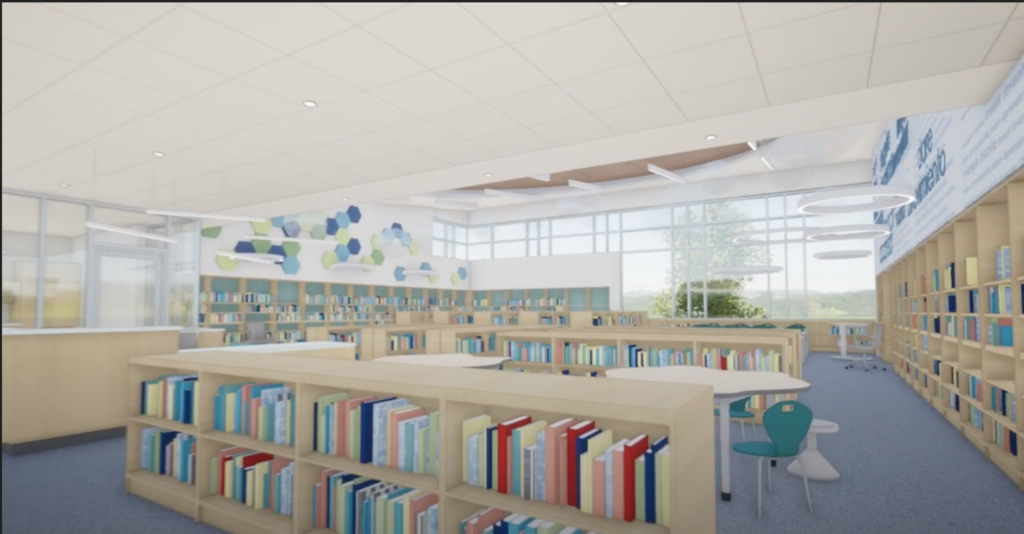
Architect's rendering of the library for the new Amethys Brook Elementary School set to open this fall. Photo: DiNisco Design
Report on the Meeting of the Amherst School Committee, February 24, 2026
This was the Amherst School Committee’s first Zoom hybrid meeting. It was held at Town Hall, was accessible on Zoom, and was recorded. Future meetings will also be hybrid meetings using the Zoom platform.
Present
Deb Leonard (Chair), Andrew Hart, Bridget Hynes, Sarah Marshall, and Laura Jane Hunter.
Staff: E. Xiomara Herman (Dr. Xi), (Superintendent)
Elementary School Restructuring for Coming Year Outlined
Much of this five-hour meeting consisted of administrators and school principals informing the school committee of the staff restructuring planned for the 2026-27 school year, which will consolidate the three elementary schools into two K-5 schools and Chestnut Street Academy, the sixth-grade school located in the Amherst Regional Middle School building. The preschool will remain at Crocker Farm.
In public comment, several parents and staff members expressed concern at the reduction in special education services and specials (art, music, and physical education) with the new plan. Laura Simon, an art teacher at Wildwood, said the new plans will mean that specials teachers at the new Amethyst Brook School will have 550 students, and those at Crocker Farm will need to travel to the new Chestnut Street Academy at the middle school for the sixth graders one day a week. Director of Curriculum and Instruction Tonya McIntyre said that the projected 145 sixth graders at Chestnut Street Academy are not enough to support a full-time specials teacher in each discipline, but Simon said this arrangement will result in fewer adaptive specials for students with special needs.
The administrators and principals were confident that the needs of students could be met within the new structure. The proposed changes have a total reduction of 10.35 positions: 4.5 in specials, 2.5 in reading and math intervention, one custodian, and several other partial FTE’s. The preschool is slated to gain 2.6 teachers and three paraprofessionals in order to accommodate increasing need for three additional half-day classrooms. There will be 2.3 principal positions and three assistant principals for the two elementary schools and Chestnut Street Academy.
Special Education Director Jo Ann Smith stated that the caseload for each special education teacher would be seven to eight students, which she said was reasonable. There will be one special education teacher per grade, and these teachers can work in the classrooms as well as individually with students. Intensivists will have caseloads of three to five students.
Sixth graders needing intensive intervention will be served by staff at the middle school, meaning that they will be able to develop a three-year relationship with the middle school staff. Smith said that the special education staff at the middle school will have the capacity to serve the incoming sixth graders.
The staffing plans are not final, as precise enrollment at each school is not yet known. There are 70 students who are districted out of their current school by the new district lines, but have the option to remain there. Crocker Farm Principal Derek Shea said that the schools have heard from all but a dozen of these students, and almost all want to remain at their current school. The school system is working on the best way to provide these students with transportation, which may involve them going to the closest bus stop for their chosen school.
Superintendent E. Xiomara Herman (Dr. Xi) said that the first months of the school year often see a large number of incoming students that must be accommodated, so staffing may shift depending on need.
Schools to Undergo State Review Next Year
Dr. Xi informed the school committee that all three districts in the Amherst-Pelham region will undergo a review by the state Department of Elementary and Secondary Education (DESE) during the next school year. She said that the purpose of the district review is to “examine the extent to which the district has systems and structures in place to support high-quality instruction, close achievement gaps between student groups, and ensure alignment with DESE’s District Standards and Indicators.”
Dr. Xi said she thought most school districts undergo this process periodically, and she did not regard the review as punitive, but rather as an “opportunity for reflection, calibration, and growth,” especially in light of the planned restructuring. She did have some questions for DESE regarding the process in terms of how detailed the review will be, its timeline, and what the next steps will be.
Budget Update
School Finance Director Shannon Bernacchia presented the latest draft of the FY27 budget for the Amherst elementary schools. The proposed budget has a deficit of $573,744, but this does not include the fact that the town has recommended an increase of 3.8%, rather than the previous 3.5%, and has included the extra 1% added to the FY26 budget as a one-time increase that will be added to the base number for this year. These two changes should add about $360,000 to the budget.
School Committee Members List Budget Priorities
ASC Chair Deb Leonard asked each committee member for their priorities for budgetary support. After each member’s input, the priorities with the most support were:
- Administrative and staff support to ensure compliance with anti-bullying and restraint policies.
- Training and staffing to better manage the spectrum of student behaviors.
- Building a culture of inclusion for student well-being and mental health.
- Support for multi-modal instruction and project-based learning.
- Class sizes in the mid-range for recommended optimal size.
- Opportunities for working in small groups.
- Maintaining the current student/teacher ratio.
- Math instruction and support.
- No cuts to specials.
- If cuts to student-facing staff are needed, central office staff should be reduced proportionately.
Dr. Xi noted that some of the priorities conflicted with others. For instance, reductions in central office staff may make it difficult to ensure compliance with bullying and restraint policies. Bridget Hynes and Sarah Marshall agreed to go over the priorities to rank them and make them consistent. An extra meeting may be required to approve the priorities, because the budget must be completed by the March 24 meeting.
Update on Bullying and Seclusion and Restraints Data
This school year marked the first time the system used the BRIM tool to report bullying incidents. Of the 46 incidents reported, 50% were found to be unfounded, 10 cases were confirmed, seven were cancelled, mostly because they were duplicate reports, and six are in progress.
As far as incidents of restraint, Smith said that there have been 32 or 33 this year across all elementary schools, 70% of which lasted four minutes or less. About eight students have had more than one incident.
New Seclusion and Restraints Policy in the Works
Changes in the state’s “Students: Physical Restraint, Seclusion, and Behavioral Support Policy” to go into effect in August 2026 necessitated updating Amherst’s policy. Hynes presented a draft of the new policy for committee feedback. The draft policy emphasizes that restraint and seclusion may be used only as an emergency and a last resort. “Physical restraint and seclusion are not behavioral programming strategies and shall not be utilized for therapeutic, educational, disciplinary, coercive, retaliatory, or convenience purposes.“
The document states:
Governing Principles: The District adopts the following standards:
1. The preservation of student physical and psychological safety supersedes all behavioral compliance objectives.
2. Staff shall employ all other behavioral interventions and measures before seclusion and restraint including but not limited to: positive behavioral supports, de-escalation and coregulation techniques, opportunities for a break, student consultation with the school’s mental health team for trauma-informed approaches to heightened feelings, consultation with caregivers, and crisis planning.
3. Emergency interventions shall be terminated immediately once the risk of serious physical harm dissipates.
4. Seclusion may only be used in emergency circumstances and carried out only under the conditions below:
– The student poses an imminent threat of serious physical harm.
– An adult is present and continuously and actively monitors the student, and is available to the student at all times.
– The space is safe, sanitary, appropriately sized for the age and needs of the student, appropriately lighted, ventilated and heated or cooled, consistent with the remainder of the building, free of objects or fixtures that are inherently dangerous to the student, and compliant with fire/building codes.
– Immediate parental notification occurs on the day seclusion occurs; written notice within 3 school days (via email and mail).
– Documentation and reporting to DESE follow 603 CMR 46.06 requirement
5. Seclusion and restraint may never be used: as punishment or discipline for verbal refusal, disruption, or noncompliance; solely for property destruction; absent safety risk as a standing response within an IEP or Behavior Plan
6. Each incident shall be presumed to represent a breakdown in the prevention system and therefore a student safety failure, not merely a behavioral event. The district shall initiate a structured review to determine the precipitating factors, environmental conditions, staff actions, de-escalation attempts, and whether appropriate behavioral supports and accommodations were in place and implemented with fidelity. The review must identify root causes rather than assign blame and shall result in a documented corrective action plan. Corrective planning shall include adjustments to the student’s behavioral supports, training or coaching for staff, environmental or scheduling modifications, and consideration of additional services, evaluation, or placement review when patterns emerge.
7. Repeated seclusions or restraints shall trigger escalating administrative oversight and team reconvening, in accordance with the timelines below. The priority is to ensure the intervention is not functioning as a substitute for appropriate programming or access to education.
Committee members were clearly distressed by the testimony from caregivers whose children had been repeatedly put in seclusion, otherwise known as the blue room. Laura Jane Hunter said the caregivers’ testimony was “haunting” and that the problem seems systemic.
Although the numbers were small, the psychological impact on those students was large. While most confinements lasted less than four minutes, that is a long time for young students. Special Education Director Jo Ann Smith stressed that seclusion and, sometimes, physical restraints are necessary for the safety of both staff and students, and that these incidents are hard on staff members as well. She added that, on occasion, delay in employing these actions has resulted in injury to staff or students.
Committee members stressed the need to anticipate behaviors and stop them before seclusion is necessary. They were also not happy with the seclusion rooms planned in the new Amethyst Brook School. There are four small “reflection rooms” in the new building, two on one floor and one each on the other two floors. School committee members questioned the small size of the rooms and wanted to know how they would be monitored (one-way mirror, closed circuit cameras, etc.) They also thought that four was too many for a use that is supposed to be rare.
Dr. Xi was also unhappy with the design of the “reflection rooms” and said she would talk to the construction team before the work was completed. She clarified the difference between a time-out, which can be taken in the classroom or outside and can be initiated by the student, and seclusion, which is imposed on the student. She suggested holding a public forum for caregivers and staff to get input from stakeholders on the restraint and seclusion policy. Hynes noted that some caregivers may find it uncomfortable to participate in a public forum, and suggested that they could come to a Policy Subcommittee meeting, which would be small. Smith emphasized that staff should also share their perspectives.
There is something profoundly sad about Maura Keene’s extensive report on the Amherst School Committee meeting of February 24th.. The sadness comes from watching good and talented people – by whom I mean the School Committee, school administrators and teachers – seem to be in traps that they don’t know how to escape from. And indeed they are trapped by so many assumptions an d attitudes that emanate from the state department of education and the approach to school reform starting in the 1990s. The language is cold and distancing – “student” instead of “child”, “instruction” instead of. “learning”, “behavior” instead of “activity”, art, music and movement as” specials” instead of “core curriculum”.
What is to be done? Maybe start by asking a different sort of question:
How can children and adults enjoy being together more in schools?
How can we encourage children to experiment with different approaches to self-expression?
How do we make art, music and movement central to the school experience of children and adults?
How can adults be seen as learners and children seen as teachers in schools?
Questions such as these are ways of getting out of the traps that schoolpeople, young and old, seem to feel they are in right now. For many, such questions will seem fatuous and squishy. They may not solve problems or resolve dilemmas. But neither will policies or directives. Schools are where children learn and grow by watching adults be adults. What are they learning?