
Finance Committee Recommends Using Free Cash to Replace Middle School Auditorium Roof. FY27 Budget Outlook Slightly Improved
Photo: Picpedia.com. (CC BY-SA 3.0)
Report on the Meeting of the Finance Committee, February 24, 2026
By Maura Keene
This meeting was held over Zoom and was recorded.
Present
Cathy Schoen (Chair and District 1). Jill Brevik (District 1), Lynn Griesemer (District 2), Sam MacLeod and Ana Devlin Gauthier (District 5), Joseph Jayne (nonvoting resident member)
Staff: Sean Mangano (Finance Director), Paul Bockelman (Town Manager), and Athena O’Keeffe (Council Clerk)
Committee Recommends Allocating Free Cash for Middle School Auditorium Roof
The Finance Committee voted unanimously to recommend that the Town Council take $1.6 million from the $4.3 million proposed for road and sidewalk repairs to give to the regional school district to replace the auditorium roof at the Middle School, while the remainder of the roof is being replaced this summer under a Massachusetts School Building Authority (MSBA) grant. The badly leaking auditorium roof is not old enough to qualify for MSBA funding.
The discussion at the February 23 Town Council meeting centered on whether the funds should be considered a gift to the regional schools or should come with conditions for repayment for the $320,000 above what Amherst would owe according to the regional funding formula. The recommendation to require repayment was defeated by a 9-3 vote at the council meeting. However, Finance Director Sean Mangano said he would draw up an intergovernmental agreement noting that the money came from Amherst alone and that would guarantee that if the work ended up costing less, the difference would be returned to Amherst. The $1.6 million for the auditorium roof is based on a recent estimate and includes contingency funds.
Lynn Griesemer said, “There is no question that this Middle School roof is a mess, but what I’m most concerned about is the nuance where basically people are looking for Amherst to always bail people out. My priorities are for the Town of Amherst, for DPW, for fire, and for roads. While I’m going to support this, I really don’t like the idea that Amherst is supposed to bail out the region.”
Nonvoting member Joseph Jayne asked if there had been any pushback from councilors about taking money from roads and sidewalks to fix the Middle School roof. Mangano answered that the $2.7 million is still more than the town usually spends on roads, but the increased amount was to meet the Town Manager’s five-year plan to at least maintain the roads in their current condition. The average of $5 million a year for five years comes from a DPW software program that models needed repairs. Even with $5 million a year, Mangano said, there is a deficit in what is needed. Taking $1.6 million out will make the gap greater.
Jill Brevik said, “It probably shouldn’t have gotten to the point where the ceiling is caving in, so I think all of us have a responsibility to bear and maybe thinking about how to work together better in the future instead of saying how do we keep these kinds of requests at bay. It’s a request that I think benefits everyone. Just thinking about framing of that conversation in a more positive light—not schools or roads, but schools and roads.”
Ana Devlin Gauthier agreed with allotting money for the Middle School roof. She said, “I would rather pull from this “bonus” paving money than let this school project get worse. In terms of Amherst supplementing the other towns, I believe that whoever can step up should step up, and if right now that’s Amherst, I think that that should be Amherst. I also recognize that often it is Amherst who has stepped up, given that we’re a bigger town. We have more play in our budget.” She agreed with Griesemer that Amherst should keep track of the significant gifts the town makes to the region.
Cathy Schoen noted that the town needs to look into other sources of funding for roads to compensate for the reduced funding this year. She said it is especially important because “with the Jones Library, there was the hope of massive fundraising. Waiting two more years [for the Trustees] to do their full share is costing us a fair amount. We’ve got to do short-term funding until we get the rest of the trustees’ funding, so we’ve been making choices along the lines that cut into capital for other purposes.”
Bockelman offered a cautionary note: “I do support Councilor Brevik’s sentiment, because I do think that we are all part of the same community, but I also think it’s important to differentiate that the Amherst Regional School District is a separate governmental entity. It has its own sources of funds. It gets money straight from the state. It’s responsible for developing a capital plan and for managing its resources. I’m finding in the last few years, a lot of these decisions are being pushed to the council, and it’s just not where it should be.”
Other Appropriations from Free Cash Approved. Use of Funds Reserved for Youth Empowerment Center Questioned
The certified free cash for FY2025 was $10,221,184 . Any amount over 5% of the town’s budget of $103 million should be allocated to other expenses, which leaves $5.17 million. Mangano presented the planned use of those funds to the Finance Committee. In addition to the $1.6 million for the Middle School auditorium roof and $2.7 million for roads and sidewalks, he noted $89,000 in opioid settlement funds, $56,440 for the Black Reparations stabilization fund, $150,000 for two years of maintenance of the new track and field at the high school, and $455,000 for a youth empowerment center. Three hundred thirty-five dollars will be added to capital reserves. Total reserves are over $15 million.
The opioid settlement funds are funds the town will receive each year for about 20 years as the result of a settlement between the state and the drug manufacturers who contributed to the opioid epidemic. The Public Health Director is developing a plan for how best to combat drug addiction and support those affected. The total in the fund is $283,000. None has been used as yet.
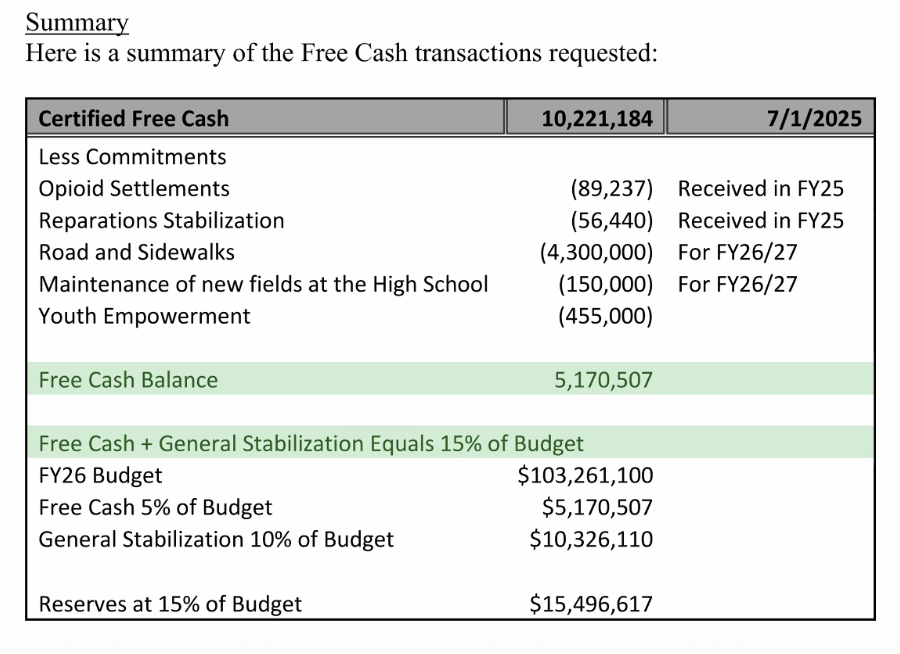
As a result of an agreement made by the Town Council in 2022, the amount the town receives in cannabis tax revenue will be put in a Reparations Stabilization fund until the total in the fund reaches $2 million. This year $56,440 will be added to the fund to bring the total up to almost $664,000. A successor committee to the African Heritage Reparations Assembly (AHRA) will determine how the funds can be best used.
The town will devote $150,000 toward the first two years of maintenance for the new track and field at the high school until the regional schools can procure a contractor. After two years, the maintenance cost will be shared by the town and the regional schools. The $75,000 per year is based on what Longmeadow spends for a similar facility.
One of the recommendations of the Community Safety Working Group (2021) and the AHRA (2023) was to establish a youth empowerment center aimed at youth of color. To that end, $500,000 of ARPA money was put in a fund. Some of the money has been used for youth programming, but $455,000 remains. Griesemer questioned whether that amount should be repurposed, since there has been no progress toward establishing a youth empowerment center in the past five years. “Perhaps this goal is being partially met by something like Morning Movement,” she said. “How long are we going to sit on this goal, and at what point should we be considering modifying it, because half a million dollars is no small change?”
Schoen agreed that this amount should be looked at, possibly to make up some of the shortfall in funds before the Trustees reimburse the town for their share of the Jones Library project. She noted that the $455,000 is not enough to rent a building or hire staff. No change was suggested to those funds at this meeting.
There will be a public forum on these appropriations before the March 9 Town Council meeting, and the council will vote on them during that meeting.
Some Good News on the FY27 Budget
Mangano reported that he has adjusted the expected revenue for new growth and interest income downward, but still felt the town could manage a 3.8% increase to all four divisions (town, library, elementary schools, and regional schools), rather than the 3.5% previously anticipated.
The fires at Olympia Place reduced expected revenue from new property tax, and the falling interest rates, as well as the fact that the town is now using money to support the Jones Library and Amethyst Brook Elementary School, mean that there will be less income from investments. But the lower-than-expected cost of health insurance and an increase in state aid have balanced out those changes. Also, the town’s PVTA assessment is lower, and retirement expenses are stable.
In addition to raising the increase in funding from 3.5 to 3.8%, Mangano recommended adding two more firefighters using $200,000 from the ambulance fund, and adding the $269,000 used as a one-time allocation to the elementary schools to the base for this year’s increase. This would increase the town’s contribution to the elementary schools by $400,000.
Problems with the Middle School roof have reportedly been known since 2016. There should have been ample time for the Regional School Committee and the Four Towns to come up with a plan for fixing it. Instead, Amherst will now pay for the work by default.
Adding insult to injury, the $1.6 million is being diverted from repairs to Amherst’s notoriously bad roads. Amherst’s Pavement Condition Index rating of “fair” (62) compares with the closely related Overall Condition Index for the greater Pioneer Valley of 76.
And Amherst’s “Average Tax Bill as a % of Income” (45.4%) dwarfs the measures for Leverett (16.9%), Pelham (20.1%) and Shutesbury (20.3%).