
Amherst’s East Village: Where History Happened
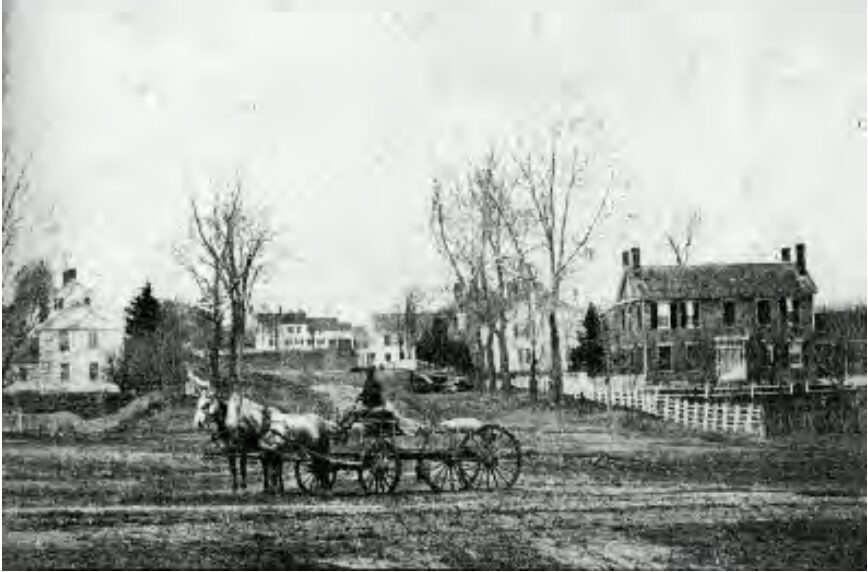
Historic East Amherst Village. Photo: amherstma.gov
On Wednesday, March 4, the town’s Planning Board will take up a proposal from the town’s Local Historic District Commission (LHDC) that Amherst’s East Village become its own Local Historic District. As defined by the Commonwealth of Massachusetts, this is a “geographically defined area protected by municipal ordinance to preserve its historic, architectural or aesthetic character” whilst also allowing for its evolution and growth. As a form of zoning overlay, the designation allows for management by a local commission, in much the same way that our current LHDC oversees the North Prospect-Lincoln-Sunset-Fearing District and the Dickinson Local Historic District. The commission is charged with reviewing exterior changes to buildings visible from public ways to ensure compatibility with local character. Landscaping, routine maintenance, HVAC systems and other changes are not subject to review.
In my opinion, the move would be a good step, offering more protection to the oldest colonial center of our historic town. This is not to discount some important early industrial colonial history in North Amherst.
In 1986, the National Register for Historic Places listed the East Village as a historic district—a state and national designation but a largely honorary one. But the move shows that in the 1980s, not long after the 200th anniversary of the Revolution, our town was seeking to recognize the East Village as a unique neighborhood dating back to the 1700s. Further protection in 2026, the year when we are celebrating the 250th birth of the nation, would offer a physical designation for the East Village where the buildings are seen to embody stories and culture associated with this actual physical place. We could even have an interpretive sign placed on the common to reinforce this point. Once you know what really happened here in the past and also consider the exciting plans for its further development in the future, you may appreciate why drawing attention to it is long overdue. It can be both a place of greater housing density (see more here) and a source of pride as the site of the first English settlement in Amherst. Like the rest of town, the eastern portion of Amherst became part of Hadley in 1728, that became a separate parish in 1735, “Hadley’s Third precinct.” In 1753 the area became the second precinct and in 1759 the district of Amherst. By 1775, East Street was a major crossroads in the new town of Amherst,, the year the area was incorporated. This can be seen clearly in the map below, showing East Amherst, where South and North East Street and Main Street intersected. This intersection by East Common was the center of East Amherst, and it also forms the heart of the proposed LHDC.
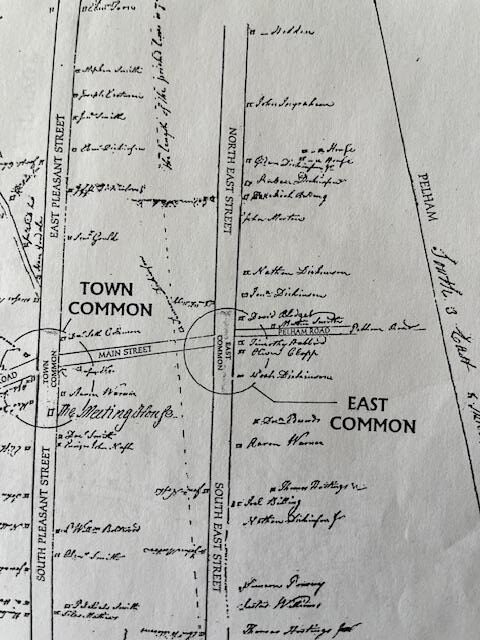
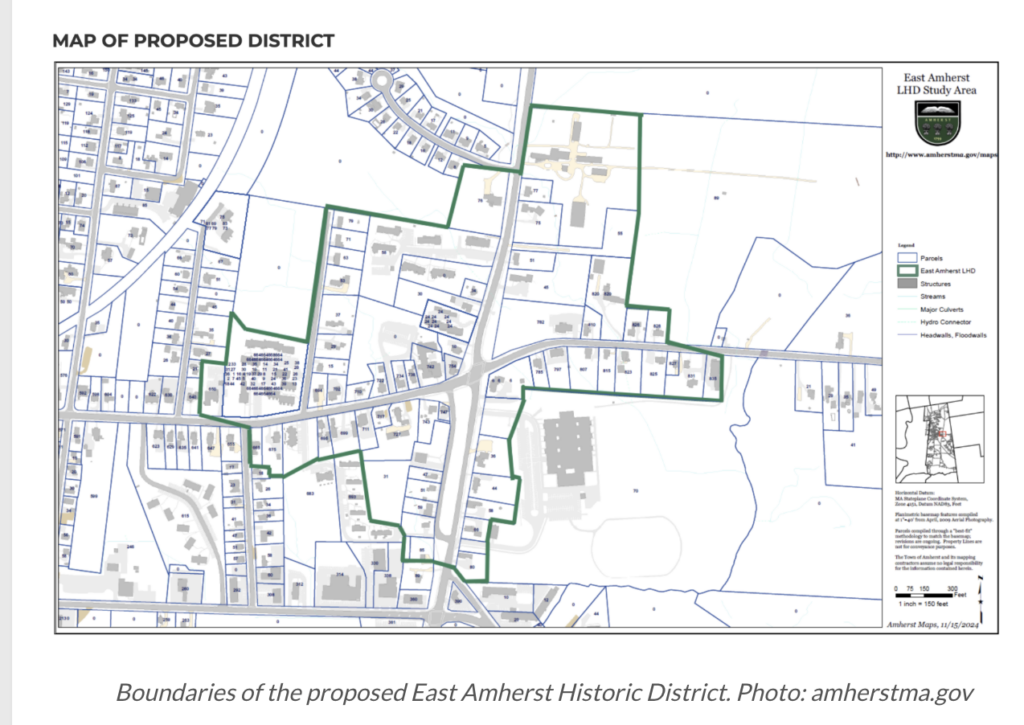
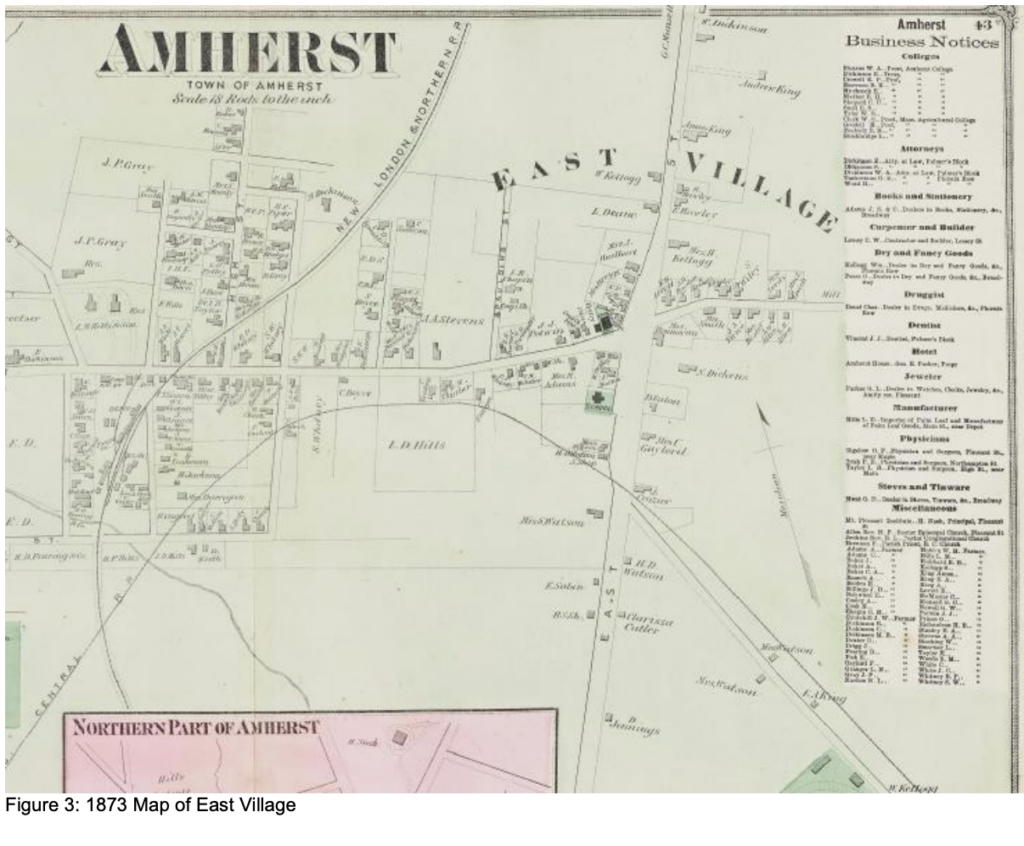
The goal at this time period was for each village center to support a meeting house, a cemetery, a post office (established in East Amherst in 1806), a school, a poorhouse, a town pound (for stray animals), and a well for fresh water. The east village center commons, like the south village center, had one main roadway through it, crisscrossed by wagon-paths and little creeks and streams. Both still share the Fort River as a source of freshwater. Commons like these sometimes functioned as military mustering grounds if one of them was not expressly planned for such purposes.
The common by Town Hall (officially the North Common (an area then, as now, north of Amherst College) also served early on as a communal hayfield (until Austin Dickinson created the Amherst Ornamental Tree Association and advocated for the land to be mown lawns with stately elms). In contrast, parcels by the south and east commons of Amherst were slowly leveled and sold off as house lots. By 1784 a group of Amherst’s Congregationalists wanted to distinguish themselves from the Tory-dominated First Church, and they formed the Second Parish meetinghouse on Main Street, that is also a part of the proposed Local Historic District. Most of the new church leadership was made up of Revolutionary War veterans. The church was located at the north end of the East Common and the current building dates back to 1839. It now serves as the home of the Jewish Community Center of Amherst (JCA).
While Amherst College began to take shape to the west—on “the Hill”—in the early 1800s, the East Village continued to be the patriotic heart of early Amherst.
It is still centered today around an historic common “for public use” (albeit a little smaller than it was originally), surrounded by a representative and ordered grouping of modest homes, such as the Ephraim T. Sabin House at 80 South East Street. Sabin was a local blacksmith. At the actual crossroads of East and Main Streets there are a number of older brick homes that are arguably more architecturally significant, dating from the period before the Revolution. Quoting from the report that our Local Historic District Commission initiated: “Several houses in East Amherst remain from this early settlement. They include the Noah Dickinson House, 743 Main Street and the Daniel Kellogg House. The Noah Dickinson House dates from 1754 and the Daniel Kellogg House from 1758. These Georgian style homes are remarkably intact.”
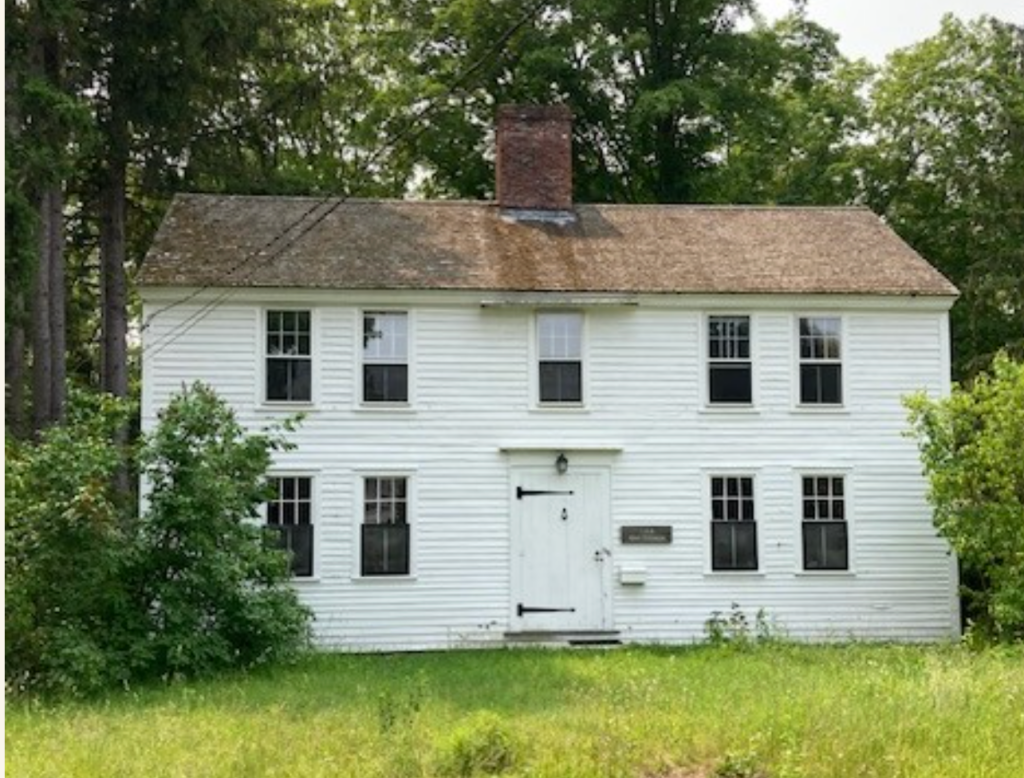
East Village had at least two taverns: one was the Clapp Tavern possibly on the north side of the Commons that, according to Amherst historians, Edwin Wilton Carpenter and Charles Frederick Moorehouse (1896), had been a center of ferment at the time of Shay’s Rebellion. (These insurgents also met in Pelham), This tavern has not survived but the Baggs Tavern, at 6 South East Street, dating back to the 1700s, survives as a law office, and was operated as a tavern by John Baggs during the first half of the nineteenth century.
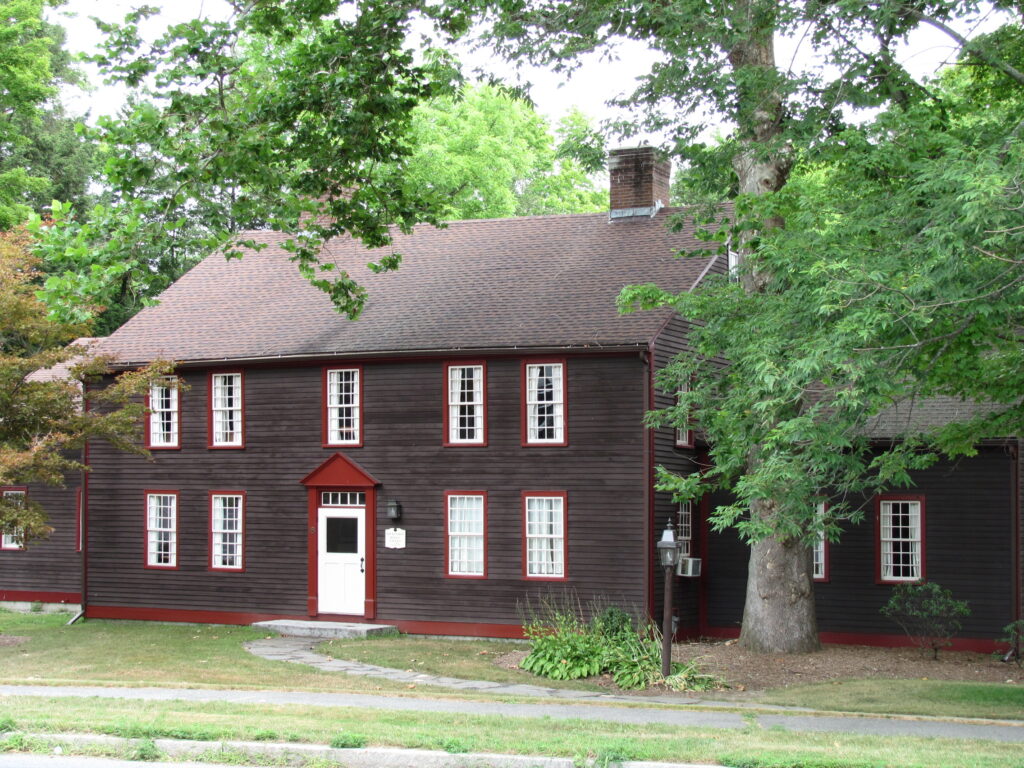
Nearby, at 58 South East Street, is the home of Ebenezer Mattoon, one of the leaders of Shays Rebellion along with more than a hundred of the town’s early citizens. This house dates from 1782, after Mattoon’s service in the Revolutionary War and before Shays Rebellion began in 1786-7.
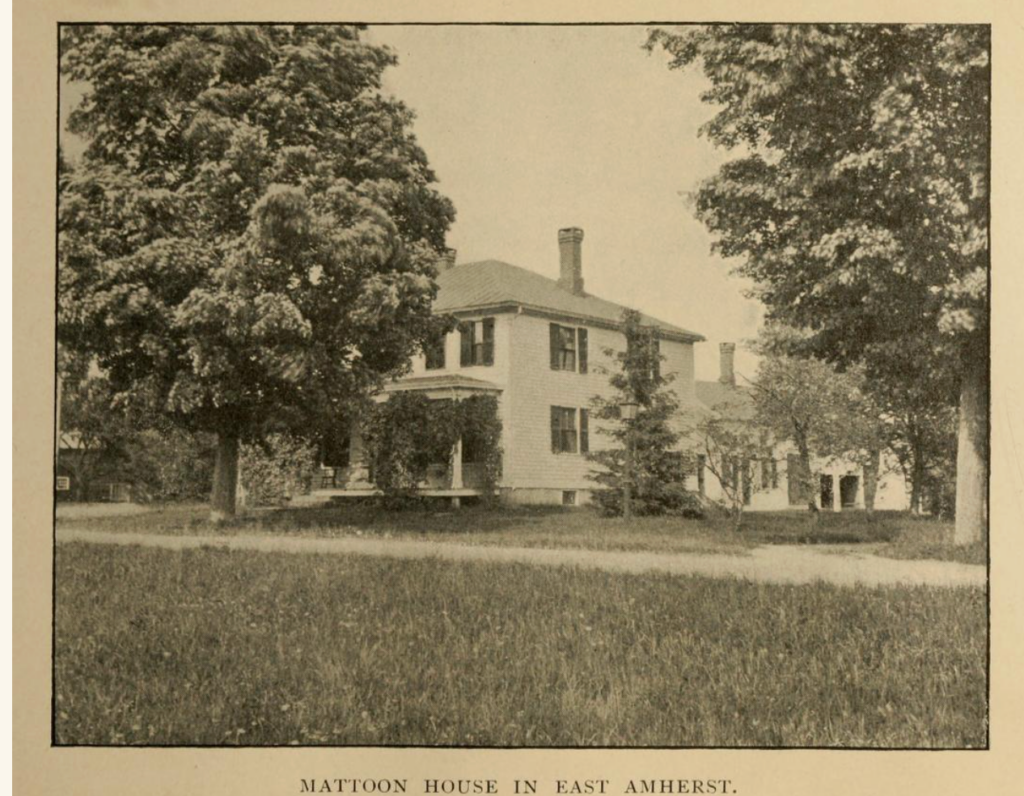
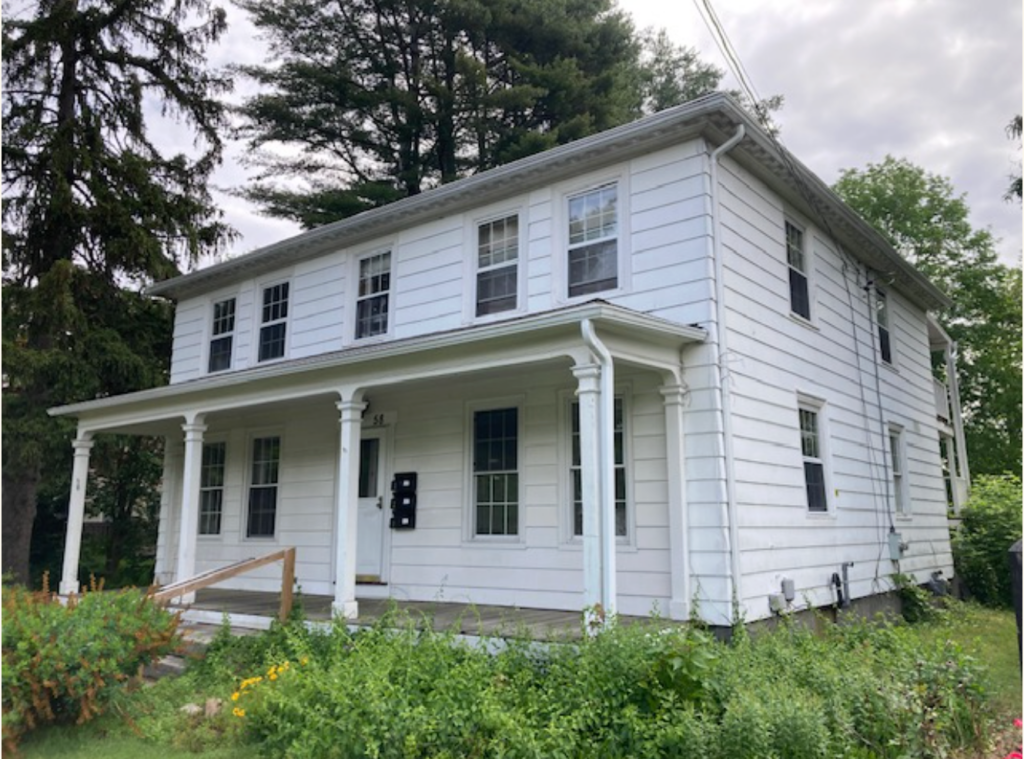
By the 1860s, East Amherst had become much more commercial than it appears today. In the East Amherst Local Historic District Preliminary Study Report for the Amherst Historic District Commission, some excellent examples of workers’ housing are included, such as the Smith House East at 797 Main Street, “a remarkable multi-family dwelling built in 1815 to house the many workers of East Amherst, and it remains in residential use today.”
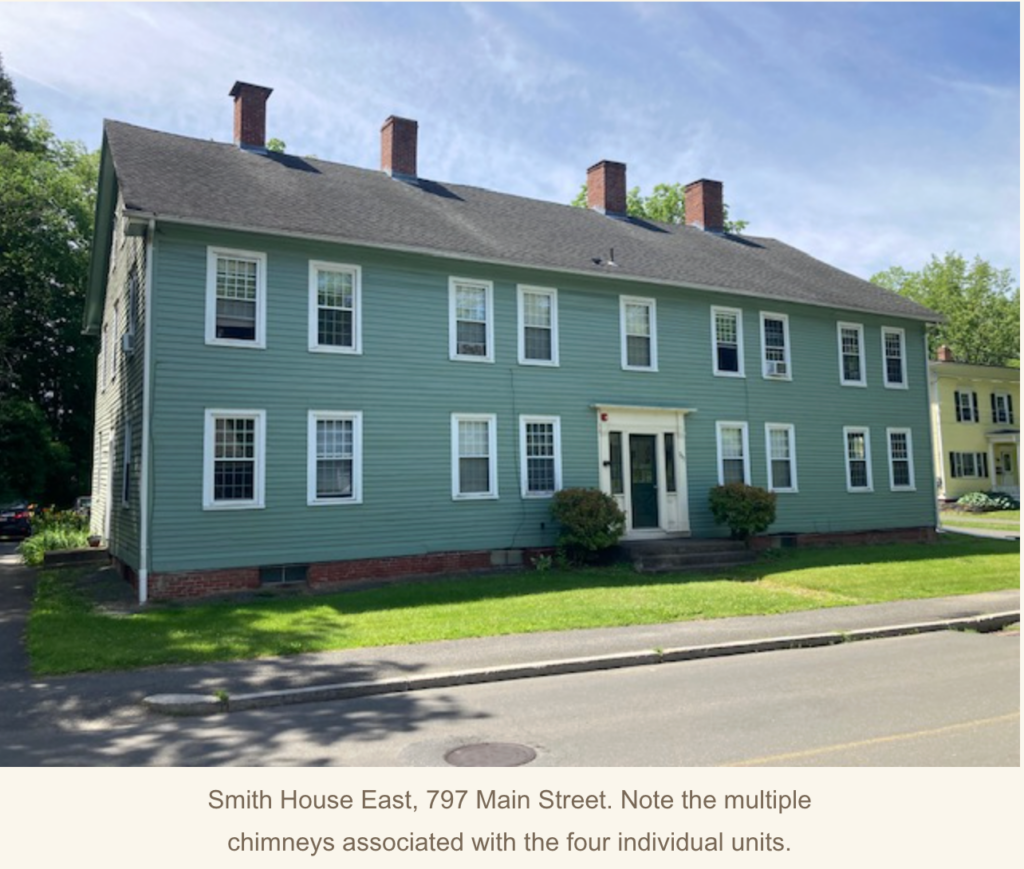
From this mid-Victorian era, some buildings in the proposed district still give a sense of East Amherst in the mid-1800s when storefronts, tanneries, blacksmiths, shoemakers, harness makers, tool-makers, and arms manufacturers existed alongside its historic farms and private homes. By the 1870s, all three Amherst village centers—the north center by our present Town Hall, the south center on Fiddler’s Green (the South Common) by the Congregationalist South Church, and the east village—had their own Village Improvement Societies (civic organizations, emerging in the late 19th century in Massachusetts (starting around 1853), dedicated to beautifying, sanitizing, and enhancing the quality of life in small towns and villages).
Giving this area greater protection is arguably a form of cultural resilience that keeps the past alive, embodied in the actual buildings that record our 250 years as a nation. We can continue to protect the community’s colonial roots while also welcoming new histories being made today.
Upcoming Talk on Shay’s Rebellion
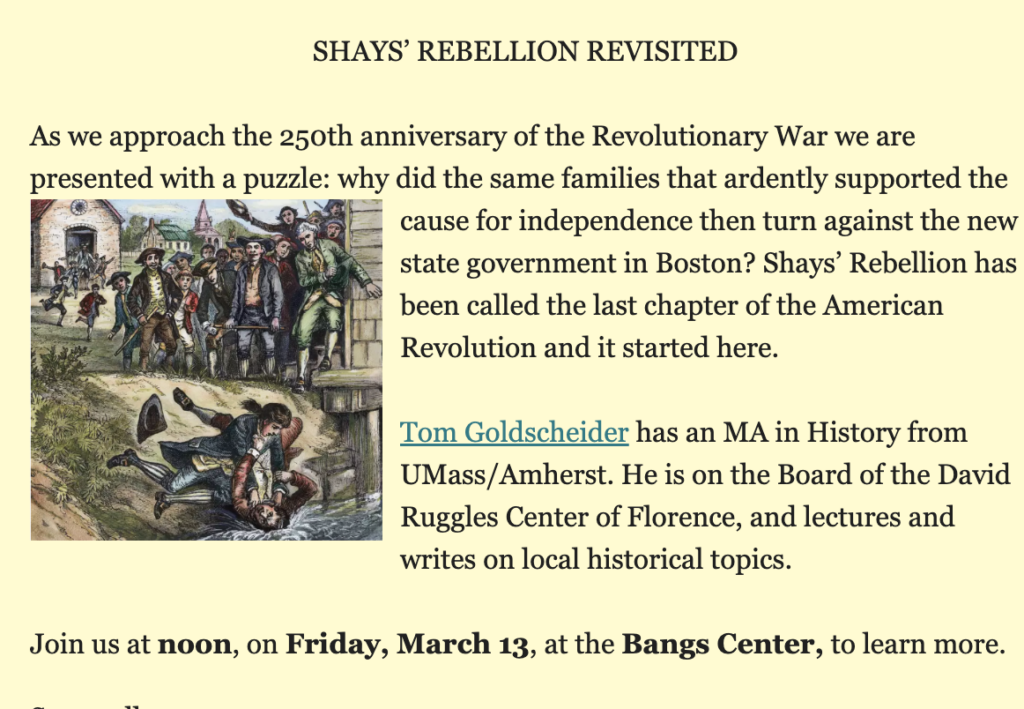
It is worth noting that the Amherst Historical Society is holding a talk on Shays Rebellion at the Bangs Community Center on Friday, March 13, at noon. More information
Great article — One correction: Ebenezer Mattoon was not a leader of the 1786 protests against Governor Bowdoin’s austerity policies, known to the people as the Regulation, and to the elites as “Shays’ Rebellion.” Mattoon was a shopkeeper who kept himself aloof from the protests, but this alienated people and hurt his business. When the crisis came to a head, he tried to make amends by writing to James Bowdoin asking for clemency for Bernardston resident Jason Parmenter, who had been arrested and sentenced to death. His letter was part of a successful campaign. Parmenter and Pelham resident Henry McCullough were scheduled to hang in June 1787 from a gallows on “Pancake Plain,” now the fairgrounds in Northampton, but they got a dramatic stay of execution on the gallows.
It is great to have this correction to the piece. I did remember recently that about 40 denizens of Shutesbury were involved in the Shay Rebellion (based on new finding aids gathered by UMass Amherst in connection with the town’s 250th anniversary as a town. http://findingaids.library.umass.edu/ead/mums957. There is also a wonderful map related to the Regulation and the Shays protests (https://commons.wikimedia.org/wiki/File:ShaysRebellionMapByEzraStiles.jpg#:~:text=jpg.%20Size%20of%20this%20preview:%20724%20%C3%97,2%2C048%20pixels%20%7C%203%2C216%20%C3%97%202%2C662%20pixels.) from Yale’s Rare Book collection made by college president Rev. Ezra Stiles detailing the troop movements. Rev. Stiles was a great supporter of the Revolution and the map shows both the movement of General Benjamin Lincoln’s government troops and those of the regulators.