
UMass Organizers Seek Unity in Latest Popular Assembly
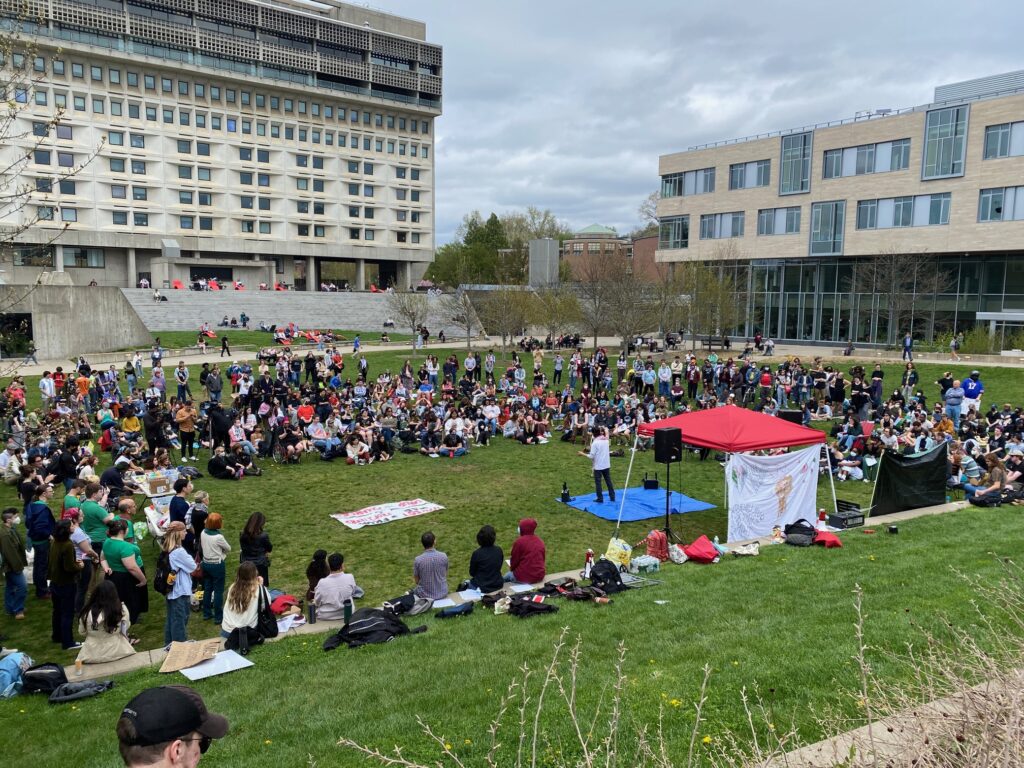
The first UMass People's Assembly, May 1, 2024. Photo: Art Keene
by Colin Weinstein
The following article, “UMass Organizers Seek Unity in Latest Popular Assembly,” by Colin Weinstein, appeared originally in The Shoestring on March 22, 2026. It is reposted here under Creative Commons license.
The fourth event of its kind in recent years brought organizers together to discuss coordinated efforts between parallel movements on campus.
In a UMass Amherst lecture hall last week, about 75 undergrads, graduate students, staff members, and faculty chatted, laughed, and ate pizza as reggaeton filled the massive space. If not for the Palestinian flag-draped podium and numerous keffiyeh-covered necks, one could be forgiven for thinking the scene was an administration-organized social event.
But this group had come together for a different purpose: the fourth installment of the “Popular Assembly,” a gathering of student organizations and union caucuses brought together largely by their experiences organizing under a university administration they say is hostile to their causes.
“At the last assembly in December, we heard a lot of testimony about the different kinds of repression and targeting and harassment that are happening at different sectors of our campus,” music professor and assembly organizer Marianna Ritchey told The Shoestring. ”So it was really a fact-finding kind of event.”
Thursday’s assembly had a different purpose, however. “Our goal here is to increase participation across all these different projects and efforts and struggles, and further democratize our various projects,” Ritchey said.
Organizers held their first assembly on May 1, 2024 after UMass ordered the dismantling of the first UMass Gaza solidarity encampment. Since then, repression of student, faculty, and staff organizing have continued, most notably with the violent dismantling of the second UMass encampment and ensuing disciplinary and legal actions against organizers, and with disciplinary actions taken against students who participated in a protest against the participation of weapons manufacturer RTX (formerly Raytheon) in a September career fair. More recently, UMass’s Sunrise Movement chapter was frozen for dropping a banner from the Student Union Pavillion which critiqued the administration’s spending decisions and austerity measures.
As Professional Staff Union member Koby Leff put it in remarks at last week’s assembly, October’s “People’s Tribunal” emerged as a strategy for organizers to respond to “interrelated repression efforts at the Five Colleges and other institutions around the Valley” — by putting them “on trial.”
The Tribunal also played a role in bringing together this coalition of intra- and inter-university groups, which until very recently “was pretty disparate,” according to Hannah Bernhard, a Professional Staff Union chapter board member. “I think faculty knew that they weren’t as connected to staff. Staff knew that they weren’t as connected to students. There was a graduate and undergraduate student split.”
Thursday’s agenda began with a “trivia quiz” with facts drawn from history professor Kevin Young’s recent report “Besieged From Without, Undermined From Within,” which proposes ways to avoid cuts to academic programs and limits on hiring imposed by UMass in response to federal funding cuts. The audience raised one to four fingers to indicate their answers as multiple choice questions flashed across the screens. Among them were, “Who is the highest paid employee at UMass?” (Answer: the head basketball coach, who took home nearly $1.3 million in 2025).
“Between 2010 and 2025, by what percentage did admin jobs grow?” read another question. “It’s such a ridiculous number it has to be 143%,” an audience member said. That was the highest option — and it was correct, according to the report.
Next came testimony from students about their struggles to organize and learn on campus. Testimony began with undergraduate organizer Kivlighan de Montebello, whom the university suspended for his participation in the career fair protest, only for him to later sue the university over allegations that the school violated his First Amendment rights and win a preliminary injunction, forcing UMass to reinstate him as the lawsuit progresses.
“This is to say, we have a right to protest and a right to direct democracy,” de Montebello told attendees.
He began his testimony asking how many in the audience had been to the Mullins Center — UMass’ arena — only to reveal that his first trip there came after his arrest during the second UMass Gaza solidarity encampment, where he sat handcuffed overnight with scores of fellow arrestees.
“As people graduate, I don’t want us to forget the horrific repression students, faculty, and staff have faced on this campus in the past three years,” he said. Later, he directed his attention toward how to resist and build, asking the audience, “While they’re all very connected — the fascists — how can we be more connected?”
Next, Will Chaney, a PhD candidate in economics and member of the Graduate Employees Organization Palestine Solidarity Caucus, recounted his experience being interrogated by the law firm Hunton Andrews Kurth for an investigation that the UMass Office of Opportunity and Equal Access initiated against him for his participation in the same career fair protest.
Chaney said the lawyers asked him questions like “Do you condemn Hamas?” and “Are you giving money to Hamas?” Chaney also said lawyers presented him videos of supposed UMass pro-Palestine protesters from the social media pages of the Zionist group Betar, which the New York Attorney General’s Office forced to shut down in January due to its violent tactics. He also recounted how the lawyers described a video to him featuring UMass protestors pointing “in a violent way” at “a person with the Israeli flag who often wears it like a cape” while “chanting about Hitler’s final solution.” Finally shown the video, Chaney claimed it showed none of those things.
“Very similar to [the murders of] Renee Good and Alex Pretti, that kind of gaslighting,” Chaney said “They want you to not believe your own eyes.”
According to Chaney, evidence gathered in the investigation has been compiled in “200 heavily redacted pages … which we’re calling ‘the Career Unfair Files.’” He remains uncertain about whether he’ll face disciplinary action.
One undergraduate student organizer spoke about the cancellation of the “four-skilled” Arabic language program, of which she’s a student, particularly “at a time the Trump administration is perpetrating a witch hunt of Middle Eastern studies in higher education.”
After 30 or so minutes of testimony, organizers shared a draft unity statement for review and ratification. Its purpose: to outline the shared values and goals of the multi-school coalition and “[act] as our North Star guiding our political struggle,” as faculty organizer and history professor Diana Sierra Becerra put it. The statement was broken down into three main principles — “Democratization: Power In the Hands of The People,” “Economic Good,”and “Collective Liberation.” According to the statement, “in practice this means: rejecting carceral systems” — primarily removing cops from campus — “divestment from war,” and “effective mechanisms for eliminating institutionalized racism, misogyny, transphobia, Islamophobia, ableism, and all other forms of domination.”
After reviewing the unity statement in small groups, the assembly broke up into seven “workshops,” intended to get people plugged into fledgling organizing projects, among them “Democratize RA and TA positions” and “Kick ICE Off Campus!” hosted by the Palestine Solidarity Caucus and the UMass members of the National Schools Drop ICE Campaign, respectively. After discussion, the larger group reconvened with representatives sharing the next steps they’d agreed on for their projects — mostly the organization of group chats and the planning of subsequent meetings.
The evening ended with a guided meditation. The dozens of mouths that had engaged in impassioned testimony and diligent discussion all night — about goals, strategy, and experiences — now went silent, focused only on breathing in and out. Eventually they started up again, with chatting and pizza-eating, as people filed out of their seats with Chilean Communist folk singer Victor Jara’s anti-Imperialist classic “El Derecho de Vivir en Paz” ringing in the background.