
Opinion: We Love the Amherst Vision, But Who’s Paying for It?
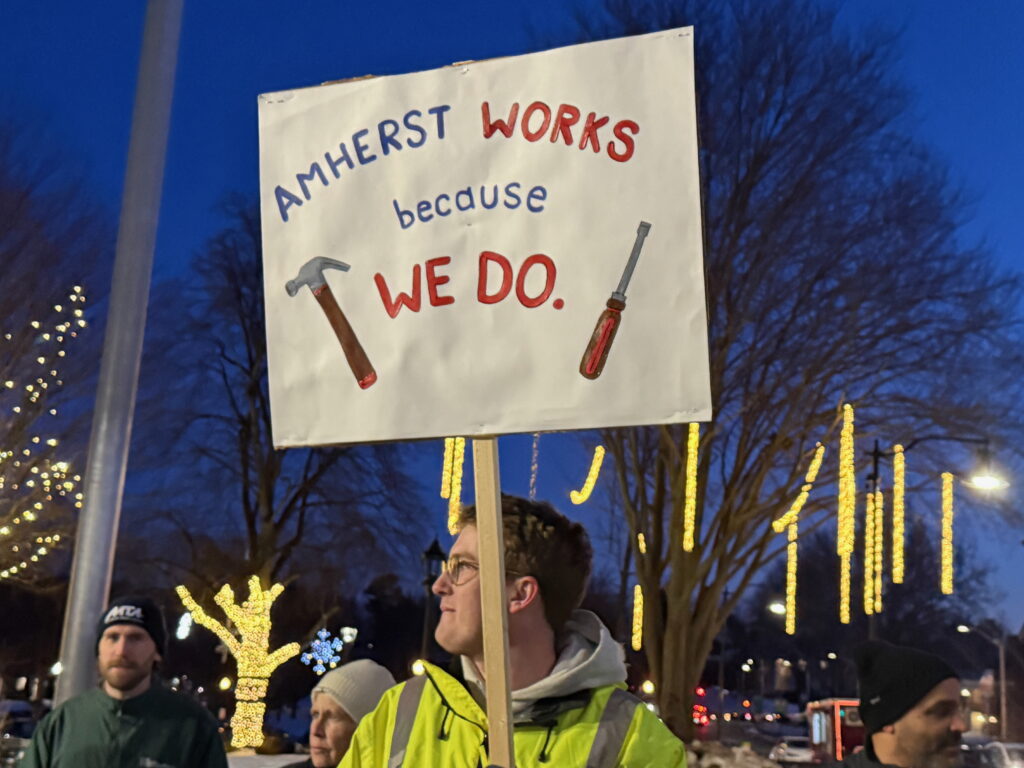
Amherst DPW's Rally for a Fair Contract, March 2, 2026. Photo: Art Keene
Social Injustice Goes Global

The facilities that protect our streets, our workers, and our families aren’t optional. Fire stations and DPW centers are the backbone of a functioning town—and right now, Amherst is finally starting to talk seriously about building them.
The Town Council is moving forward without what should be the bare minimum: a fully transparent, all-inclusive study that explores every possible construction model, location, and timeline with not some options but all of the most convenient ones.
And that gap—between urgency and due diligence—is where the real risk begins and that’s exactly why the experience of the Jones Library matters here as project doesn’t have to collapse to be a policy failure.
And that’s exactly where the glow-up starts to look a little different. Back in the late 2010s, the Jones plan sounded great: modernize the library, make it accessible, bring it into the future. Cool—and necessary, even but then the numbers came in.
• Total project cost: ~$46 million
• Town share: ~$15.75 million
• State funding: another $15+ million
• And by 2022? Already $11.6 million over earlier estimates
That should’ve been the moment to slow down, reassess, scale back. Instead, the project kept moving—because once you’re locked in, turning around isn’t just difficult… it’s politically and financially almost impossible.
Pandemic Reality… Ignored then COVID hit.
Every institution in the country had to rethink how it operated — especially public spaces like libraries. Usage patterns changed, budgets tightened, and uncertainty skyrocketed and this was the perfect moment to ask: do we still need this exact project, at this exact scale? And Amherst’s answer was to keep going.
Meanwhile the costs didn’t stop as inflation hit construction hard. Labor and materials cost went up. Everything went up, and the library is still asking for more, including additional CPA funding, even after the town had already committed millions.
At the same time, the town quietly acknowledged that the DPW facility (built 1915) is deteriorating, the Fire Station (built 1929) is outdated and inadequate, and replacing them could cost $35M–$65M. So we found $46M+ energy for a library expansion while essential services are still waiting.
Then Reality Hits: Fires, Strain, and Capacity
And this isn’t theoretical when fires hit dense housing like the recent multi-alarm blaze near Olympia Drive exposes the gap instantly: high call volumes, limited staffing, and aging facilities.
At the same time, the town is supporting a massive student population tied to the University of Massachusetts, Amherst that’s largely tax-exempt. Demands for services go up, but revenue doesn’t keep up and so the pressure lands on the town, the budget and the residents.
The Part No One Wants to Say Out Loud is that this isn’t really about libraries but about how decisions get made because what happened here follows a pattern we recognize instantly: Start with a good idea. scale it up, ignore early warning signs, assume funding will work itself out and push forward because stopping feels worse and that’s not planning but momentum disguised as strategy.
We’re looking at combined costs between $35 million and $65 million for Fire and DPW facilities. To put that into perspective, a 2006 report estimated a fire facility at $14 million. That’s not just inflation but what happens when towns delay, defer, and then rush.
A 150% increase isn’t just a number but a policy failure that shows up in property taxes, rent, and who can actually afford to stay in Amherst.
Why This Moment Matters
If lower-cost construction models are being quietly dismissed before being fully explored, Amherst risks repeating a familiar pattern:
- Limited options presented
- Urgency used as justification
- Costs that escalate after approval
- Residents left reacting to instead of shaping outcomes
This isn’t about being anti-development. It’s about being pro-accountability.
Because smart planning doesn’t rush—it compares, tests, and proves.
The Jones Library Effect
On the surface, it’s everything a town wants: historic charm, community programming, a hub for students and families. But underneath, it’s become something else—a warning sign.
A case study in how: good intentions + ambitious scope + incomplete financial clarity = long-term fiscal pressure.
Residents should be demanding a full comparative study of all construction and siting options asking why certain lower-cost models may be excluded, pushing for transparent cost breakdowns before decisions are finalized and contacting town councilors now, because once contracts are signed, “public input” becomes a formality.
Amherst can build safe, modern, efficient fire and DPW facilities but it cannot afford to do it blindly not again at $65 million when the lessons are already sitting right in the center of town.
So What is a Library in 2026?
The Jones Library isn’t failing in the obvious way as it is open, runs programs and will stand newer, bigger, shinier, but here’s the thing no one likes to say out loud.
A project doesn’t have to collapse to be a policy failure but if the math stretches the town, the debt lingers longer than the excitement and it quietly competes with things like fire response times, road maintenance, or basic public works.
While Amherst is still figuring out how to carry the weight of the library project, we’re also staring down $35 to $65 million for fire and DPW facilities which we absolutely need.
No one is arguing against safe buildings for firefighters or functional spaces for public works. The debate is whether we’ve learned anything because the pattern feels familiar: big vision, limited options on the table, costs that creep, then sprint and a quiet assumption that taxpayers will just… absorb it
The real problem isn’t the building but the gap between intention and reality. Libraries succeed when hours match working schedules, when programming reflects actual communities, when people feel safe showing up, when the space evolves as fast as the town does. Not when they’re just architecturally impressive, and the same logic applies to everything else we build.
The Jones Library is a mirror that reflects what happens when a town invests heavily in something visible—something symbolic—while the invisible systems quietly wait their turn.
Fire stations and DPW yards are the infrastructure that doesn’t photograph well but literally keeps the town running.
Because in 2026, success isn’t:
“We built it” that’s the easy part.
Success is:
“We built it… and we didn’t box ourselves in financially and we can still fund everything else and it actually works for the people who live here now.”
And right now Amherst is still somewhere between the blueprint and the reality of trying to figure out if it can afford both the dream and the basics.
Rizwana Khan is a writer, educator, and human rights advocate in the Town of Amherst.
Yes, indeed. Essential safety updates (fire station), roads, street lights, affordable housing, other services (e.g., CRESS), all seem to be suffering of late thanks to funding inputs and overages with the library. Seems like poor planning and shaky oversight. The town aches as a result. Two out-of-area visitors we’ve hosted recently commented on 1) the TERRIBLE roads, and 2) whether in five or ten years people will still be going to the LIBRARY for BOOKS or will have new options. (And this from a serious book person, like myself.)
Hi Rizwana,
Your piece is why I still can’t fathom why the Library project went through. Knowing the condition of the DPW building, knowing the Fire Dept has been waiting for decades and we still went ahead, gambling with funding while the infrastructure around us is falling apart.
Obviously whatever entity was behind this, whether it be Amherst Forward or someone else, the town manager and many council members used poor judgment letting this happen. I hope the other council members remember this mess when it’s time for his evaluation. Did we really need another 2 million dollars shot on Bockelman Park while the DPW workers strive to get a living wage?
I’m happy for all the people that voted and got their way with the Library addition. It’ll be wonderful. I personally would have gone with the less expensive, correction of what was wrong with the existing building. And as far as I remember, the next projects were to be taken care of because we still have the school funding to pay for so I don’t want to hear about another override bailing out the people in office.