
A Better World is Possible: The World’s First Non-Violent Municipality
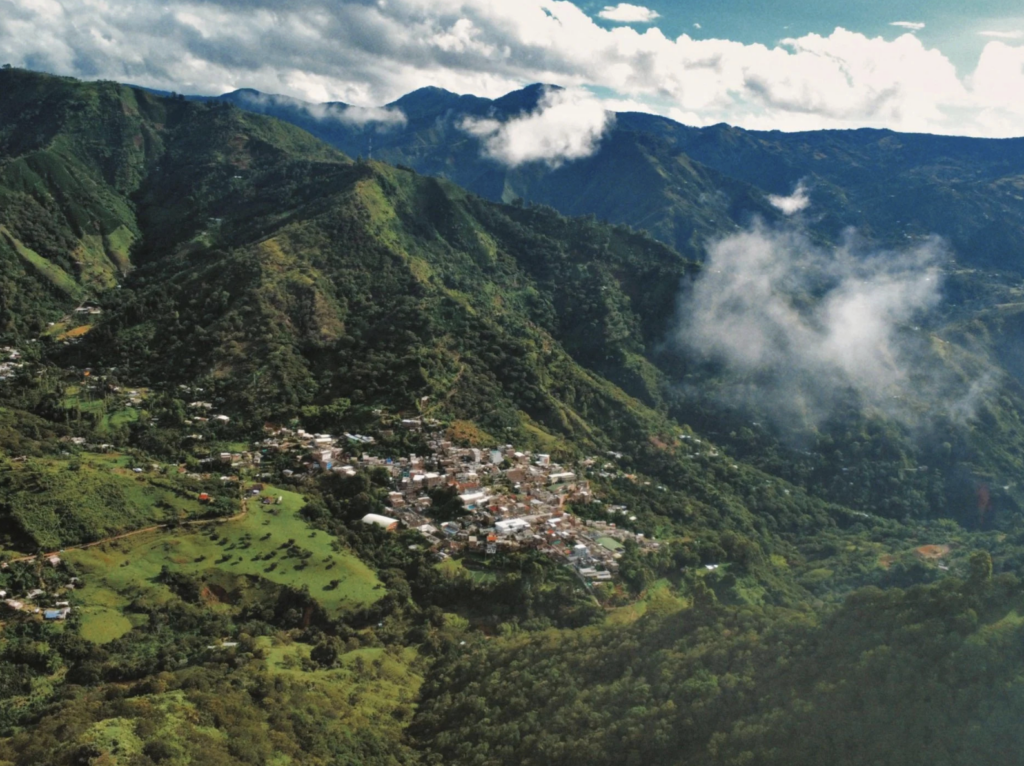
An aerial shot of Caicedo, Colombia, a coffee-growing community in the Antioqua Mountains of Colombia. (Waging Nonviolence/Omar Eliecer Blandón)
by Stacie Freasier
The following article appeared originally in Waging Nonviolence on April 22, 2026. It is reposted here under Creative Commons License (CC BY 4.0 International).
High in the mountains of western Antioquia, Colombia, where the mist settles into the coffee fields each morning and the air smells of wet earth and woodsmoke, exists the rural municipality of Caicedo. Approximately 60 miles from Medellín, Caicedo is home to around 10,000 campesinos, of whom only about 2,000 reside in its small urban center.
Something incredible takes place here. The people have chosen peace. Not once, in a moment of hope. But over and over again — through decades of terror, through kidnapping and murder, through grief so deep it could have swallowed them whole. They chose it at the ballot box. They chose it in their schools. They chose it in the way they grow their coffee and raise their children and remember their dead.
On April 1, in a bilingual webinar that moved many of us to tears, Pace e Bene Nonviolence Service officially welcomed Caicedo into the Nonviolent Cities Project — honoring it as the first nonviolent municipality in Colombia and a living example for communities everywhere that another way is possible.
What follows is their story. It belongs to them. We are only passing it along.
What They Endured
In the late 1990s and early 2000s, Caicedo was under siege. FARC guerrillas and paramilitaries took turns terrorizing the population. Coffee growers — the people who kept this mountain community alive — were singled out. Their crops were stolen off the trucks. They were extorted, kidnapped, murdered. Eleven people were killed in a single attack. The town’s temple was destroyed. The Vaho de Anacozca bridge, where people had once crossed to visit neighbors, became a place no one wanted to go.
Sign Up for our Waging Nonviolence Newsletter here. We’ll send you a weekly email with the latest articles.
The violence was designed to do what violence always does: to make people feel small, alone and afraid. To convince them that the only choices are to run, to submit, or to fight back with more of the same.
Caicedo refused all three.
The Coffee Caravans
The resistance didn’t start with a manifesto. It started with coffee.
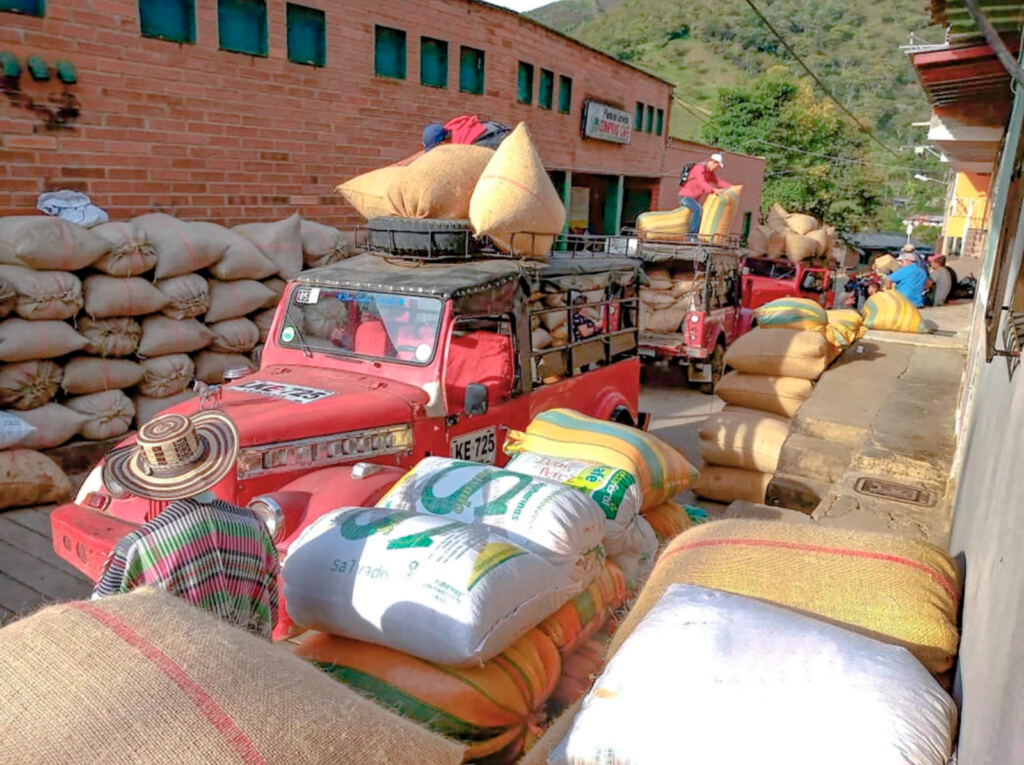
When FARC forces began intercepting harvests on the roads to Medellín, the people of Caicedo began moving together. They loaded their trucks and walked alongside them in groups — whole families, whole neighborhoods — using the visibility of their numbers as a kind of shield. The Catholic Church helped organize these first acts of collective courage, creating a space where the community could find its voice.
These coffee caravans were not protests in the traditional sense. They were something quieter and more radical than that. They were people saying, with their bodies and their labor: We are still here. We are still growing. We will not let you take this from us.
During one of these caravans, guerrillas attacked. A priest who was praying the rosary was struck on the head. His rosary beads were ripped from his hands and thrown into the river.
It was meant to humiliate. Instead, it lit a fire. Coffee growers from neighboring communities replaced the stolen beans. And the story of the priest’s rosary traveled far — across the ocean, all the way to Rhode Island, where it would reach a man who had spent his entire life answering the call of nonviolence.
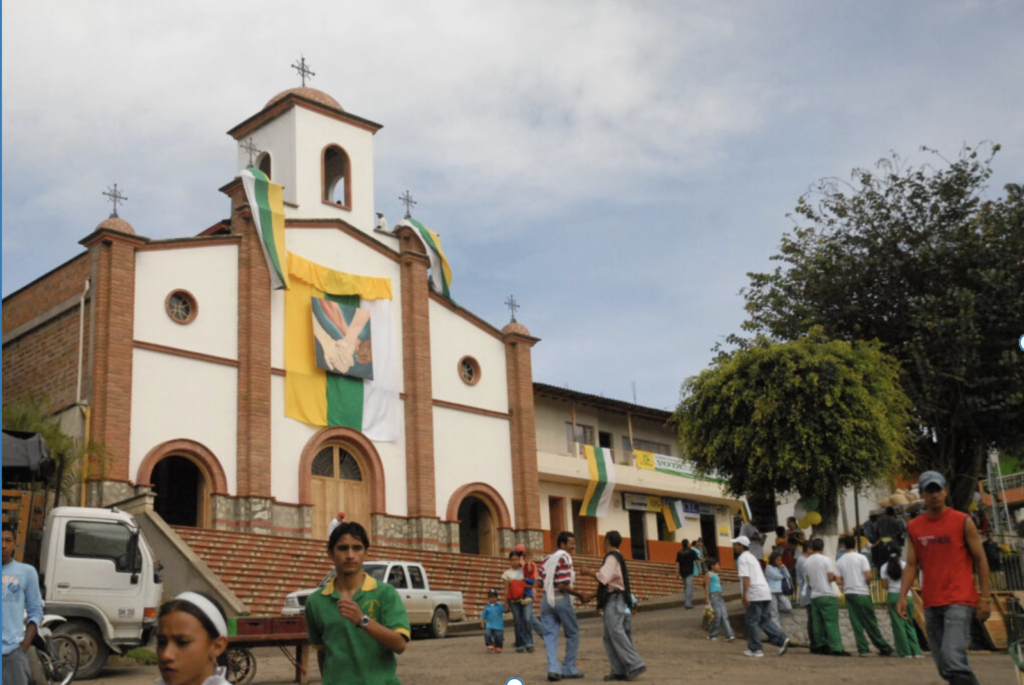
The Young People They Fought to Protect
While the adults were organizing caravans and rebuilding their bombed temple, they were also waging a quieter battle — one for the hearts and futures of their children.
In a region where guerrillas and paramilitaries routinely conscripted teenagers, Caicedo’s elders surrounded their young people with something stronger than a gun: music, art, collective memory and a shared language of peace. These weren’t after-school programs. They were survival strategies — deliberate, fierce acts of love designed to keep the next generation from being swallowed by the conflict.
Across the wider region, young people were building their own movements. In Medellín, the Red Juvenil, or Youth Network, founded in 1990 by young people who had lost loved ones to the violence, was training peers in nonviolence and cooperative play, refusing recruitment by any armed group. Caicedo’s own youth programs reflected a similar spirit — the conviction that if you teach a child to resolve a conflict without violence, you change the trajectory of a community.
The Governor, the First Lady, and the March
Gov. Guillermo Gaviria Correa was a man who read King and Gandhi and decided to govern that way. His “Congruent Peace Plan” wasn’t an abstract policy document — it was a way of life. And he shared that life with his wife, Yolanda Pinto de Gaviria, a lawyer and political leader who personally co-led marches and caravans with him across Antioquia. Together, they engaged more than 5,000 community leaders in a process of identifying problems and building nonviolent solutions.
In April 2002, Gaviria organized what he called the March of Nonviolence to Caicedo — a five-day, 75-mile walk from Medellín to the besieged mountain village. He asked the military not to come. This would be a civilian action, stripped of all protection except the moral authority of the people themselves.
The Catholic Diocese of Providence, Rhode Island, sent 10,000 rosaries to be carried from walker to walker along the route — a relay of prayer — destined for the parish of the priest whose beads had been thrown in the river. Well over a thousand people set out. Multiple mayors joined. Bernard LaFayette co-led the march alongside Gaviria and his Peace Commissioner, Gilberto Echeverri Mejía.
The march never reached Caicedo.
Captured
On April 21 — the fifth day — FARC guerrillas intercepted the column. Gov. Gaviria, Commissioner Echeverri, and LaFayette were taken.
LaFayette, who was diabetic, was released several hours later. Gaviria and Echeverri were not.
Think about what happened next.
LaFayette did not fly home. Instead, he chaired a four-day international nonviolence conference in Medellín — the one that had been planned alongside the march. Every day, more than 3,500 people came. Lines stretched down the block. Four University of Rhode Island students had traveled to Colombia alongside their university president and a psychology professor to participate.
But perhaps the most powerful gathering at that conference was the quietest one. Alongside the main sessions, 2,000 children attended a nonviolence camp — learning the principles of peaceful resistance while their governor was being held hostage somewhere in the jungle. These were not children being sheltered from the truth. They were children being prepared to build something different.
Among the featured presenters was Nobel Peace Laureate Mairead Corrigan Maguire of Belfast — a woman whose own life had been forever marked by political violence, and who understood better than most that the path from grief to peace runs through the heart, not around it. Dr. Naomi Tutu, activist and daughter of Archbishop Desmond Tutu, also spoke. Their presence said something important: this was not Colombia’s struggle alone. It belonged to the world.
A proclamation was read at the conference declaring Rhode Island and Antioquia “sister nonviolent states.” It sounds almost quaint, written down. But in a country where 500 people were being murdered every month in Antioquia alone, it was an act of radical imagination.
Yolanda
Yolanda Pinto de Gaviria did not disappear into grief.
With her husband captive in the jungle, she stepped forward. She took on the presidency of the Mother’s Day Campaign in Antioquia — a movement to reduce the shocking number of murders committed on that day each year. She launched an international campaign to free all hostages, not just her husband. Alongside LaFayette and Mairead Corrigan Maguire — who led a newly formed Global Nonviolence Committee — she brought the case to the United Nations and Amnesty International. She traveled with LaFayette to New York to plead for help.
On May 5, 2003, the Colombian military attempted a rescue. The FARC executed Gaviria, Echeverri and eight other hostages.
Lafayette flew to Colombia for the funeral. His words that day still echo:
“The world, not just Colombia, has lost a great nonviolent leader. I share the grief with Yolanda. We stand by her in this moment and with her in this struggle to build a nonviolent state in Antioquia. In the nonviolence struggle we experience losses, but even in those losses there are unseen and immeasurable gains. This causes us to be more determined. The struggle will continue.”
Gaviria was posthumously nominated for the 2004 Nobel Peace Prize. His letters from captivity were published as “Diary of a Kidnapped Colombian Governor.” Mairead Corrigan Maguire described what she found in those pages: a brave and deeply spiritual man whose compassion was not corrupted by suffering, but deepened into an all-encompassing love — even for his captors.
And Yolanda?
She has spoken about how the grief nearly broke her — how for two years she stepped away from the nonviolence movement entirely. But then she remembered her husband’s words: do not live with resentment. Build societies rooted in peace and understanding, even between adversaries.
She came back. She served in the Colombian Senate, where she co-created the Commission for Women’s Equity in the Colombian Congress, advanced legislation for caregiver recognition, and championed the institutionalization of nonviolence education across Colombia. She later served as director of the Unidad para las Víctimas — the national agency charged with repairing the lives of millions of families shattered by the armed conflict.
In that role, she met the very soldier who had been part of the failed rescue mission — the operation that ended with her husband’s death. They embraced.
That embrace is Caicedo’s story in a single image.
The Thread Unbroken
Let us trace it clearly, because it matters.
Martin Luther King Jr. told LaFayette to internationalize nonviolence. LaFayette brought it to Antioquia. Gaviria and Yolanda built it into government. LaFayette helped them organize the march. They were captured together. Gaviria was killed. Yolanda carried the work into the Senate. And the people of Caicedo — the very community all of this was meant to protect — responded not with vengeance, not with despair, but by voting. Twice. In 2007 and again in 2013, they went to the ballot box and declared themselves “Noviolento.”
Not because someone told them to. Because they chose it.
In 2014, Colombia’s National Center for Historical Memory made it official, designating Caicedo the country’s first nonviolent municipality. In 2020, the center launched a memory initiative called “Al mundo entero: Caicedo, un camino hacia la noviolencia,” or “To the Whole World: Caicedo, A Path Toward Nonviolence,” built on years of community workshops documenting local stories of resistance, featuring the voices, photographs and reflections of the people who lived them.
Gov. Gaviria’s brother, Aníbal, carried the nonviolence agenda forward as the next governor of Antioquia. The murder rate dropped by over 60 percent. The government adopted a formal Public Policy for Peace, Nonviolence and Reconciliation. Young people were trained as nonviolence facilitators through the Antioquia Adventurers Network. The Sowers of Peace Award was established to honor communities doing this work across the department.
And in 2023, Antioquia hosted the International Summit on Nonviolence in Caicedo itself — 20 years after the march that never arrived, in the town that never stopped walking toward peace.
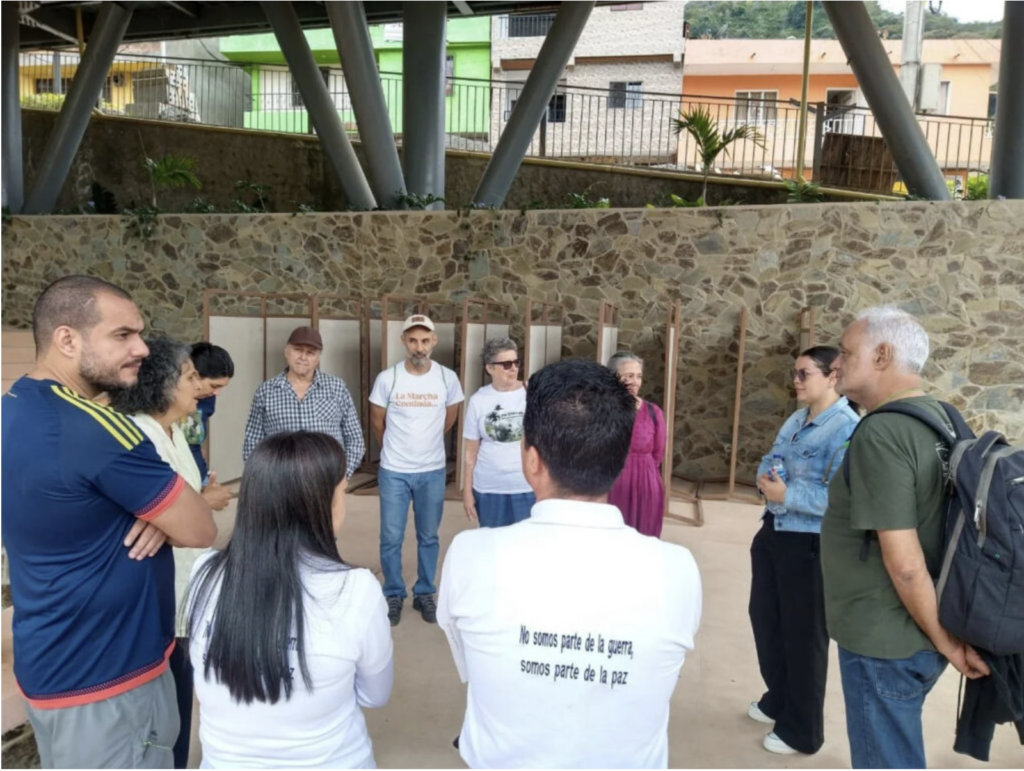
Transforming Pain into Purpose
In our April 1 webinar, we didn’t hear speeches. We heard testimony.
Omar Blandón. Edilia González. Fernely Benítez Lopera. Each of them spoke about what it means to live in a place that turned its deepest wounds into its defining purpose. Edilia, in particular, represents the women of Caicedo who sustained this movement through its most brutal years — the mothers, the farmers, the teachers, the organizers who kept nonviolence alive in their kitchens, their churches and their fields, even when no one was looking.
Daniel Gaviria, son of the governor of Antioquia, Guillermo Gaviria Correa, spoke about his personal experience studying the U.S. civil rights movement as his father embarked on the march to Caicedo in 2003. He shared how his belief in nonviolence was tested to the breaking point when his father was assassinated. And how a letter from his father reminds him to this day of the challenge and power of adhering to principles of nonviolence.
What they’ve built is extraordinary. A museum to hold the memory of the movement for every generation that follows. Annual commemorations honor those who gave their lives. An “open book of nonviolence” formed by naming the streets of town after people who inspire them on this path. And through Aprocafes, the local specialty coffee cooperative, Caicedo has made its nonviolence tangible — growing and selling coffee that carries the story of the community’s courage in every bag. The coffee caravans that once served as acts of survival have become an agricultural enterprise rooted in peace, connecting this tiny mountain town to international markets and global summits.
The Voice of the Future
And then there was Danna Yalena Diosa.
An 11-year-old student from Caicedo, she was the youngest voice in our webinar — and perhaps the most powerful. She spoke about what she has learned growing up in this community: that you resolve conflicts through dialogue, not force. That you attack errors, not people. That you include everyone, because peace built without certain voices isn’t really peace at all. (Listen to Danna Yalena here.)
Danna Yalena is not an exception. She is what happens when a community decides to invest in its children’s hearts as deliberately as it invests in its coffee harvests. In Caicedo, nonviolence education doesn’t begin in college or in an activist organization. It begins at home, in school, in the rhythms of daily life. The Antioquia Adventurers Network trains young people as nonviolence facilitators. Colombia’s national Cátedra de la Paz (Chair of Peace) curriculum — a vision Yolanda Pinto de Gaviria had long championed through her own legislation — has brought peace education into classrooms across the country.
But in Caicedo, this is not theory. Young people grow up hearing the stories of the caravans, of the march, of the governor who gave his life. They visit the museum. They participate in the commemorations. They learn the principles of nonviolence not from a textbook but from the community that has lived them — that is still living them every day.
Listening to Danna Yalena, something became clear: this movement will outlast all of us. From Yolanda Pinto in the halls of the Colombian Senate to Edilia González in the fields of Caicedo to Danna Yalena Diosa in her classroom — the women and young people of this community are its past, its present and its future.
Welcome Home
On April 1, Pace e Bene formally welcomed Caicedo into the Nonviolent Cities Project.
We did this not because we have something to give them, but because they have something to teach all of us. For over a decade, Pace e Bene has invited communities to put the word “nonviolent” in front of their city name and work to make it real — through schools, faith communities, city councils, economic structures, every institution that shapes how we live together. Caicedo has already done this, under conditions most of us can scarcely imagine.
Our Year of Nonviolent Solutions, running throughout 2026, asks communities everywhere to identify and uplift the nonviolent solutions already at work in their midst. Caicedo may be the most powerful example of a nonviolent solution in action that exists anywhere in the world.
An Invitation
Watch the webinar. Listen to Omar, Edilia, Daniel, Fernely and Danna Yalena. Listen in both languages. Let their words settle.
Then ask yourself: What would it look like to bring this spirit to my own community?
Caicedo reminds us that nonviolence is never finished. It is a practice — renewed each morning like the mist over the coffee fields.
Support Us
Waging Nonviolence depends on reader support. Make a donation today!
It began with farmers protecting their harvests and a priest whose rosary was thrown in a river. It grew through a march co-led by a Colombian governor and a civil rights veteran from Tampa, Florida, who had promised King he would take their movement to the world. It was sustained by a widow who chose public service over private grief, by a Nobel laureate from Belfast who helped build a global coalition, by the women of Caicedo who kept nonviolence alive in their homes and fields when the world wasn’t watching, and by 2,000 children who learned the principles of peace while their governor was held captive in the jungle.
It was tested by kidnapping and murder — and it held.
It was ratified at the ballot box. Woven into public policy. Preserved in a museum. Planted in coffee fields. And passed, with great tenderness, to a new generation — young people like Danna Yalena Diosa and the young trainers of the Antioquia Adventurers Network — who carry it forward not as a burden, but as a birthright.
LaFayette, who passed away on March 5 at the age of 85, would have rejoiced to see this moment. A small mountain community, born in violence, declared nonviolent by its own people, welcomed now into a global family committed to proving that another way is possible.
Sí, hay un camino: la Noviolencia.
Yes. There is a way: Nonviolence.
Bienvenidos, Caicedo. Welcome to the Nonviolent Cities Project.
This story was produced by Campaign Nonviolence
Stacie Freasier (she/they) directs resources toward nonviolence education, racial justice, and community organizing as Director of Development at Pace e Bene Nonviolence Service and Founder of c3 Catalyst, a consulting practice serving nonprofits. She is a Level II Kingian Nonviolence Conflict Reconciliation Trainer for the Selma Center, with a training lineage from the late Dr. Bernard LaFayette, Jr. She hosts the podcasts Racism on the Levels and Nonviolent Austin Radio Hour and is a key organizer within Nonviolent Austin.
A Better World Is Possible” is an Indy feature that offers snapshots of creative undertakings, community experiments, innovative municipal projects, and excursions of the imagination that suggest possible interventions for the sundry challenges we face in our communities and as a species. Have you seen creative approaches to community problems or examples of things that other communities do to make life better for their residents that you think we should be talking about? Send your observations/suggestions to amherstindy@gmail.com. See previous posts here.
An outstanding article. A moving account of the first step toward the creation of a nonviolent world order, which must begin with small communities in which children at the earliest ages learn through the examples around them that nonviolence is a powerful way of life.