
Area Organizers Respond to Escalating Federal Aggression Towards Cuba
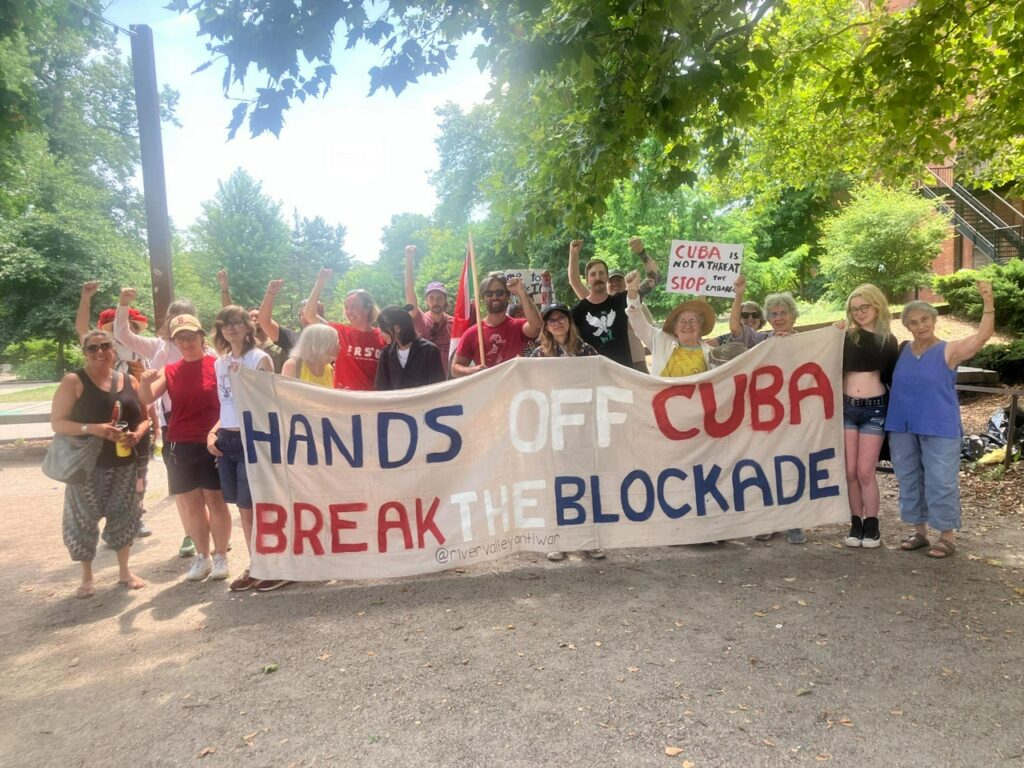
River Valley Anti-War Committee rally in solidarity with Cuba. Pulaski Park, Northampton, MA, July 26, 2026. Photo: Fight Back! News
by R. Nicholas
As the Trump administration’s trade embargo against Cuba ramps up, local organizers spoke to The Shoestring about their solidarity efforts.
The following article appeared originally in The Shoestring on July 31, 2026. It is reposted here under a Creative Commons license.
Merri Ansara was part of the first Venceremos Brigade in 1969, which brought United States citizens to Cuba, 10 years after a socialist revolution toppled a U.S.-backed dictatorship. Anasara and other volunteers defied an embargo on the Caribbean island nation to practice solidarity through voluntary labor and educational opportunities.
“I went as a completely ignorant, uneducated, non-political person,” Ansara told The Shoestring from her home in Easthampton. “That first brigade broke the silence on the embargo that surrounded U.S. and Cuba at the time. Later on, 179 of the 260 people in the first brigade from the U.S. who participated in it were interviewed, and every single person said that it changed their lives.”
Travel to Cuba became more difficult in the ensuing years as the United States ratcheted up tensions, particularly with 1992’s Cuban Democracy Act and the Helms-Burton Act of 1996, both of which strengthened the embargo. As the Trump administration rolls back liberalization efforts and applies new pressure on Cuba through renewed trade sanctions and targeting of solidarity groups, a growing cohort of the U.S. left is continuing their decades of solidarity activity despite threats from Republicans.
In addition to regularly traveling to the island to bring supplies over the years — and encouraging others to do the same through a travel agency she ran until the early 2000s — Ansara hosts a monthly Cuban film series at Luthier’s Co-op. In 2023, she spoke with U.S. Rep. Jim McGovern, D-Worcester, about normalizing relations with Cuba, conversations which helped lead to the January 2024 letter sponsored by McGovern and Rep. Ayanna Pressley, D-Boston, asking President Joe Biden to take Cuba off the state sponsor of terrorism list. (He did, but Trump rescinded this action early in his second presidency).
“These projects give people a way to voice their desire for normal relations with Cuba,” she said. “Massachusetts alone has a couple of hundred years of close contact and relationships with Cuba. Revere Sugar and United Fruit Company were headquartered in Boston and directly connected in trade with Cuba. The first commercial ice company was headquartered in Massachusetts and their first customer was Cuba. The wrappers for Cuban cigars came from Hatfield as part of the Connecticut Valley’s tobacco industry. There is a larger story just about Massachusetts and Cuba alone.”
On April 26, Ansara traveled to Cuba as part of the National Network on Cuba’s annual May Day Brigade, along with other supporters including Eric Ross, a doctoral candidate at UMass Amherst who works with Mass Cuba Solidarity, a part of the National Network. This year’s May Day Brigade brought hundreds of thousands of dollars in medical supplies, school supplies, and other essential materials otherwise inaccessible to Cubans due to U.S. sanctions. Prior to the brigade, Mass Cuba Solidarity set up boxes around western Mass where the community could donate medication, medical supplies, and sanitary products, which were then brought directly to the island.
“One of the intentions of the U.S. government is to artificially inflate and inculcate a sense of fear amongst people who might otherwise be interested in supporting Cuba,” Ross told The Shoestring. “A lot of it is a sort of fear tactic, a political theater in order to deter people from going to Cuba and seeing what it’s like there and helping the Cuban people.”
The U.S. right has ratcheted up pressure on pro-Cuban activists recently.
A new State Department report, titled “Cuba: The Capital of 21st Century Communism,” positions the island nation as a “failed state” that has nonetheless served as an international hub for “hatred of the United States” and a backer of an “unprecedented wave of left-wing terrorism on American soil.”
The report lists dozens of U.S. groups and individuals as “Front Groups and Fellow Travellers,” including elected officials like Pressley and New York Mayor Zohran Mamdani, “antifa,” Ben Cohen of Ben & Jerry’s ice cream, the National Network on Cuba, and Code Pink, a national anti-war group in which Ansara is a member.
“I think it’s got a twofold purpose,” Ansara told The Shoestring. “One is to try to stop the normalization of humanitarian aid to Cuba and leave clear room for the asphyxiation of the country, and the other is the determination to destroy Code Pink and other certain effective organs of the left.”
Aside from a visit from the FBI in the 1970s, Ansara said she’s never faced serious state repression for her solidarity efforts.
The Shoestring contacted the offices of McGovern, Sen. Elizabeth Warren, Sen. Ed Markey, and Rep. Seth Moulton asking for comment on the State Department document and the targeting of activist groups with chapters in Massachusetts. McGovern’s office was the only one to respond with a statement, which called the report “a thinly veiled pretext to crack down on civil society groups and freedom of expression in the United States, citing a bogus claim of national security threat from Cuba.”
“The naming of specific groups in the report clearly demonstrates this administration’s aim to silence dissent and free speech from groups they disagree with,” the statement continued. “The Trump Administration acts just like the authoritarian governments they pretend to differentiate themselves from. I will continue to stand with those fighting for human rights and standing up to oppression around the world.”
Ross, who was still in Cuba when Trump signed Executive Order 14404 to expand the sanctions against Cuba on May 1, said the United States has opposed the Cuban Revolution “not because it was unpopular, but precisely because it was so popular and so successful in addressing the needs of its people while demonstrating that a better society was possible.” The sanctions, he argued, are “meant to worsen what is already a criminal longstanding blockade, but also further deter people like ourselves that were willing to travel to Cuba and further cut off Cuba from international solidarity and material support.”
For Gloria Caballero, that solidarity is personal. The former Holyoke school board member and one-time Green Rainbow Coalition mayoral candidate was born and raised in Cuba, moving to Massachusetts in 1997 and leaving her mother and siblings on the island.
“People need to understand that Cuba has the right to be; they are not bothering anybody,” Caballero told The Shoestring over the phone.
“Today we are at a place of scarcity with people dying because of lack of medicine, no gas, power outages,” she said. “And yet these are 10 million people that are trying to mind their business, dancing, drinking their own rum and smoking their cigars, trying to be good human beings, and just finding ways to survive in the most creative and artistic way and sharing whatever they have. I cannot wait until the United States lifts the blockade that tries to make our social and political project fail.”
Like Ansara, Caballero has also met with Massachusetts politicians in an attempt to pressure a lift on sanctions at the federal level. In 2023, she and others met with U.S. Rep. Richard Neal, whom she said she told about having to bring bread to her mother in Cuba on every trip as groceries have become so expensive under the embargo. She asked him to write a letter to Biden in support of removing the sanctions affecting her family.
“I got emotional, and I saw tears in his eyes as well,” she said. “Neal looked at his aide, and he said, ‘We’re going to write that letter.’ But then he looked at me and said, ‘You know, Havana has such a coastline that would be an amazing place for real estate investment.’ And the guy started talking about his own investment, completely dismissing the message that I was trying to get through to him to understand.”
To this day, Caballero says, Neal has not sent the letter.
Neal’s office did not respond to requests for comment.
“The embargo affects not only the Cuban people, but all of the Cuban diaspora unless you’re very rich” said Caballero. “It is hard to accumulate wealth when you’re constantly sending to Cuba, taking away from what you would otherwise accumulate for your future, your family here.”
When asked what they would advise for U.S. citizens wanting to support Cubans, Ansara, Ross, and Caballero all stressed both travel and giving aid. Ansara is currently raising funds for Light for Life, which works to donate solar panels to maternity homes in Cuba suffering without reliable electricity under the current fuel blockade.
“One family in America could sponsor a Cuban family monthly with $100 of food bought online and that would make a difference,” Caballero said. “They would be internally breaking that embargo. But sometimes people don’t even want money. They want a voice that’s telling them, I hear you, I see you, I understand you. Come visit us, stay with us, come here and cook with us. That’s what we want.”
R. Nicholas is a former editor and staff labor reporter of The Shoestring. He is currently a freelance journalist residing in Amherst, MA.
Read More
Northampton MA Stands in Solidarity with Cuba (Fight Back!News)
Trump’s Cruelty is Strangling Cuba (Truthout)“
A Better World is Possible: The Year Cuba Taught Itself to Read (Amherst Indy)