
Activists Condemn Assault on Academic Freedom at UMass
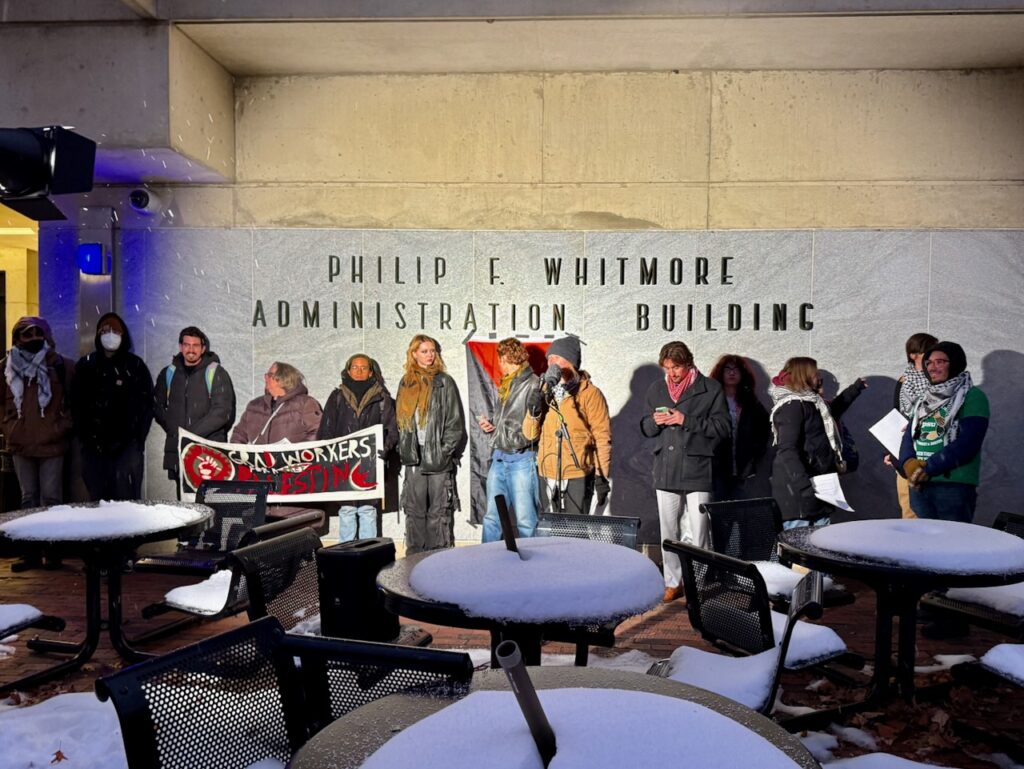
Members of the Western Mass People's Tribunal held a press conference on December 4, 2025 to condemn UMass' assault on academic freedom. Photo: Art Keene
Student activists supporting justice in Palestine, along with members of the Professional Staff Union and concerned faculty, held a press conference at the entrance to the UMass Whitmore Administration Building on a cold and snowy afternoon on December 4, to condemn the assault on academic freedom at UMass and disciplinary discrimination against students supporting Palestine. The event was organized by the Western Mass People’s Tribunal, the same coalition of activists that held a public tribunal on October 25, charging UMass and other Western Mass institutions with complicity in the ongoing genocide in Gaza. The event was recorded and can be viewed here.
Five speakers raised concerns that UMass Amherst Chancellor Javier Reyes and his administration have been harshly repressive toward the antiwar & Palestine solidarity movements on campus, as evident in the mass arrests of peaceful student protesters on October 25, 2023 and May 7, 2024. The speakers reported that the administration has begun to dole out extreme punishments to a handful of pro-Palestine student organizers—disciplinary actions that would effectively end their enrollment at UMass. These actions, they said, work to silence the voices of those speaking out against war and genocide and for justice in Palestine.
The speakers called attention to the discontinuation of academic programs at UMass Amherst and the dismissal of faculty teaching Arabic language and Palestinian history, noting that this contributes to cultural erasure. And they complained that while the cost of tuition continues to increase, the campus’ surplus budget is diverted away from academic opportunities and toward surveillance and militarization.
Organizers also condemned the administration’s weak responses to Islamophobia and anti-Arab racism on campus that has led the Council of American-Islamic Relations to designate UMass as a hostile campus and the Department of Education to begin a federal investigation into anti-Palestinian bias on campus.
The first speaker was Will Kenney, a graduate student at UMass Amherst and a member of Students for Justice in Palestine (SJP). He set the context for the event, saying that the world is witnessing the first live-streamed genocide in history and noting that Israel has already violated the so-called ceasefire in the Gaza Strip 591 times, killing more than 350 Palestinians since October 10, 2025, when it was declarad. Turning to the role of the university, he said, “we are gathered here today to hold to account an administration that is supporting a genocide, ignoring its workers, and silencing its students.” He condemned the UMass administration for “failing to meet a standard of minimum moral integrity,” and the hypocrisy of “supporting the ongoing genocide in Gaza financially and ideologically, while silencing and patronizing UMass students and faculty over the last two years.”
The next speaker was Kivligen de Montebello Jr., a Social Thought and Political Economy (STEPEC) major and a member of SJP who is currently appealing his suspension from UMass following charges of violating the student code of conduct. He said that his case exemplified how the university is singling out students who speak out against war and genocide.
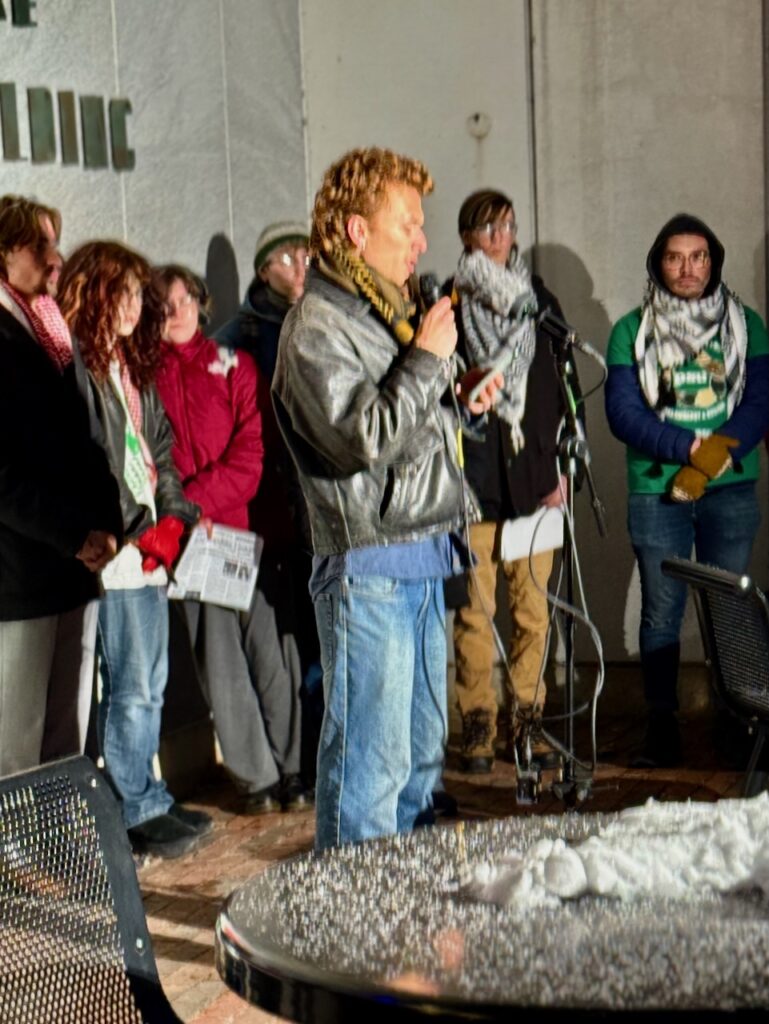
De Montebello was one of the students who protested the presence of weapons manufacturer RTX (formerly Raytheon) at a UMass Isenberg Career Fair this past September. Participants in that demonstration report that they all complied with the UMass Demonstration Response and Safety Team’s (DRST) directions to cease chanting and leave when informed that they faced disciplinary action; nonetheless, de Montebello, the only student protestor charged at that event, received five conduct charges for participating in the event and was suspended through May 31, 2026. He described his suspension as part of an effort to intimidate students and prevent them from speaking out against the university’s complicity in war. He added that his suspension reflects a double standard of selective enforcement, noting that no disciplinary action was taken against a pro-Israel student who threatened other students and shouted “death to Arabs.” He noted that the multiple calls for divestment from Israeli apartheid from across the campus have been met with arrests and suspensions, concluding, “This is no longer an educational institution but an institution that profits from death.”
Last week the UMass Student Government Association passed a resolution reaffirming de Montebello’s right to protest and urging the university to drop all charges against him.
Will Chaney, a graduate student in economics and a member of Graduate Student Employees Organization’s (GEO) Palestine Solidarity Caucus, described how he is currently under investigation by the UMass Equal Opportunity Access Office and is facing potential charges of six conduct code violations including charges of harassment and creating a disturbance during the encampments of 2024 (see also here). UMass has retained a law firm to conduct the investigation. Chaney noted that 170 students involved in anti-war and pro-Palestine actions have been found guilty of violating the university’s code of conduct without the university offering any evidence or facts. The administration’s purpose, he said, is not to defend campus safety “but to have a chilling effect on those who speak up in support of justice for Palestine. By speaking up, we risk further sanction, but we do so in hope of ending the repression here and the ongoing genocide in Palestine.”
Speakers Abigail O’Donnell and Marielsa McBride spoke of the cuts that UMass is making to Arabic language and Middle Eastern Studies courses. O’Donnell, a senior history major, reported that Dr. Mohammad Ataie, a long-time instructor in the History Department, was selected by the department to fill a permanent position but that decision was vetoed by the Dean of Humanities and Fine Arts and at the same time, Ataie’s courses were cancelled. O’Donnell described this as a “discriminatory attack,” not allowing students to learn about the history of Palestine and Israel and the Iranian Revolution. Following a concerted petition campaign by student activists, one of the cancelled courses, History 131, which focuses on the Middle East from 1500 to the present, was reinstated for the spring semester. O’Donnell said, “Students are being sent a message that certain points of view are not welcome.” She concluded, “We will not let marginalized voices and histories be erased from our campus.”
McBride read a statement from Kaitlyn Durand, a graduate student studying Arabic. Durand lamented systematic cuts in Arabic language courses at UMass as well as the termination of the Five College Arabic program. And she condemned the dismissal of a beloved instructor who had taught intensive Arabic at UMass for the last 14 years. While not all Arabic instruction has been cut, she said it is notable that the “four skill” program in the language department, which teaches speaking and listening as well as reading and writing has been removed. The remaining courses in “Judaic and Near Eastern Studies” only teach reading and writing. She said that these cutbacks were “a step in a systematic campaign to delegitimize, dismantle, and demolish Arab history and Arab culture.” She called on the administration to reinstate its four skill Arabic program and the instructor who was dismissed.
Kevin Young, Associate Professor of History at UMass Amherst,, summarized his just-released report entited “Besiged from Without, Undermined from Within: How UMass Amherst’s Budgetary Decisions Contradict Its Mission and Weaken Its Defenses Against Hostile Politicians,” (see full report and supporting documents here) on the UMass budget situation. He noted that UMass has justified cuts, such as those previously mentioned, under the pretense of financial constraints. However, his report documented that over the past three years there have been substantial budget surpluses for the campus and that there is no need to cut the resources on which students, workers, and the community depend when there are several viable alternatives. He cited waste in the athletic budgets and excessive administrator salaries as just a few of the areas where funds might be captured.
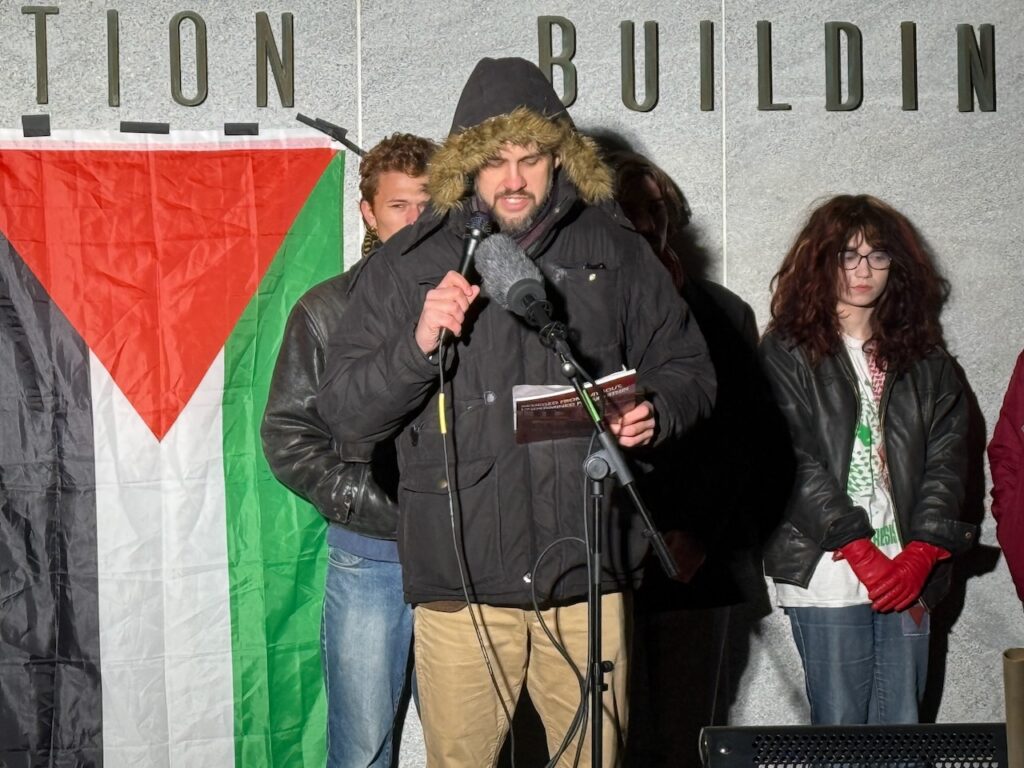
He said, “Repression and austerity go hand in hand. Austerity provides a pretense for administrators to cut disfavored programs”. He concluded saying, “by speaking out, we are defending the promise of higher education.”
The final speaker was Ari Jewell, representing the UMass Amherst Professional Staff Union (PSU), which, shortly after this press conference, voted overwhelmingly in support of motion of no-confidence in Chancellor Reyes. Reporting on the bargaining impasse faced by the union, Jewell condemned the political repression that impacts the entire campus, and lamented an administration that respects neither its students nor its employees.
UMass spokesperson Emily Gest was quoted in the Daily Hampshire Gazette, disputing several of the allegations raised at the press conference. She asserted that the university actively protects the rights of students to demonstrate and that at the RTX demonstration, the DSRT ensured that students were allowed to pass out flyers, even as the students’ actions were met with objections. Regarding the cancellation of classes, Gest stated, “All decisions on which courses take place are made by faculty and not administrators.” And concerning Kevin Young’s budget report, Gest said, “Across multiple areas, the report mischaracterizes investments in student and faculty support as detracting from academic spending rather than strengthening it”.
Student organizers countered Gest’s rebuttal of their press conference in a FAQ, which they released on December 6.
Does academic freedom apply to all? Even those professing support for a Jewish geopolitical entity in the Jewish people’s historic homeland territory?