
Town Council President’s Attempt to Silence DPW Workers Fails. Union Condemns Deplorable Working Conditions and Low Wages
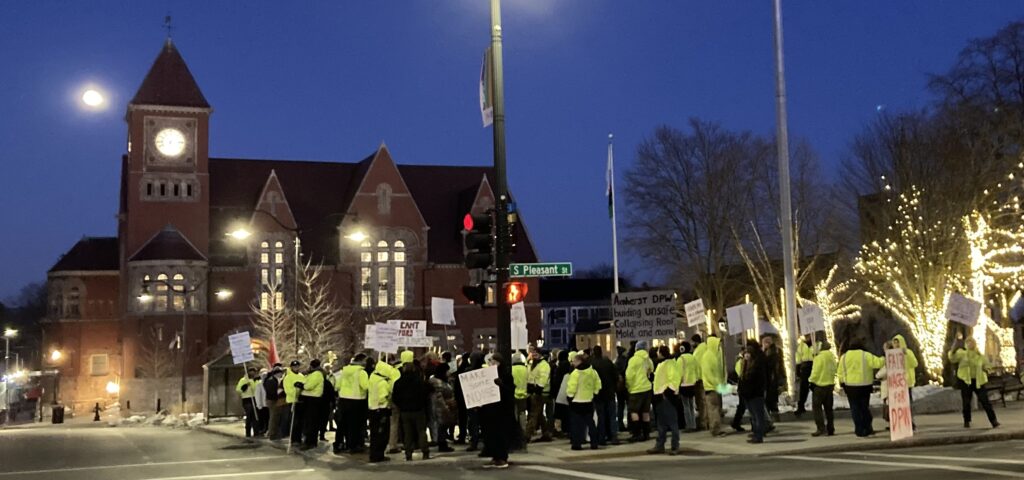
Amherst DPW Rally for a Fair Contract, March 2, 2026. Photo: Josna Rege
The air was brisk but the spirit was heated as about 150 people gathered on the North Common across from Town Hall on Monday evening, March 2, to support the Amherst DPW (Department of Public Works) Association’s call for a fair contract. The union has been working without a contract for seven months, after beginning negotiations over a year ago. Talks with the town have stalled, and the union is calling for the Town Manager to return to the bargaining table in good faith.
The rally was held just prior to a special meeting of the Town Council that had been requested so that DPW workers could air their grievances and concerns about the stalled contract talks and intolerable working conditions at DPW headquarters. But soon after the union had announced that there would be a special meeting and a rally, Council President Mandi Jo Hanneke determined that the meeting would take place entirely in executive session, denying the union a public forum to voice their concerns to the council. Hanneke cited M.G.L. c. 30A, § 21(a)(3) stating that “to discuss strategy with respect to collective bargaining or litigation as an open meeting may have a detrimental effect on the bargaining or litigating position of the public body.”
However, the intent of the special meeting was not for the council to discuss collective bargaining strategy, which is the purview of the Town Manager and not the Town Council, and speakers at the rally complained that this was just another instance of the town manipulating procedure to deny DPW workers an opportunity to publicly air their concerns.
The Town Room was filled with DPW workers and supporters who had attended the rally and who came inside for the start of the meeting. Hanneke opened the meeting with an announcement that the only agenda item was the executive session with no public comment permitted. She then made a motion to enter executive session. Councilors Amber Cano-Martin and Jill Brevik argued that an executive session was not warranted, as Town Councilors are already aware that they do not have a role in bargaining and contract matters. The vote to enter into executive session failed by a 6-6-1 vote (voting yes: Andy Churchill, Ana Devlin Gauthier, Lynn Griesemer, Hanneke, Sam MacLeod, and George Ryan; voting no: Brevik, Cano-Martin, Hala Lord, Jennifer Taub, Pam Rooney; and Ellisha Walker; abstaining: Cathy Schoen). Hanneke shut down requests from councilors to give the workers a chance to speak, saying that public comment was not listed on the agenda and that allowing them to speak would be a violation of Open Meeting Law.
Hanneke stated that workers would be free to return to speak during public comment at any regular Town Council meeting. The Town Council then voted 7-5-1 to adjourn and the videorecording of the meeting ended, disconnecting the three councilors (Lord, Taub, and Walker) who were attending remotely. A lawyer from KP Law, Clerk of the Council Athena O’Keeffe, and District 3 Councilor George Ryan quickly left following adjournment. Nine councilors, including Hanneke, remained in the room with roughly 40 DPW workers and the Town Manager, and spent about 40 minutes listening to the workers’ concerns, leaving many perplexed about the previously imposed constraints.
At the Rally
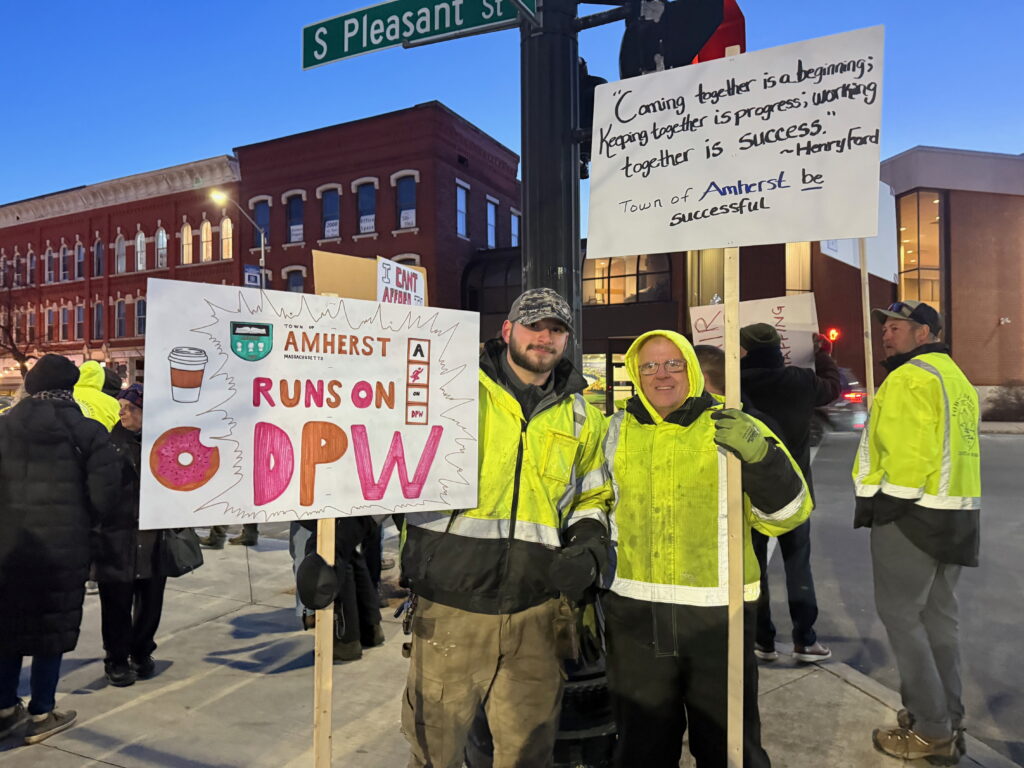
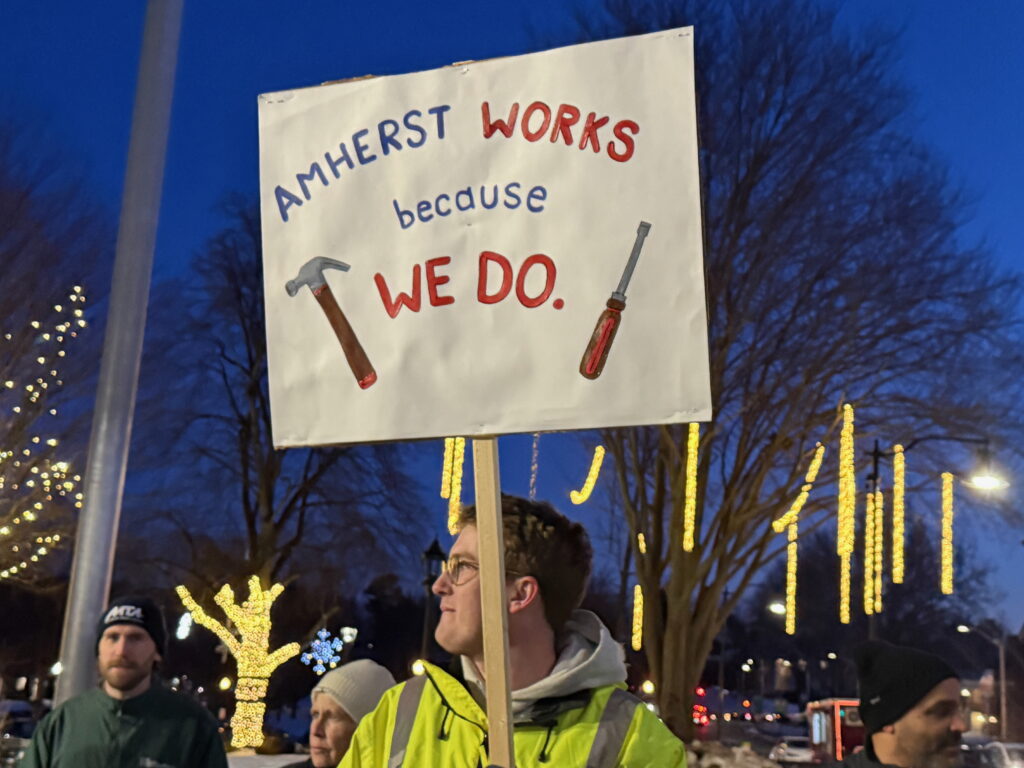
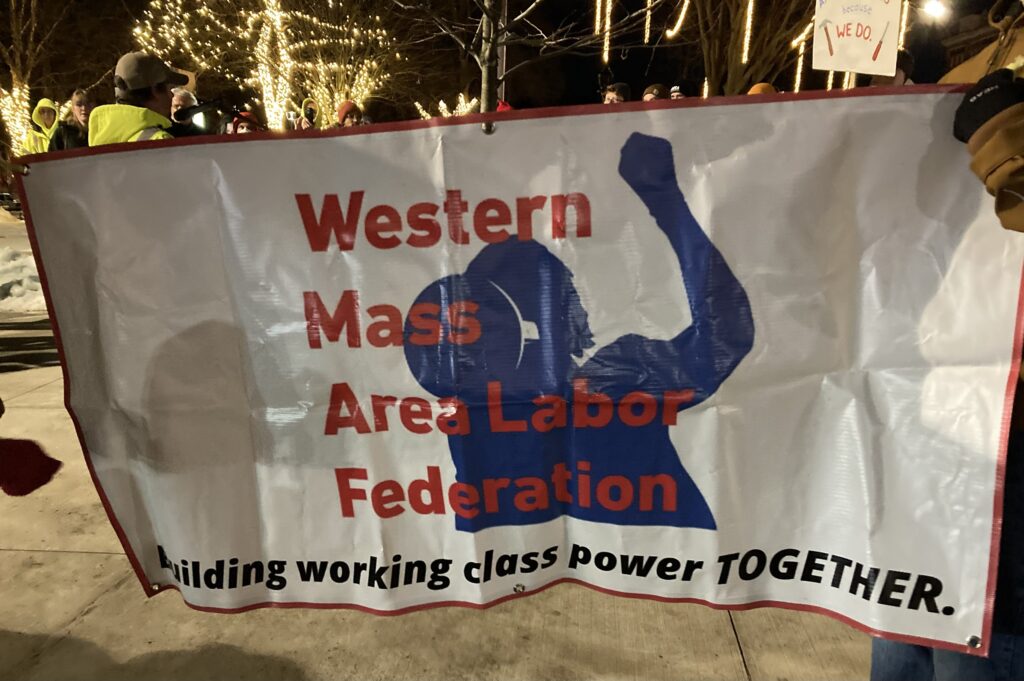
Prior to the council meeting, town workers, dressed in their municipal yellow winter jackets, stood on all four corners of the town’s main intersection at Main and Pleasant, holding signs proclaiming their grievances and attesting to the town-sustaining work done by the DPW, while shouting union chants, singing union anthems, and receiving strong support from passing motorists who honked their horns and shouted support from their windows.
The rally was sponsored by the Amherst DPW Association, the union of the town’s DPW workers and was attended by about 60 DPW workers, as well as town residents.
A lineup of DPW supervisors spoke of high turnover at the DPW, failure to increase staffing to meet the town’s growing population, low wages, a dangerous toxic workplace, and the unwillingness of the town to bargain in good faith, and compensation so low that the town cannot recruit or retain enough qualified people; and of enduring all of this while keeping essential services such as roads, water, lights, and sewer, indeed all town infrastructure fully operational.
“We are asking for fair wages that allow workers to live in the community they serve, staffing levels sufficient to protect public safety, and that the staff be kept safe from the mold, flaking lead paint, and inadequate ventilation of carcinogens, and we are asking for transparency because even if the town is okay with treating us this way, we know that the people who live in town and pay their taxes are not.”
John Foster, Amherst’s Drinking Water Supervisor
All speakers emphasized that the Town of Amherst would shut down quickly without the work of DPW staff, and they said that without a fair contract, workers would shut the town down. Speeches were met with shouts from the crowd of “shame!” and “shut it down!”, loud boos, and an occasional “thank you for the water,” each time a deplorable circumstance faced by DPW workers was mentioned.
Union President Andrew Brace led off a lineup of speakers. He opened by thanking the public for their support. He said, “We’ve never had support like this before. Every time we go into the bargaining room, they offer us nothing, with no reasoning and no evidence, and we’re not going to take it anymore! Over and over again, we point out how essential the work that DPW workers do is: water, sewer, cemeteries, streets, parks, playing fields, lights—there’s a wide range of responsibilities that we do that keep the town running. To not acknowledge that is a disservice to the workers and a disservice to the residents.”
Brace noted that turnover is a serious problem at the DPW and that the town hires inexperienced people, trains them, and after a few years sees them leave to take higher paying jobs in nearby municipalities. He said, “ Fifty percent of our non-supervisory staff have been here for less than three years and the town refuses to recognize that as an issue.”
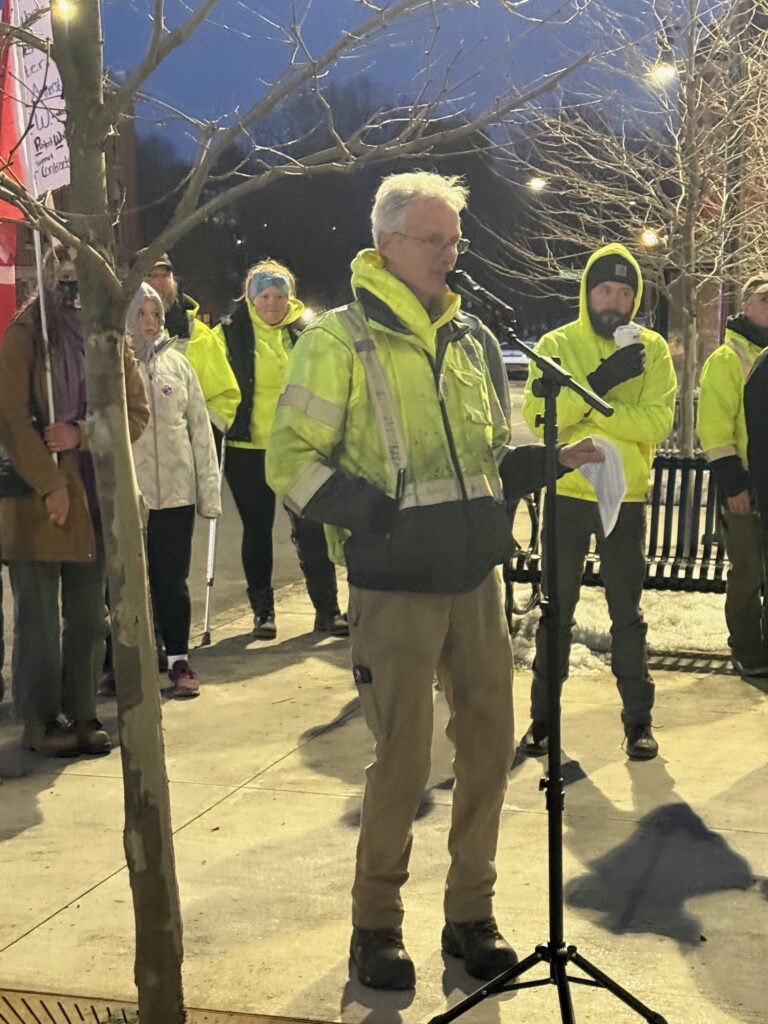
Alan Snow, Division Director and Tree Warden of the Trees and Grounds Division, noted that the population of Amherst has essentially doubled in the last 50 years and that Amherst has grown from being a small town to a city, “the city known as the Town of Amherst.” But while the town has grown, DPW staffing has not increased to address that growth. “Town Hall is busting at the seams with new staff and new positions because we have grown. We [The DPW] need to grow with the town.” He concluded, “I just want what we all want—fair pay—and to not offer fair pay is to disrespect not just the workers but the residents of Amherst.”
Jon Foster, the Town’s Drinking Water Supervisor, noted that the council’s refusal to meet with DPW workers was just another example of ongoing bad faith on the part of the town. He said, “Changing the format [of the special Town Council meeting] is not about procedure, it’s about control and making sure that the truth doesn’t get heard by the public. DPW workers in this town do not make a living wage. You can’t live in this town on a DPW wage. The town depends on only four T-4 Operators (Water Treatment Plant Level 4 Certified Operators) which are skilled, licensed, regulated positions. The town hires unskilled people, trains them, and then sees them leave for much higher-paying positions in other municipalities.”
Foster expressed frustration that the town is paying consultants and lawyers to help break the union and help them to not pay DPW workers adequately. “The town represents itself as progressive, committed to justice and equity. What about economic justice for the workers who keep this town functioning?” he asked.
He added, “Amherst operates some of the most complex infrastructure in the region; three water treatment plants, five wells, an aging distribution system, waste water compliance, stormwater management, fleet maintenance, snow and ice response, and extensive public property and grounds maintenance, and yet we are among the worst funded, worst paid, for a town of this size and complexity.”
Foster went on to talk about the shocking workplace in which DPW workers labor, which he described as a toxic building. “No one should be exposed to those conditions…. The town did a safety study a few years ago that came back with results showing toxic levels of mold and VOCs (volatile organic compounds) which the town has mostly ignored and this has become a perfect metaphor for how the town has treated its DPW workers.”
“We are asking for fair wages that allow workers to live in the community they serve, staffing levels sufficient to protect public safety, and that the staff be kept safe from the mold, flaking lead paint, and inadequate ventilation of carcinogens, and we are asking for transparency because even if the town is okay with treating us this way, we know that the people who live in town and pay their taxes are not. This rally isn’t about politics; it’s about public health, infrastructure, and respect. The workers deserve a contract that reflects the value of the work that they do every single day… Surely, the first step in fixing what is not working in this town is for the town to pay its workers a fair wage. We care about this town and it is time for this town to care about us,” he said.
Town Manager Says Talks Will Resume Soon
In an email dated March 1, sent to supporters of the DPW who had written letters of concern, Town Manager Paul Bockelman reported that talks with the union will resume this week. He said:
“Our DPW workers are highly valued colleagues and true first responders. Their incredible work has been on full display during the multiple large snowstorms this Winter and the subsequent clean-up efforts. They are on duty seven-days-a-week serving the Town to ensure vital services are readily available.
I am committed to working with our union leaders to reach a settlement that is fair, that makes needed investments, and that is financially sustainable for the Town.
Last week, Union leadership and I agreed to continue meeting this week. I will re-double my efforts to reach an agreement.”
Brief Council Meeting Adjourns Without Hearing Workers
The Town Council Meeting that followed the rally lasted 12 minutes. Hanneke prefaced her call to move into executive session, telling the workers who had packed the room that while public comment would not be allowed at this special meeting, they could return to offer public comment at future regular Town Council meetings. This left many in the room perplexed at the procedural distinction that comments could not be heard at this meeting. Hanneke then called for a vote to move into executive session, citing the Mass. Gen. Laws noted above. That vote failed 6-6-1. Hanneke then declared that, since there was no business remaining on the agenda, she would take a vote to adjourn.
After the vote to enter executive session failed, Devlin Gauthier asked, since there were so many people assembled who wished to be heard, if the council could take public comment under the provision of “matters not anticipated by the chair 48 hours in advance of the meeting”? Hanneke responded that she had anticipated a large crowd and hence, could not open public comment under that provision without violating Open Meeting Law.
The vote to adjourn passed 7-5-1, with Councilors Churchill, Devlin-Gauthier, Mcleod , Rooney, Ryan, Hanneke, Griesemer, voting yes, Brevik, Cano-Martin, Taub, Schoen and Walker voting no, and Lord abstaining..
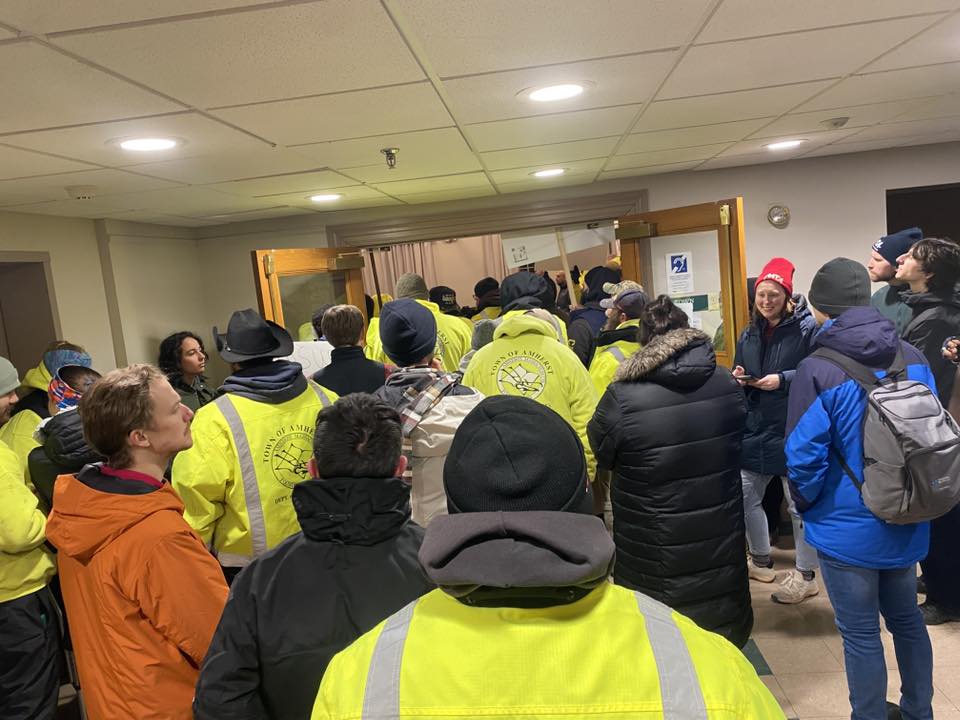
Councilors Listen to Workers After the Official Meeting
Following the adjournment, and after the town attorneys, the Clerk of Council Athena O’Keeffe, and Councilor Ryan had left the room and Councilors Walker, Lord, and Taub had signed off of Zoom, the other nine councilors remained in the room along with Town Manager Paul Bockelman and a large contingent of DPW staff and a handful of residents. After an awkward silence, Union President Andrew Brace began to address the councilors, saying, “We’re not here to break any laws. We know that the council can’t help us to bargain a contract, but we’re here because we try to provide essential services, and we’re not respected, we’re not paid, and it’s not fair for our staff, and it’s not fair for the town. And you guys have known about it for years now.”
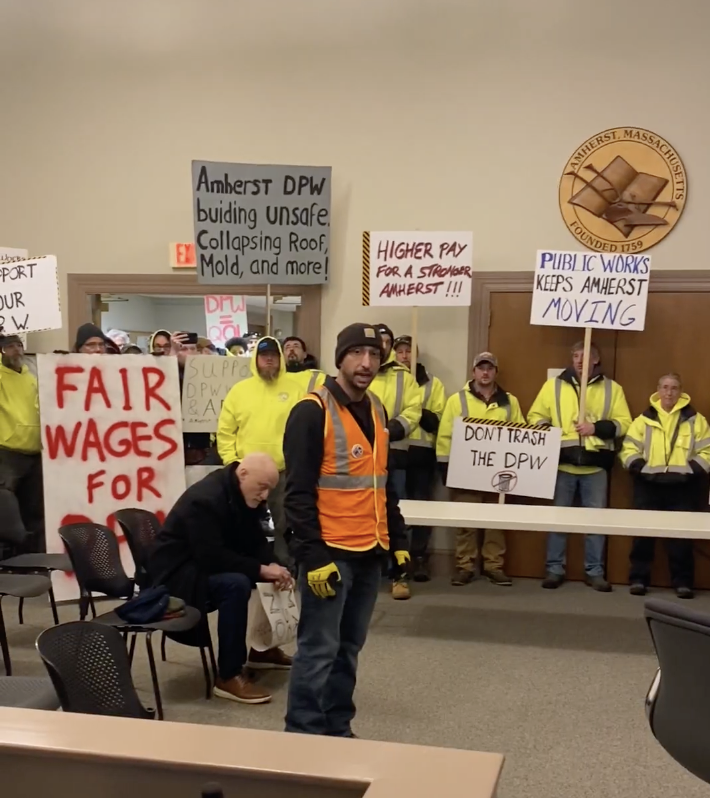
What followed was mostly an airing of experiences and concerns, many of which had been raised at the rally, from several of the 40 workers and supervisors in the room
Jon Foster lamented that we have a new $20 million water treatment plant and we don’t have an operator qualified to run it. “We have four water treatment operators in town for three plants and we’re running our people out the door. I just don’t understand the town’s thinking about this situation,” he said.
And Alan Snow elaborated on his comments at the rally about the inadequate staffing at DPW. He said, “we build all of this new stuff, new playgrounds, new school, a new library, and you would think that when we build new stuff we would build maintenance into the budgets to take care of this stuff, and from what I’ve seen, we don’t do this in this town.
The councilors mostly listened though there were a few brief exchanges such as when Councilor Andrew Churchill said “The reason we were trying to have this meeting tonight was to figure out what we legally can do and can’t do in terms of contract issues. Because there’s negotiations going on and we’re the council that doesn’t directly participate in the negotiations, but we wanted to give you guys a voice. This was actually going to be a technical meeting where we heard from the lawyer that we can and we can’t do some things so we don’t mess up the negotiations. But because of this, I don’t know what we’re going to do to figure that out. This was faced with boos and shouts of “shame” from DPW union members and the crowd of supporters in the room.”
Councilor Amber Cano-Martin said as the meeting was about to break up, “Thank you for coming to educate us about some of the issues that you all are facing. I just wanted to say that I know we’re not in session tonight as councilors, but I hope that we can go forward [and] work with you to address these issues. And just to make very clear that none of us think that we are the agent that bargains with you. We understand that it’s the Town Manager and that we understand that we cannot engage in bargaining with you. And that is not something that we would ever attempt to do in a meeting with you. So, thank you for being here and for taking the time. I can share your stories.”
The informal gathering dispersed after about 40 minutes without any commitments for further action on the part of the councilors, and left several in the room wondering why the councilors had been willing to hear the workers informally but not on the record.
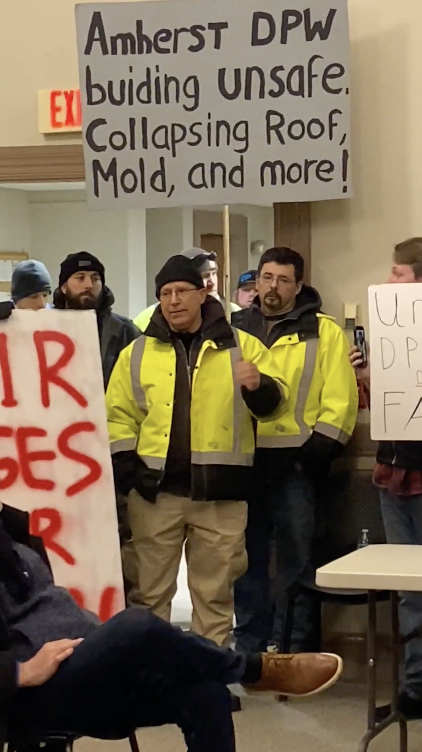
It was not necessary for the Council leadership to be hostile to the DPW workers. And it was not necessary to have KP Law educate the councilors as to their role in an executive session. The residents of Amherst and councilors should be hearing the stories of the DPW workers, just as they have heard stories told by Fire personnel and by school teachers and paras regarding their salaries and conditions of work. If the DPW workers could give public comment at any meeting, why couldn’t they do so on Monday? The way for our council to support our DPW staff in expressing their concerns is by providing a forum for them to speak. Thanks to the councilors who requested and supported having a forum, and who voted not to go to executive session, which was just a ploy to avoid having a meaningful forum. I agree with whoever said, “Shame!”
I was at the rally and in the Town Room for the meeting. The room was packed and overflowing. There couldn’t have been a more stark contrast between the profoundly human response of the DPW workers telling their stories and the ridiculous games being played by some town officials.
Thank you to all the folks in the DPW that keep the town going and to the councilors who valued them enough to stand up against the move to silence them.
Doesnt the Amherst town charter require that public comment has to be taken at all public meetings?
Public comment at special Town Council meetings is at the discretion of the Council President.
Erin, the Charter now requires public comment periods only at regular meetings of the Town Council. The Charter Review Committee has recommended that this requirement be extended to all regular meetings of Town Council committees. Public Forums are also required to include public comment periods.
“ Last week, Union leadership and I agreed to continue meeting this week. I will re-double my efforts to reach an agreement.”
From what I’ve heard ( can’t say it’s fact ), there have been zero negotiations going on. Months and months of zero. Re-doubling of that effort is still zero.
It is time this town’s management and the people in charge paid attention to what the DPW organization needs. It’s kind of obvious you don’t value them when you do this to them! Show them you don’t just care about the Jones Library and student rentals!
Ironically, one DPW worker holds a sign quoting Henry Ford, who was famously against unionization. Ford resorted to violence during worker’s strikes.
Indy, I feel like when you publish folks saying things like “From what I’ve heard (can’t say it’s fact)” that the comment section becomes more like a gossip column.
Editor’s note: The Indy does not post hearsay. Kurt Geryk appears to be referencing Jeff Osrbone’s statement above, “From what I’ve heard ( can’t say it’s fact ), there have been zero negotiations going on. Months and months of zero. Re-doubling of that effort is still zero.”
This may appear to be hearsay, and under different circumstances we might have excluded the comment, but the charge that no negotiations had happened for some time was confirmed with multiple sources close to the union, and the Town Manager’s own statement cited in the article suggests that talks had only recently resumed in the previous week. Nonetheless, we might have pointed out that Osborne’s statement had cleared fact-checking or that we had verified what he heard was true, or something along those lines. Going forward, we’ll keep an eye out to avoid that ambiguity.