
Planning Board: Downtown Design Standards Constrain New Housing Construction
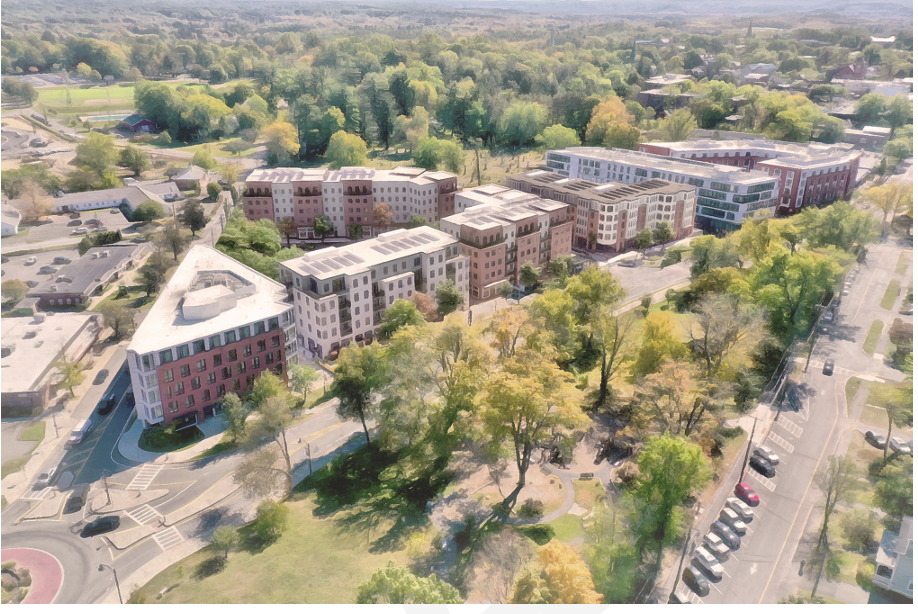
Architect's concept of a design for the Modern Main Street District of downtown Amherst. New structures, line sidewalks along East Pleasant and Triangle Street, and frame Pray Street, which is reimagined as a walkable “Festival Street” (A), that could be partly closed to traffic for special events. Wider sidewalks, spaces for outdoor cafes, and a continuous canopy of street trees add to the comfort and utility of the pedestrian environment. Photo: amherstma.gov
Report on the Meeting of the Amherst Planning Board, March 18, 2026
This meeting was held over Zoom and was recorded.
Present
Doug Marshall (Chair), Bruce Coldham, Fred Hartwell, Angus McLeod, Jesse Mager, and Jerah Smith. Absent: Johanna Neumann
Staff: Nate Malloy (Senior Planner) and Pam Field Sadler (Assistant)
Planning Board Responds to Proposed Downtown Design Standards
Planning Board members were given a presentation of the proposed design standards for downtown, similar to that presented at the March 11 open house. Peter Flinker and Dillon Sussman of Dodson & Flinker Landscape Architects presented an outline of the three-volume downtown design standards that resulted from almost two years of meetings of a working group composed of stakeholders and outreach to the public.
The proposed standards divide the downtown into four design zones: Traditional Main Street, Modern Main Street, Downtown Village, and Downtown Neighborhood. The consultants realized that downtown Amherst does not have a single character and wanted to highlight the different zones while providing guidelines for future development.
Traditional Main Street is the core of downtown around the Town Common, built mainly in the 19th century. Modern Main Street is the area on East Pleasant Street near Kendrick Park with the modern mixed-use buildings. Downtown Village is the west side of North and East Pleasant Streets north of Cowls Lane and north of Triangle Street where structures are smaller in scale with more green public spaces. Finally, the Downtown Neighborhood zone abuts the neighborhoods to the west and north of downtown. This area is residential in scale but would allow conversions to mixed-use buildings with shared driveways and interior alleys to encourage infill between the existing structures.
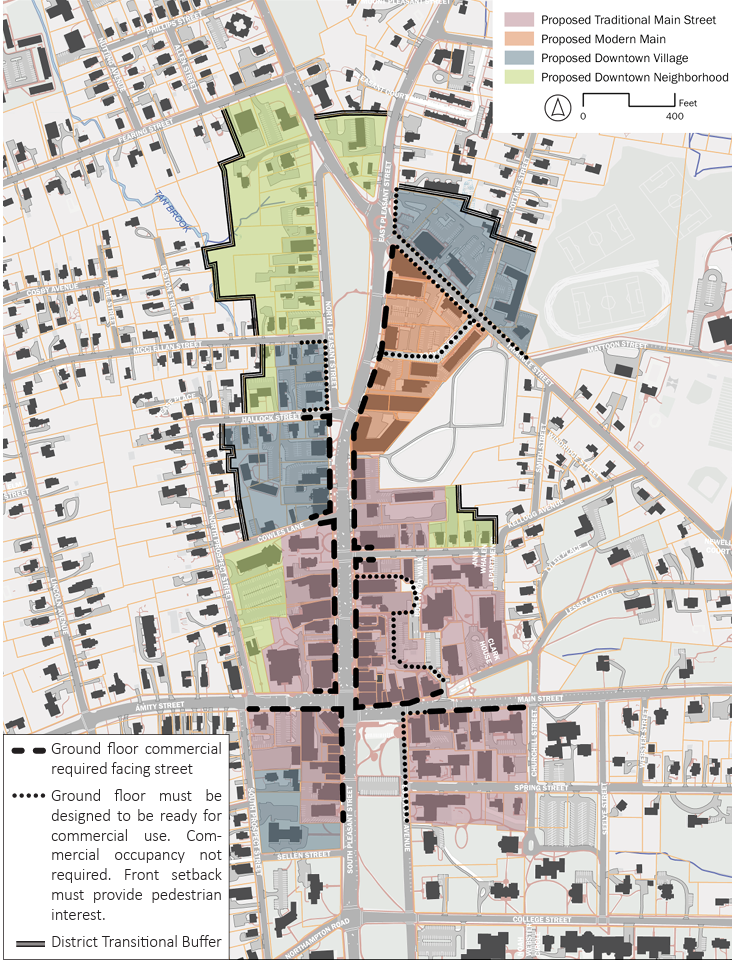
Several zoning changes were recommended, especially to the dimensional standards and the minimum area needed for each additional dwelling unit to allow for increased housing. Changes to permitting were also suggested. The draft standards specify setbacks and building size maximums depending on the zone. They also specify sidewalk widths and amenities such as benches and trees, encouraging enjoyment of the downtown and helping to protect the existing character of downtown Amherst.
Flinker noted that there was no universal consensus among the working group members, with some people stressing historical preservation and others wanting to optimize new development. The draft standards try to navigate that tension by presenting a range of options. The idea is to develop standards that are clear to developers and the boards that must approve them.
Mixed Reaction from Planning Board Members
While some Planning Board members liked the balance of preservation and growth in the draft plans, others were critical. Jerah Smith wondered how many more housing units would be created under the new standards and worried that, without incentives for developers to build taller and expand footprints, less redevelopment would occur. He asked, “What is the mechanism that will inspire that reinvestment and redevelopment that we’re looking for in our vision?”
Sussman replied that proposed changes to the limited business and general residential zones allow for reduced frontage and increased lot coverage, as well as reduced lot area required per family—all increasing density. However, he said he could not determine whether new buildings would be used for housing or commercial space.
Angus McLeod continued Smith’s thoughts: “This plan is proposing lots of changes to the downtown. At the same time, it’s also working to preserve a lot. And I think what I would encourage is some slightly more robust vision of change and faster change than what’s envisioned here.” He suggested a sixth-floor option for the traditional Main Street, and eliminating the Downtown Neighborhood zone. Referring to the area north of Triangle Street, which is actually Downtown Village or currently Limited Business (B-L), he said the area “is currently a bunch of parking lots and a few pretty worthless buildings that I think could all be torn down and have more modern main buildings put in.”
Planning Board Chair Doug Marshall added, “My biggest complaint is with the vision for the west side of Kendrick Park. Kendrick Park has really come into existence. It wasn’t even a park when I think I first moved here. The playground happened, and now it’s a park. To ignore that transformation and suppress the high desirability for that side of the park to be really wonderful housing for a lot more people seems a real miss to me. For us to artificially restrict that seems unfortunate to me. I will say, from a preservation point of view, very few of the houses along that stretch strike me as significant architecturally.”
Town planner Nate Malloy suggested that the Planning Board continue to discuss and possibly tweak Dodson and Flinker’s suggestions, especially for the north end of downtown. It will be mainly up to the Planning Board to introduce zoning amendments that will integrate the standards into the Zoning Bylaw.
Public Comments Sought
The draft standards were presented to the Design Review Board on March 16 and will also come before the Commission for People with Disabilities, the Community Resources Committee of the Town Council, and the Zoning Board of Appeals. Residents are encouraged to visit the Design Standards website, explore all three volumes, and leave feedback. The consultants will continue to take feedback until July 1, 2026. Comments on individual design standards can be made here. Click here to submit multiple comments by downloading a spreadsheet.
Town’s Clean Energy Bylaw Nearing Completion
The threat of a large solar installation off Shutesbury Road in 2021 led to the realization that the town’s guidelines for such large-scale projects were inadequate. Therefore, a Solar Bylaw Working Group was created and met biweekly from June 2022 through November 2023 to produce guidelines for large solar farms and an interactive map of appropriate sites.
The documentation was then turned over to the Community Resources Committee (CRC) to finalize a bylaw. However, as the CRC was finishing their work, the state issued new guidelines that went into effect on March 1, 2026, so the CRC had to amend their work to agree with the state regulations. The draft bylaw will be referred to the Town Attorney and will require a public hearing by the Planning Board and the CRC and a vote by the Town Council to be approved.
Sustainability Director Stephanie Ciccarello said that the state noted that many solar projects were being delayed for years by municipalities needing to approve them. This was interfering with the state’s meeting its climate action goals, so there is now a streamlined permitting pathway that issues a consolidated permit for each project.
There must be a decision on the permit within a year of the application being filed, meaning that all boards and departments involved (e.g. Conservation Commission, Planning Board, Zoning Board of Appeals, fire inspection, electrical inspection, Building Commissioner) must render a decision within 12 months or the project will be “constructively approved.” However, there is a 60-day prefiling period when the relevant entities can ask for the applicant to supply the information needed for evaluation. If one body does not grant approval, the permit can be denied.
Planning Board members expressed concern about the 12-month deadline for a decision. Malloy said that boards could meet together to decrease the timeline for evaluation, but it would still be a challenge for the town to meet the deadline. There would be a point person on the town staff to coordinate the process. Cicarello did not think that Amherst would have a lot of projects to evaluate, because there is not that much suitable land available. Rooftop and canopy solar projects are exempt from this process.
Housing and Zoning Subcommittee Recommends Revision of Mixed-Use Building Bylaw
Malloy contended that owners of mixed-use buildings were having difficulty renting their nonresidential space. The current bylaw requires that 30% of the ground floor area be nonresidential. Malloy said that the Housing and Zoning Subcommittee of the Planning Board was considering adopting a more flexible standard, similar to that used in the University Drive Overlay zone. That standard requires that 75% of the street-facing area to a depth of 24 feet be nonresidential. These new guidelines would only apply to areas outside of the downtown.
The Planning Board referred the proposed new mixed-use building bylaw to the Town Council by a unanimous vote.
The subcommittee also recommended reducing the lot area needed for each additional dwelling unit in the Residential Village Center, Business Village Center, Neighborhood Business and Commercial zoning districts, to allow more dense housing in those areas.
McLeod and Smith are developing a plan to combine the Professional Research Park and Office Park zones and to suggest what type of housing could be built in those zones.
Bruce Coldham is exploring creating subdivisions with smaller lots to create workforce housing, possibly through a MGL40Y process which promotes starter homes.
The Dodson & Flinker report attempts to find the sweet spot between those who want to limit overdevelopment and those who support more 5- or even 6-story buildings downtown. I think it is not widely recognized that Amherst has surpassed the state’s 10% affordable housing benchmark, leading every surrounding town; only Northampton has also achieved that goal.
As for proposals to lower the requirement below 30% of the ground floor being commercial, please recall that 30% was already a reduction from 60%, which was in force until 2021. I recently saw a very impressive map of all the businesses in Amherst Center, and I was surprised by how many there are, even as a frequent user of downtown. I cast my vote against any further reduction.
The Dodson & Flinker report already suggests a strong compromise: allowing first floors to be “commercial ready” in case tenants emerge for those spaces. In addition, the area west of Kendrick Park borders a local historic district, so the Planning Board may want to be more conservative about loosening zoning controls.
That entire section of town also has a single owner who does not want to build 5- or 6-story buildings. The report proposes a plan for that area that seems both reasonable and profitable and does not require as much zoning flexibility as some have suggested.
Lastly, I am told that UMass’s foreseeable spending will focus not on building new dorms, but on renovating 1970s-era housing. I understand why that is necessary. However, we waited years for public-private partnerships to become legal; they did, and then not much happened. UMass is our major industry, but it should not continue to be the tail wagging the dog.
I’m not an expert on the specifics discussed here, but I’d like to say that I’m very much in support of the artists rendition of the portion of Down Town adjacent to Kendrick Park. I especially like how it concentrates development close to UMass, and creates major steps towards a more bike and pedestrian friendly future!