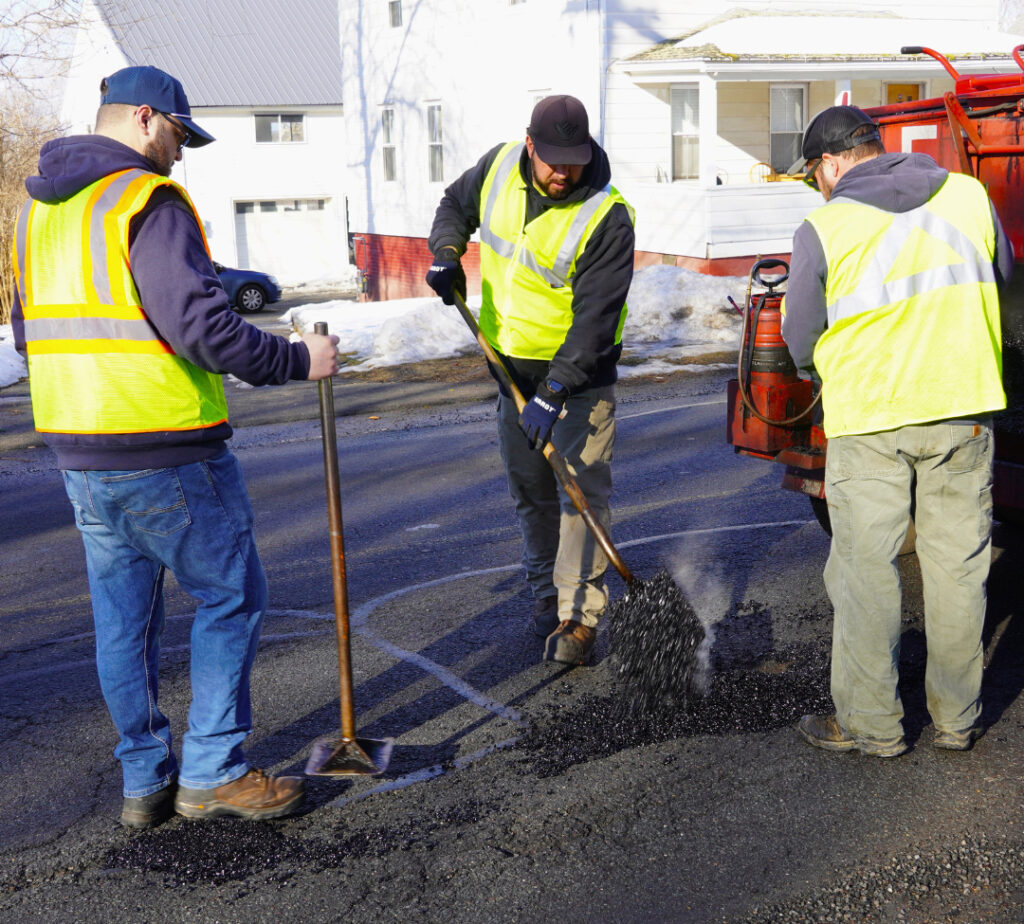
A crew from the Amherst Department of Public Works filling potholes on Sunderland Road, Febuary 2025. (L-R) Scott Gavron, Robert Zakaitis, and DJ Gancorz. Photo: amherstma.gov
Editor’s note: In anticipation of this week’s discussion by the Town Council of the situation at the DPW, we are reposting this article from July of 2024. The following article appeared originally in the Amherst Indy on July 4, 2025.
In 2024 Amherst spent just under $2 million from its general fund on public works according to state data. When divided by a population of 39,263, this works out to an investment of local tax revenues into highways and other infrastructure of $49.75 per resident.
This level of expenditure places Amherst in last place among all Massachusetts cities and towns. The statewide average public works spending per person is $367 or more than seven times higher than what Amherst allocated from its general fund.
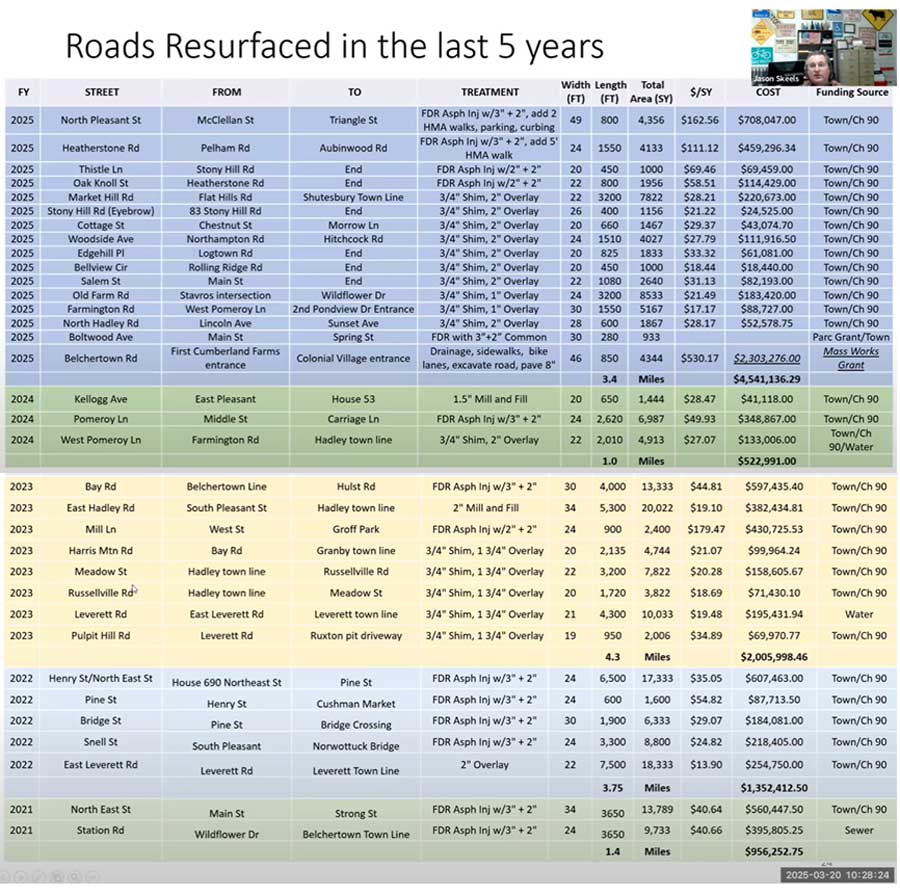
Amherst’s low budget priority for public works helps explain why the town invested only $522,991 in road resurfacing in 2024 and completed only 1 mile of road treatment.
Amherst road resurfacing since 2021. Source: amherstma.gov
Road maintenance is typically paid for by a combination of general fund appropriations and state Chapter 90/Fair Share funding that added $1.2 million in 2024. Town Engineer Jason Skeels explained that in 2024 “we were working on the Pomeroy roundabout and were worried about the budget so we only did a couple of roads and saved some of our chapter 90 money just in case we had to spend it to finish the roundabout.”
In FY25 Amherst road resurfacing coverage improved to 4.3 miles thanks to a MassWorks grant of $2.3 million for work on Belchertown Rd. Using the town’s StreetScan program, Skeels estimates that to maintain the town’s current Pavement Condition Index of 62 (55 to 70 is considered “fair”) will require a resurfacing commitment of $18 million over the next five years, or $3.6 million per year. Actual improvement of road conditions will require spending $5 million per year.
Amherst Library Spending Exceeds Public Works Other categories of general fund spending have fared better in Amherst, e.g. library funding. The Jones Library is a cherished institution in town, benefiting from a dedicated Friends organization and a strong library lobby.
The town contributed $2,213,530 from its general fund in 2024 toward the Jones Library operating budget for a rate of $55.26 per resident. This makes Amherst one of only two towns in the commonwealth to spend more for library services than for public works. The other is West Tisbury on the island of Martha’s Vineyard with a total of 14 miles of roads.
Beginning in FY27 the commitment of town funds toward the Jones Library will see a bump, as the Capital Improvement Program calls for paying back debt service of $1.3 million for the library renovation-expansion project. This amounts to an additional general fund expense of approximately $34 per resident.
What’s a Citizen to Do? A robust submission of comments to the Amherst Indy indicates a high level of concern among residents over the state of Amherst roads, and offers several suggestions.
The idea that the University of Massachusetts should contribute toward improving Amherst’s roads makes sense. UMass accounts for more than half of the town’s population and is responsible for a corresponding amount of wear and tear on the town’s roads. The state’s formula for apportioning Chapter 90 road funds is in fact based on each community’s population and employment as well as road miles. This works to Amherst’s benefit as in 2024 the town received $11,500 per mile in state road funding compared to the statewide average of $9,000 per mile. However, as is the case with Chapter 70 public education support, state funding for roads does not come close to providing what Amherst needs.
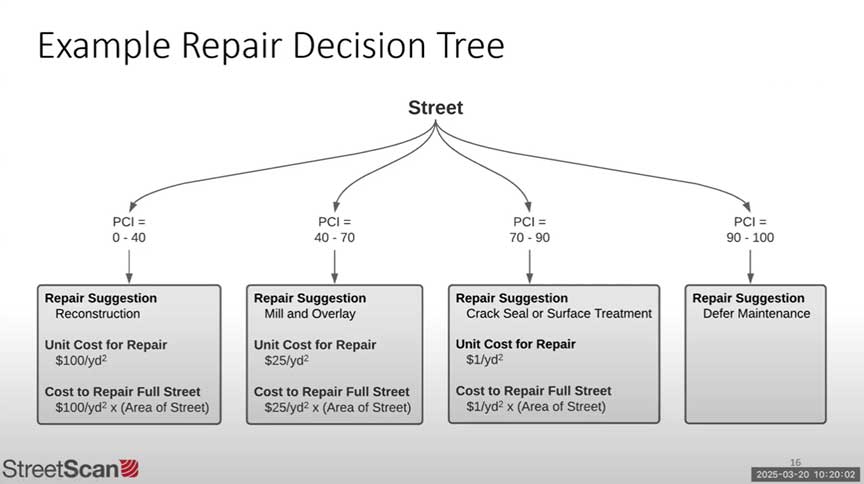
Questioning the materials and techniques used to address road repairs is also in order. Surface treatment is no substitute for milling/overlay which is no substitute for road reconstruction. More durable repairs are more expensive.
More serious road problems require more costly repair approaches. Source: amherstma.gov
The ultimate solution is to elect leaders who understand sound fiscal management and recognize the importance of public works. The campaign season for the November election of a new town council is gearing up. Know where candidates stand on road maintenance or consider taking out nomination papers!
4 thoughts on “Indy Rewind: Amherst Ranks Last in Massachusetts in Public Works Spending Per Capita”
And, more recent data show an increase in DPW spending.
From FY 2010 – FY2024, Amherst had never spent more than $2 million from its general fund on public works, according to state data.
For FY 2025, those state data show Amherst spending $2,222,055.
The number of roundabouts in Amherst continues to grow as the roads continue to deteriorate. Various reasons given for roundabouts are to improve vehicle and pedestrian safety at dangerous intersections, and to keep traffic flowing rather than have it back up at busy locations. While there is some minimal truth to these assertions, my own experiences driving through those intersections for 30 years has always made me wonder if that is sufficient justification to spend large amounts of limited funds on the small square footage of single intersections while the rest of the hundred-plus miles of Amherst’s roads receive little to no attention. And for places like the turn from the end of University Drive onto Snell Street? I can only continue to conclude that the designing and building of roundabouts is a lot more fun to do than it is to keep an ordinary street in reasonable shape.
Denise, the roundabout at Amity and University is funded through a state grant. Kudos to our hard-working town staff for working with UMass on this important improvement to traffic flow at what is one of the most highly-trafficked intersections in the town.
Let’s see how the Amity/University roundabout interacts with cycle traffic on Swift Way, connecting UMass with the Norwottuck/MassCentralRailTrail. This ~2 mile-long bike/ped link was a project funded by federal as well as state grants, secured by hard-working members of Town Meeting committees (like Art Swift and this commenter) in conjunction with forward-looking Town staff members (like former Conservation Director Pete Westover). Many others (like Craig della Penna) from other parts of valley helped in other ways.
Unfortunately, all the new curb-cuts on the east side of University south of Amity have made the utilization of Swift Way by cyclists and pedestrians a bit less safe than when it opened nearly a quarter century ago, but the bike lanes north of Amity (included when UMass rebuilt University a few years ago) could be extended through and south of the roundabout, and might be an improvement if properly designed….

And, more recent data show an increase in DPW spending.
From FY 2010 – FY2024, Amherst had never spent more than $2 million from its general fund on public works, according to state data.
For FY 2025, those state data show Amherst spending $2,222,055.
The number of roundabouts in Amherst continues to grow as the roads continue to deteriorate. Various reasons given for roundabouts are to improve vehicle and pedestrian safety at dangerous intersections, and to keep traffic flowing rather than have it back up at busy locations. While there is some minimal truth to these assertions, my own experiences driving through those intersections for 30 years has always made me wonder if that is sufficient justification to spend large amounts of limited funds on the small square footage of single intersections while the rest of the hundred-plus miles of Amherst’s roads receive little to no attention. And for places like the turn from the end of University Drive onto Snell Street? I can only continue to conclude that the designing and building of roundabouts is a lot more fun to do than it is to keep an ordinary street in reasonable shape.
Denise, the roundabout at Amity and University is funded through a state grant. Kudos to our hard-working town staff for working with UMass on this important improvement to traffic flow at what is one of the most highly-trafficked intersections in the town.
Let’s see how the Amity/University roundabout interacts with cycle traffic on Swift Way, connecting UMass with the Norwottuck/MassCentralRailTrail. This ~2 mile-long bike/ped link was a project funded by federal as well as state grants, secured by hard-working members of Town Meeting committees (like Art Swift and this commenter) in conjunction with forward-looking Town staff members (like former Conservation Director Pete Westover). Many others (like Craig della Penna) from other parts of valley helped in other ways.
Unfortunately, all the new curb-cuts on the east side of University south of Amity have made the utilization of Swift Way by cyclists and pedestrians a bit less safe than when it opened nearly a quarter century ago, but the bike lanes north of Amity (included when UMass rebuilt University a few years ago) could be extended through and south of the roundabout, and might be an improvement if properly designed….