
Controversy over Additional CPA Funding for Jones Library Continues
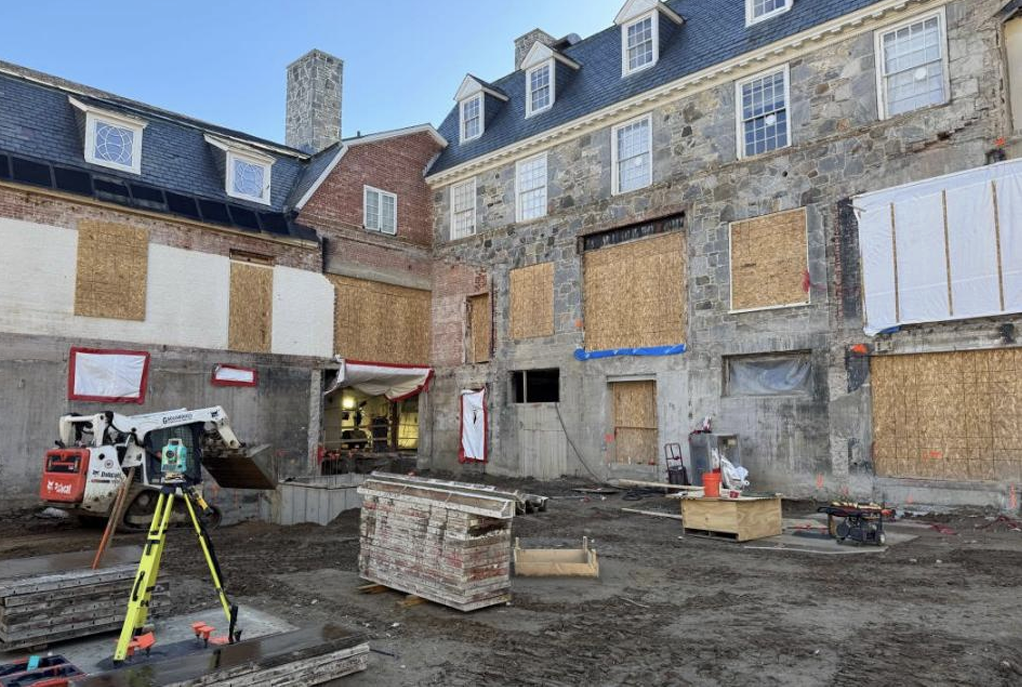
Rear of Jones Library following the demolition of the 1993 addition. Photo: amherstma.gov
Report of the Public Forum of the Amherst Town Council on 2027 CPA Grants, April 6,2027
This was a hybrid meeting held in Town Hall and was recorded.
Present
Mandi Jo Hanneke (President, at large), Jill Brevik and Cathy Schoen (District 1), Amber Cano-Martin and Lynn Griesemer (District 2), Hala Lord and George Ryan (District 3), Pam Rooney and Jennifer Taub (District 4), Ana Devlin Gauthier and Sam MacLeod (District 5), and Andy Churchill and Ellisha Walker (at large).
Finance Committee: Joseph Jayne (resident non-voting member)
Staff: Paul Bockelman (Town Manager) and Athena O’Keeffe (Council Clerk)
This was a special joint meeting of the Town Council and the Finance Committee.
The public forum required by the Town Charter for the Community Preservation Act (CPA) funding recommended by the CPA committee for FY27 generated little discussion outside of the $330,000 allocated for the Jones Library Expansion Project.
The library had originally asked for $1.3 million for historic preservation at the Jones Library, but the CPA committee pared the amount down because the windows included in the proposal were slated for replacement and not preservation, so they would not be allowed under CPA requirements for historic preservation funds. The remaining amount is to be used to preserve 80% of the Philippine mahogany in the 1928 portion of the building, although the remaining 20% may be discarded if no alternative use is found. However, questions have been raised about whether this work qualifies for CPA funds since preservation of the Philippine mahogany was already accounted for in the original construction bid for the project, and because the project itself violates the Secretary of the Interior’s Standards for the Treatment of Historic Properties, compliance with which is required for CPA historic preservation funding.
Some of the woodwork preservation has already been completed, also making that amount ineligible for CPA funds. So the total amount the library is requesting has been reduced to $330,000 from the $477,000 recommended by the CPA committee. The renovation and expansion project had already received a $1 million CPA grant for protection of the Special Collections in FY21.
Four members of the public offered comments on the Jones Library project. Jones Library Capital Campaign Co-Chair Kent Faerber asked for and was granted an additional two minutes for his statement. He said, “We hope the Town Council will approach this grant by respecting both the letter and the spirit of the law in which it is brought to you.” He went on to explain that CPA funds have very specific terms in how they can be used and that they cannot be used for roads or schools, but only for historic preservation, affordable housing, and recreation and open space.
He emphasized that the CPA funds requested by the library are specifically for the preservation of the Philippine mahogany woodwork, and “most of the considerations raised about the larger project are not relevant.” He also stated that the grant “will not raise or lower anyone’s taxes. The same surcharge will be collected whether this grant is approved or not. That is why the prior CPA grant was not considered ‘a penny more’ when the town limited its general revenue to the project.”
Faerber added that “a carefully composed committee is charged with comparing which applications among only those presented to it each year best carry out the purposes of the CPA Act, and then constructing a slate of recommendations that carefully reflect that comparison. Pulling one element out of the committee’s slate upsets the calculation and should not be done without an overwhelming reason to do so.” He concluded with the opinion from the town attorney, Capital Project Manager Bob Peirent, and the contractor Fontaine Brothers that the work included in the application was not underway and did not supplant (i.e. supercede and replace) other funds allocated to the project in the $46 million budget approved by the Town Council.
He ended by saying, “We hope the Council will set aside whatever it thinks about the larger library project and carry out the purposes of the CPA by supporting this much more limited but very important preservation of some of the town’s most significant historic assets.”
Arguments against awarding additional CPA money to the library were voiced by Jeff Lee and Maria Kopicki. Lee pointed to a letter from the law firm of Anderson Krieger, which articulates their opinion “that the Jones Library CPA request is not compliant with the law for two reasons: it violates the non-supplanting rule of the CPA, and it does not meet the Secretary of the Interior’s standards for treatment of historic properties.” He noted that this latter point had been communicated in a letter from the Mass Historical Commission (MHC).
Lee disputed the argument put forth in the letter from Historic Preservation Consultant Virginia Adams solicited by the Jones Library that claimed that the Memorandum of Agreement regarding the Section 106 review (mandatory federal review for historic preservation) was signed by the MHC. He stated that in any case, there are no requirements to meet the Secretary of the Interior’s standards for the 106 review. However, “there are rules that say that CPA requests need to meet the Secretary’s standards.”
Kopicki called attention to memos that she had sent to the CPA committee. She said, “This is even simpler than Kent Faerber is saying. This is not about, will this project happen? It’s not about, will the woodwork happen? The woodwork’s going to happen; the woodwork’s been part of the budget; it’s in the construction documents. That’s why it’s inappropriate for the library fundraisers to ask for this money. This is about promises that you made, and the trustees made every time this came up for a vote. And when you reconsidered whether to rescind funding for this project last spring, you received a memo that said the rest of the money that the fundraisers will raise, is going to be private, federal or state.”
She then pointed out that Amherst taxpayer money is the “primary and overwhelming” source of money that goes out in CPA awards, “And the fact is, this money does have an impact on other things. It has an impact on other projects that didn’t get funded at all this year and may die. I’m talking about pickleball. It has an impact about how that $3 million is going to be used.”
A letter from Town Planner Walker Powell regarding the meeting that the Amherst Historical Commission (AHC) had in October to evaluate the historical preservation requests to the CPA Committee generated a response from AHC member Hetty Startup, who disagreed with Powell’s statement that the Jones application was “unanimously ranked as high priority by the Commission.”
Startup said, “I have a slightly different memory of how things unfolded at the meeting. I do remember questioning why they were applying, because it was my understanding that things had already been taken care of in the final bid for the project. Our chairperson (and CPA representative) is always having to recuse themselves, because they work for the MHC. It was my understanding that there was going to be some kind of memo that would communicate with the CPA committee members about how we discussed these projects. So, I’m kind of concerned that the processes of decision-making aren’t quite on the level. We discussed [the woodwork} extensively as a commission, so I’m just a little confused about them coming forward again. It doesn’t feel right to me.”
Vincent O’Connor felt that CPA funds for historic preservation should not be used for public buildings that have other sources of funding, but should be allocated to historic properties throughout the town.
Gratitude Expressed for Other Recommended CPA Projects
Bonnie Isman thanked the CPA committee for recommending a $275,000 grant to repair the foundation of the Simeon Strong House, current home to the Amherst Historical Society. She noted the Strong House is over 250 years old and was originally a center for Tories and loyalists during the Revolutionary war, later becoming the Amherst home of the Daughters of the American Revolution.
Joy Bowman expressed appreciation for the town’s support in working to get funds to repair the Goodwin AME Zion Church. The church’s CPA application was incomplete, because of the death of its pastor, but the CPA committee reserved funds for the repairs needed to deal with the leaking roof and foundation. Bowman said that an architect was coming to look at the church and to help clarify the application.
In addition to the grants recommended, the CPA committee also recommended borrowing $1.5 million to complete the replacement of the bathhouse at the War Memorial pool. The project had previously been awarded a grant of $1.25 million.
The Finance Committee will evaluate the CPA committee’s recommendations on April 7. The council vote will most likely be on April 27.