Finance Committee Wants More Information about Jones Library CPA Request
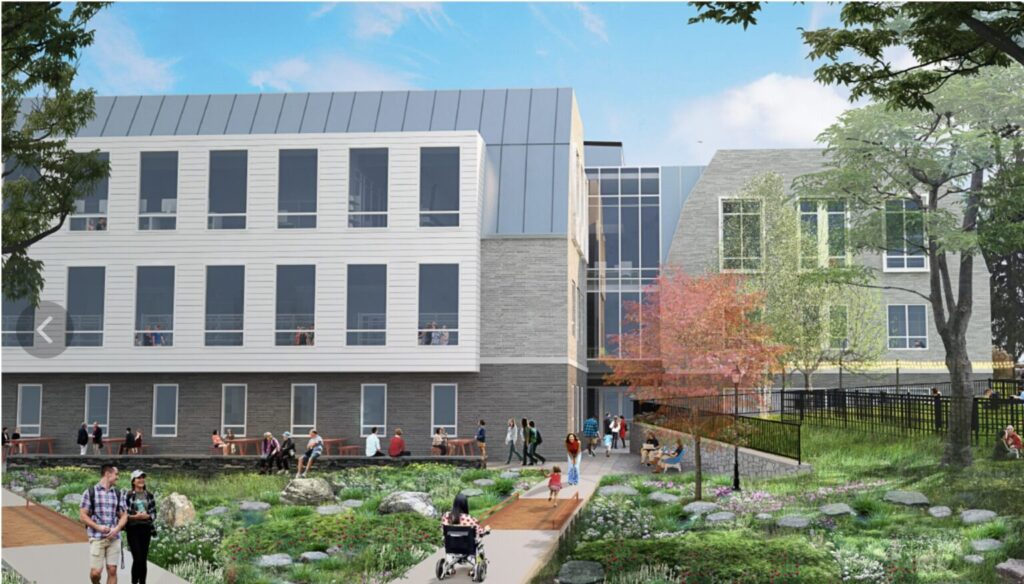
Architect's rendering of South Elevation, Jones Library expansion. Photo: amherstma.gov
Report on the Meeting of the Finance Committee, April 7, 2026
This meeting was held over Zoom and was recorded.
Present
Cathy Schoen (Chair, District 1), Jill Brevik (District 1), Lynn Griesemer (District 2), and Sam MacLeod and Ana Devlin Gauthier (District 5). Resident non-voting members: Joseph Jayne, Cathleen Mitchell. Absent: Tom Porter. Staff: Sean Mangano (Finance Director)
As was the case at the March 23 Town Council meeting, there was little controversy about the projects recommended for Community Preservation Act (CPA) funding by the CPA committee, aside from the $330,000 for the Jones Library renovation and expansion. The Finance Committee unanimously supported funding of all projects except the library. They requested more information about the library project’s eligibility for CPA funds.
Still Unclear Whether Jones Request Complies with the Law
The Finance Committee voted unanimously to remove the library project from the slate of recommended projects and to discuss it separately. Resident nonvoting members Joseph Jayne and Cathleen Mitchell also supported separating out the library from the other projects.
It was noted that the library’s request was reduced from $477,000 to $330,000, because some of the work covered in the higher amount had already been started and hence was ineligible for CPA funding.
Finance Committee Chair Cathy Schoen began the discussion of the Jones request, saying, “I have always thought of CPA funds as tax dollars, so I thought that we should have been counting the $1 million [for special collections] as part of the town’s tax support. When we considered rescinding [the money for the project] because it looked like the trustees didn’t have enough money, we were assured that they had sufficient funds. They have sufficient funds in their endowment—that’s the collateral. When we considered it last April, there was no mention of coming back to the town in CPA.”
Sam MacLeod said, as a former chair of the CPA committee, he appreciated the work of the committee and personally respected their decisions. He mentioned the conflicting communications the council received about the project, but he did not see something that would lead him to overrule the decisions of the CPA committee.
Jill Brevik cited the previous commitment by the council to not devote more money to the project and that going back on that promise “would contribute to eroding trust in leadership.” She noted that the money could be used for affordable housing during a time when there is a housing crisis and concluded, “What grounds me in my decision is that commitment that we’ve made to giving the money that we gave to this project and standing firm in that decision.”
Nonvoting member Cathleen Mitchell felt that “whether the town has said no more tax money may be relevant to the Town Council’s decision was not relevant to the CPA committee’s decision. This is one issue that they very clearly stated they did not consider.”
Ana Devlin Gauthier disputed the assertion that the council as a whole stated that “not a penny more [of tax dollars]” would go to the library project. She attributed the statement solely to then council President Griesemer. There was never a council vote taken. Although she said she had concerns about the conflicting information received, she supported the decision of the CPA committee.
Schoen agreed that the council had never voted to cap the town money for the library at $15.8 million, but at the time of the vote to rescind funding for the project, “we were assured that the trustees would be able to close the gap from fundraising. There was no mention of coming back to CPA.”
Nonvoting member Joseph Jayne stated, “Looking at this just from the dollar amount, it seems a small percentage of the library’s budget. This is going to happen regardless. I think it’s a great project, but I feel that we should consider those dollars and the leverage we get as a town for some of the smaller projects [where] those dollars are going to be covering a larger percentage of expenses—where those dollars will go a longer way in terms of implementing and supporting some of these projects that don’t have such huge budgets.”
Lynn Griesemer supported the CPA allocation. She said she would consider the letter from the town attorney KP Law that the project was eligible over any other legal opinion. She felt that CPA funds were distinct from other taxpayer money.
She also presented her view of the library project’s history, “This project’s been going on for at least 10 years. The project survived COVID, which led to an additional bump in cost. It has continued to survive enormous opposition and controversy in this town, mostly because it happened to come before other projects, not because people are opposed necessarily. And that opposition has gone so far as to cost this project close to $10 million more. People in opposition have gone so far as to write the federal government leading to withdrawal of over a million dollar grant. The doors will open on this project at some point. I find this an unfortunate situation that every year, this has to be publicly redebated as to whether or not we feel we should have a state-of-the-art 21st-century library in Amherst.”
(Editor’s note: The $1M grant Griesemer refers to was lost when the Trump administration canceled all NEH grants, (see also here) and before an Amherst resident filed a complaint with the Feds)
Schoen rebutted some of Griesemer’s portrayal of the delays that contributed to the escalation of the cost of the library project. She noted, “The big jump in costs was COVID, and when we got hit by that, we asked the [Massachusetts Board of] Library Commissioners (MBLC) to wait, because the town did not have the money. There was a second delay when the bids came out too high, and we had to go back and redesign. And then there was another delay that the library trustees did not start the 106 [the required Massachusetts Historical Commission review] really early, so we even had some retrofits to get the HUD grant. These were not opposition.”
Given the conflicting opinions from two law firms as to whether the project was eligible for CPA funding, Brevik and Devlin Gauthier suggested requesting more. Devlin Gauthier suggested asking KP Law for more information “to understand where they got the information they’re telling us—whether they talked to the folks at CPA on the state level.”
Finance Director Sean Mangano said he would reach out to the Department of Revenue and the state Community Preservation Department, as well as the town’s auditor, but he was not sure if the auditor “actually gets into the eligibility of CPA projects.” He will bring back the requested information to the April 21 meeting of the Finance Committee. The full council will most likely vote on the slate of CPA projects on April 27. The Finance Committee voted unanimously (5-0) to delay a decision on the library until they received the additional information. Mitchell supported the motion, but Jayne abstained.
MacLeod noted that, should the library not receive CPA funds, that money could be given to the pickleball courts that were not funded or could reduce the amount of borrowing for the War Memorial Pool bathhouse. However, CPA Committee Chair Katie Allan Zobel said that the committee had no plans to meet again to discuss the FY27 grants. In that case, the extra funds would be available for FY28.
Public Comments Regarding the Library CPA Request
Maria Kopicki reminded the Finance Committee of their responsibility to act on behalf of Amherst residents in advising the Town Council how to spend taxpayer money wisely, “and with full confidence that those expenditures are unequivocally compliant with all regulations.” She noted the concerns raised about the eligibility of the Jones project for CPA funds and stated that the letter from Planner Walker Powell regarding the discussion of the CPA request by the Amherst Historical Commission (AHC) was “highly inaccurate.” She said that the AHC had expressed strong reservations and requested critical information during their deliberations that was never provided.
In addition, she reminded the committee of the pledges by town and library leaders, as well as over 1,000 residents, to not spend any more money on the project. “Amherst CPA funds are taxpayer dollars, and there is no lack of need for those CPA dollars for other projects which cannot get off the ground without them.”
Toni Cunningham agreed with Kopicki that “all this (CPA money) is replacing funding that the trustees or the capital campaign said they were going to raise.”
Jones Library Capital Campaign Co-chair Kent Faerber reiterated what he said at the April 6 Town Council meeting: “These are tax dollars, but not all tax dollars are the same. CPA funds are subject to a number of restrictions, which prevent them from being used for anything other than historic preservation, recreation, open space, and affordable housing. So turning this grant down does not free up any money for anything else. This is not a referendum on the larger library project. This is a question of whether the preservation of some beautiful, very important woodwork competes with the other grant applications this year.”
Other CPA Projects Receive Strong Support of Finance Committee
Finance Committee members asked for clarification on some of the projects but voted to recommend them for funding. Schoen and Griesemer both acknowledged that their husbands were involved in the Industrial Survey of the Mill River project, which was recommended to receive $75,000 to complete the study. Griesemer’s husband was a leading applicant and Schoen’s husband is the treasurer of the District One Neighborhood Association, the applicant. Both spouses are volunteers who do not benefit financially in any way.
The CPA Committee recommended bonding $1.5 million for replacing the War Memorial Pool bathhouse, which is 75 years old and in poor repair. The project was awarded $1.25 million in FY25 which enabled the design of the new bathhouse to be completed. According to Assistant Superintendent of Public Works Amy Rusiecki, the additional funds and possibly some grants will enable completion of the project. The borrowing was endorsed unanimously by the Finance Committee.
The amount borrowed for the bathhouse will be added to the CPA debt service in future years. Other bonded projects are the Belchertown Road property slated for the Way Finders affordable housing project (annual debt payment $71,000), Valley CDC East Gables affordable housing ($63,750), Jones Library special collections ($130,000), Fort River playing fields ($91,000), and the high school track and field ($167,830). All of these projects are to be paid off over 10 years, except for the track and field, which is a 15-year loan.
Schoen asked if the recommended $20,000 was enough for the proposed skate park to get started. Zobel said that the availability of funds had prompted the CPA committee to reduce the allocation for the skate park from the requested $40,000, and that the Recreation Department thought that amount would be enough to study two possible sites and develop schematic designs for both. Depending on the design of the new War Memorial Pool bathhouse, the skate park may be located there. Ziomek estimated the construction cost at $750,000 to $1 million.
Griesemer asked about the additional liability that the town might incur from a skate park. Devlin Gauthier said that she had looked into this matter and discovered that skate parks actually lower liability, because there is accepted risk by those who use them, and they are safer than skateboarding in places not designed for that activity. She stated that there are far more claims from dog parks.
MacLeod wanted to ensure that the water incursion problems at Goodwin Church were resolved. The church was unable to submit a complete application by the deadline due to the sudden death of its pastor. Zobel said the CPA committee had reserved $48,000 for the church, but there may be state preservation funds that could fund the needed repairs. An architect is scheduled to determine the actual repairs needed.
Ziomek said the $100,000 for trail and bridge maintenance will likely be an annual request, as the town has 140 miles of trails and 2,500 acres of conservation land to maintain to ensure safe use and accessibility. The $100,000 for recreation and conservation area signs, in addition to the $100,000 awarded in FY26, should be enough to complete the 125 or 150 standardized signs and kiosks in all areas.
The request for funding for town-owned pickleball courts was not funded. Money was awarded in FY23, but it was subsequently decided that the courts should be located at Groff Park rather than at Mill River or Kiwanis Field. The need for site work at Groff Park and the increase in construction costs over the past four years meant that an additional $650,000 would be needed to complete three courts. Ziomek said it was unlikely that the town would bring the proposal back in future years.
Finance Committee Schedule for May Budget Meetings
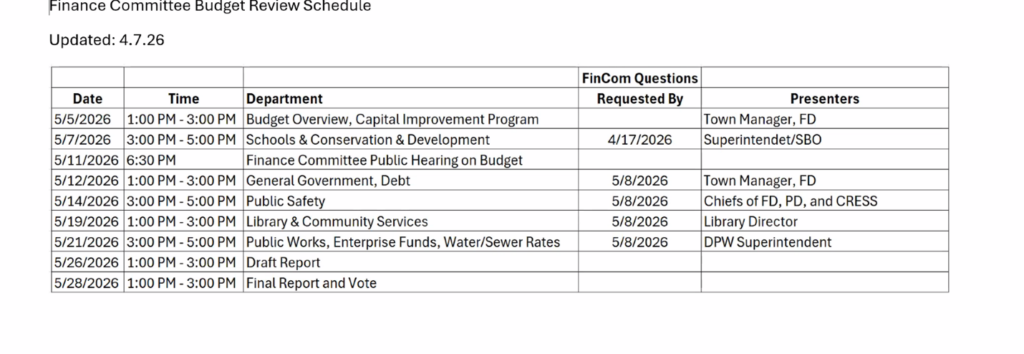
The Finance Committee agreed on the following schedule to evaluate the Town Manager’s proposed budget. The committee will meet every Tuesday and Thursday in May. The Thursday meetings were moved to 3:30 p.m., except for the May 7 meeting on the elementary school budget, which will begin at 3 p.m.