
Planning Board: Downtown Design Standards and Clean Energy Bylaw Are Too Restrictive
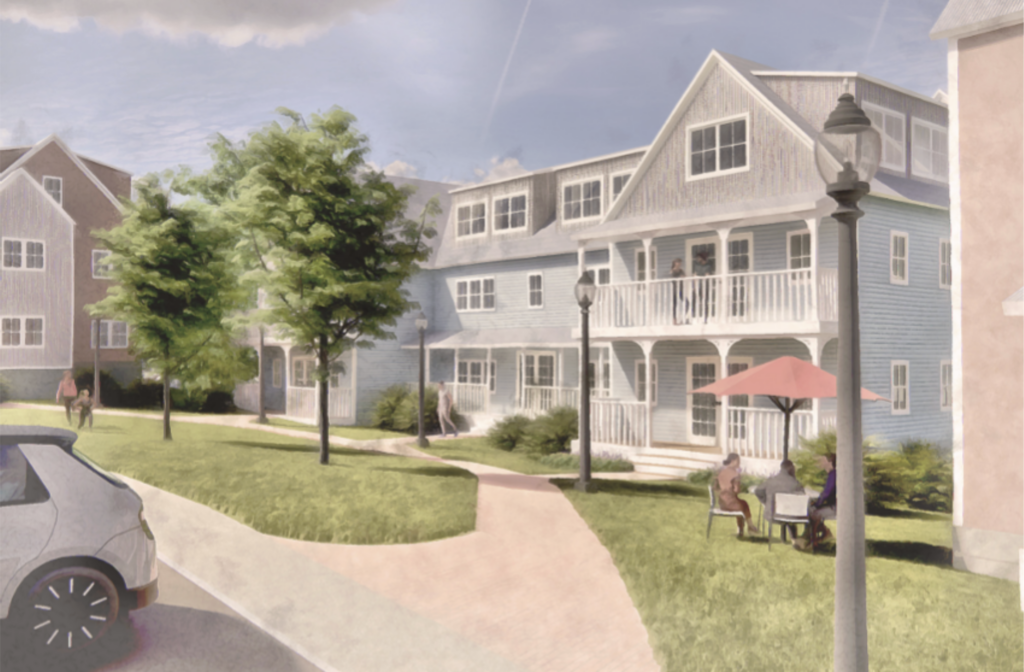
Visualization from proposed downtown design standards showing new homes in the rear of lots in the Downtown Neighborhood area west of Kendrick Park. Photo: amherstma.gov
Report on the Meeting of the Planning Board, April 8, 2026
This meeting was held over Zoom and was recorded.
Present
Doug Marshall (Chair), Fred Hartwell, Johanna Neumann, and Jerah Smith. Absent: Bruce Coldham, Jesse Mager, and Angus McLeod.
Staff: Nate Malloy (Assistant Planning Director), Pam Field-Sadler (Assistant)
With three members absent, the Planning Board held an abbreviated meeting. They continued their discussions on the Proposed Downtown Design Standards and the draft Clean Energy Bylaw, but tabled discussions of the housing and zoning subcommittee and creation of an East Amherst Local Historic District until a future meeting.
Downtown Design Standards
The Planning Board heard a presentation on the three-volume proposed downtown design standards (see also here) developed by consultants Dodson and Flinker at the March 18 meeting. The proposed standards divide the downtown into four design zones: Traditional Main Street, Modern Main Street, Downtown Village, and Downtown Neighborhood. As at the earlier meeting, Planning Board members felt the proposed standards did not go far enough in increasing housing density in the downtown.
Johanna Neumann, who was not present at the March 18 meeting said she supported the idea of developing downtown design standards, and hoped the town would adopt them, because it is a chance to signal to the market what we want downtown. Although she added, “I continue to wish that they were a little bit more ambitious. Specifically, I’m thinking the area around [Kendrick] Park is such a great place to live, and it’s currently underutilized.” She said that she was “not nostalgic” about the houses on the west side of the park.
Planning Board Chair Doug Marshall thought the consultants were responding to concerns from “fairly vocal members of stakeholder groups” that those lots back up to the residential areas to the west.
Assistant Planning Director Nate Malloy thought that the consultants tried to be respectful of the neighborhoods around downtown. He asked if we can we have four story buildings facing North Prospect St instead of three? He did note that the Dodson and Flinker report recommended increasing the allowable building height in the Limited Business (B-L) zone north of Triangle Street to three stories with more flexible building and lot coverage. He speculated that a property owner could consolidate two lots and build 20 or 30 townhouses, instead of the two or three units under the current zoning.
Neumann agreed that, “This is one step, but hearing you articulate that this would potentially create three-story buildings where there are now one-story and two-story buildings gives me a sense that this is a step in the right direction.”
However, Jerah Smith contended, “We have not seen meaningful redevelopment on most of the parcels in downtown, so something in these design standards needs to meaningfully change in order to incentivize redevelopment. And it didn’t look like there were significant changes, because right now, I see the one-story buildings off North Pleasant, and these could be six stories. So, what about those design standards could make them be that max build-out potentially.”
Marshall also worried that if three-story buildings are built, there will never be taller ones in these zones. He likened the “Downtown Village” zone to the apartment complexes in North Amherst. The property owners no longer have mortgages to pay and have no incentive to rebuild those complexes to be more densely populated.
Board members asked Malloy if there has been much interest in building to the increased density permitted by the University Drive overlay zone. He said that there has been some interest in building there, but no permit applications yet. “It’s maybe a tough time in the development world with prices and things.” He added that for the three buildings built recently in downtown, the building of five stories was incentive enough to demolish the one-story buildings. He wasn’t sure if allowing for three stories would be enough incentive.
Neumann warned of pushing too far in advocating for a policy that will get voted down. “Let’s move the process along and adopt these on the timeline that they’re on and start realizing this vision. And then if it doesn’t do what we want it to, we can, in five or 10 years revisit.”
Malloy said that the Planning Department has received little public feedback on the design standards. He hoped the town could apply some of the standards in the document to other village centers, such as North Amherst, East Amherst, Pomeroy Village, and Atkins Corner.
Marshall took issue with including Atkins Corner, because of the challenges faced by the proposed Archipelago project there due to extensive wetland, he thought that maybe that area should not even be a village center.
Smith suggested putting notices around town to solicit more feedback from the public. Malloy said they hope to get the Chamber of Commerce and Business Improvement District involved.
He hoped to present some zoning changes suggested by the standards later in the year.
The public has until July 1, 2026 to submit feedback to the town. Feedback can be submitted here.
The Planning Board decided to discuss each of the proposed downtown zones over the next three or four meetings and draft a memo with their suggestions for improving the Dodson Flinker report to the consultants and the town council. The process of how design standards will be adopted and who will be involved in the decisions was not made clear at the meeting.
Many Concerns Voiced over Draft Clean Energy Bylaw
The 20-page draft Clean Energy Bylaw was developed over several years, first by the Solar Bylaw Working Group and then by the Community Resources Committee (CRC). In the meantime, the state passed new regulations to streamline permitting of ground-mounted solar arrays and to encourage solar power and battery storage. Those new regulations go into effect in October, 2026. The local bylaw must comply with the state laws.
Marshall felt that the bylaw was redundant and unnecessarily complicated and drafted eight pages of critique. He wondered if he would be allowed to put a couple of ground-mounted solar panels to charge his car in his backyard without going through complicated permitting. He also thought that the draft bylaw reiterated many of the factors already taken into account when projects are approved by the Conservation Commission, electrical inspector, fire department, etc. He noted that the draft states, “The construction and operation of all Solar Photovoltaic Installations and BESS Installations shall be consistent with all applicable local, state and federal requirements” (page 3), and that should be enough.
Neumann said, “My initial reaction is we are putting 20 pages of regulations on a technology that society desperately needs. And I worry that this bylaw will just throw a wet rag on solar development in Amherst, and we should absolutely be a solar leadership community.” She asked Malloy, “Do you feel like there are parts in this where we are actually creating space for solar to flourish in Amherst, or is it just the punitive approach?”
Malloy replied, “Is our bylaw punitive, or is it just really comprehensive? I think what we’re trying to do is make sure that everyone knows that there could be possible impacts. If it’s a tricky site because there’s steep slopes and they have to figure out how are they doing erosion control. So, I don’t know if it’s punitive. I think it’s trying to be comprehensive.” He noted that the state has developed a number of guidelines for solar projects, and an applicant for a large project has to do a site suitability assessment. He contended that Marshall’s hypothetical backyard panels would only need administrative approval.
Then Marshall presented another scenario. “On the subject of tree clearing, if I had 125 acres and I was thinking of doing a solar farm, I would clear my land and create the new baseline, then put in the application. Right? Because if I do the application while my trees are still there, I’m going to be held to a different standard.” He thought this workaround should be addressed in the regulations, and maybe some additional requirements included.
Fred Hartwell stated that a large solar installation is an energy source connected to a utility and would be beyond the scope of the Massachusetts Electrical Code. He cautioned that the town “stay out of the business of attempting to regulate what is a utility function.”
Malloy is trying to schedule a joint public forum of the CRC and Planning Board on the Clean Energy bylaw for late May, and then it would need to go to the Town Council for a vote.