
Revised Clean Energy Bylaw Goes to Town Council
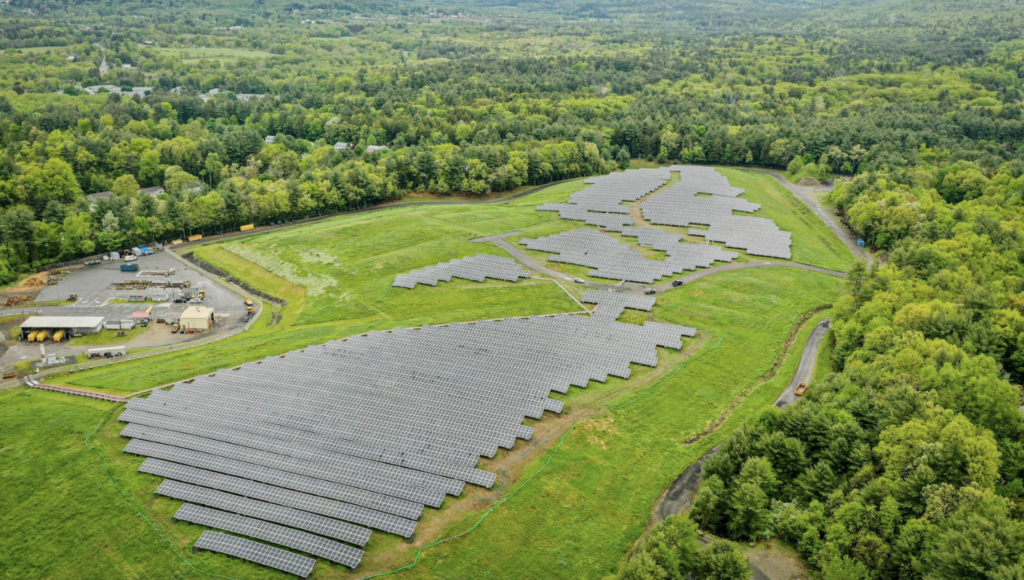
Solar farm on the Amherst landfill. Photo: amherstma.gov
Report on the Joint Meeting of the Planning Board and Community Resources Committee, August 5, 2026
This meeting was held over Zoom and was recorded.
Present
Doug Marshall (Chair), Bruce Coldham, Fred Hartwell, Roy Johnson, and Jerah Smith. Absent: Jesse Mager and Angus McLeod.
Three members of the Community Resources Committee were also present at this joint meeting: Town Councilors Jennifer Taub (District 4) and Mandi Jo Hanneke, and Andy Churchill (at large)
Staff: Walker Powell (Planner) and Pam Field-Sadler (Planning Assistant)
After meeting with the town attorney in July, Town Council President Mandi Jo Hanneke rewrote the draft Clean Energy Bylaw, taking into account Town Attorney Carolyn Murray’s suggestions for clarifying the permitting process of solar arrays and Battery Energy Storage Systems (BESS). At the August 5 meeting, the Planning Board unanimously approved version 15 of the draft Clean Energy Bylaw for recommendation to the town council. The following day, Hanneke incorporated suggestions from the Planning Board regarding waivers and added the necessary cross-references, producing version 16 (a copy of which is not yet available). The new version passed unanimously at a special meeting of the Community Resources Committee (CRC) on August 6.
The final draft renames the clean energy bylaw somewhat redundantly, Small Clean Energy Infrastructure and Consolidated Permitting for Small Clean Energy Infrastructure Facilities.
The draft bylaw now goes to the Governance, Organization, and Legislation Committee (GOL) to be evaluated for clarity, consistency, and actionability before going before the full town council for a vote. The town aims to have a new clean energy bylaw (Article 18) that meets the state’s new regulations by October, when the state regulations go into effect.
Hanneke stated that the new draft bylaw has three parts. The first addresses the consolidated permit pathway, and the other two deal with solar arrays and BESS. The consolidated pathway requires that an applicant produce all required documentation as a single packet. The town then has 12 months for the appropriate staff and committees to evaluate the information, which will then be accepted or rejected by an as-yet-to-be-identified designated town official. Use of the consolidated permit pathway is optional. An applicant can otherwise opt to apply to the relevant boards and committees for separate permits, as is done now.
Most of Hanneke’s revisions were accepted without comment, with both Planning Board and CRC members agreeing that the revised bylaw is clearer and better organized. The new bylaw does not apply to rooftop solar or to BESS contained within a structure. Very large installations, solar arrays exceeding 25 megawatts and BESS exceeding 100 megawatts, will be permitted by the state. The bylaw only applies to smaller systems.
The bylaw is the culmination of an almost five-year process that began in 2022 with the Solar Bylaw Working Group. Sustainability Director Stephanie Ciccarello has been integral to the development of the bylaw. The progress received a setback when the state revised its clean energy regulations in 2024, and much of the draft that was already completed had to be rewritten.
CRC Chair Pam Rooney will draft a report for the Town Council describing the bylaw and thanking the many residents and staff who participated in its development.