
Letter: Threat Posed by Data Centers Requires a Ban, Not a Moratorium
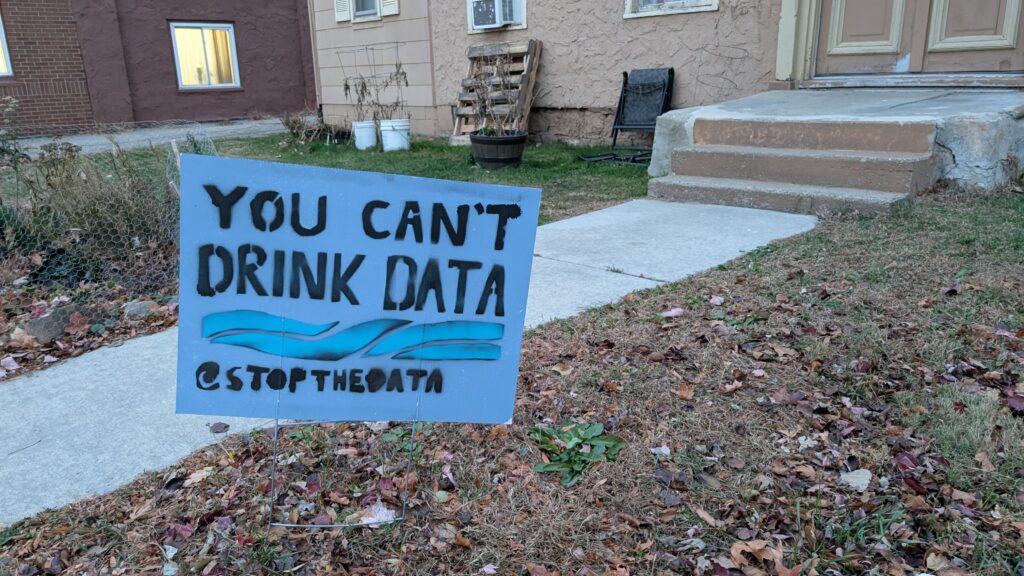
Protest of AI-Data Center in Ypsilanti Michigan. Photo: Clean Water Action
The following letter was sent to the Amherst Planning Board and the Town Council’s Community Resources Committee on Nov. 10, 2026.
I support the proposed zoning amendment banning data centers in all zoning districts in Amherst. I urge you to recommend and adopt a ban, rather than replace it with a temporary moratorium to prepare the town to accommodate these facilities.
I use artificial intelligence. I recognize its usefulness, and I am not arguing that every application of AI should disappear. But using a technology does not require accepting everything its owners want to build, everything they want to consume, or every cost they want the public to bear. I can find AI useful while insisting that the industry behind it be subject to enforceable limits and democratic control.
The economic and environmental consequences of this expansion are not hypothetical. Food & Water Watch has documented how large data centers can strain electricity and water supplies, increase fossil-fuel demand, and expose households and small businesses to infrastructure costs driven by corporate expansion. The precise impacts depend on a facility’s size, cooling system, power sources, and utility arrangements. Those differences matter, but they do not erase the underlying problem: private companies are making enormous demands on resources that communities depend upon.
Amherst should not wait for a developer to arrive with a site, a timetable, expensive attorneys, and promises of prosperity before deciding whether this is an appropriate use of the town’s land and resources. The time to set a clear boundary is before a project creates pressure to approve it—not after officials and residents scramble to understand what has already been negotiated.
The economic-development argument deserves particular skepticism. Good Jobs First, which tracks corporate subsidies, finds that data centers generally create relatively few permanent jobs despite their enormous capital investment. Construction jobs are temporary; the operating facility may buy little from nearby businesses; and generous tax exemptions can substantially reduce the public revenue offered as justification for approval. A billion-dollar investment is not the same thing as a billion-dollar benefit to the host community.
Nor should residents have to subsidize an industry through higher utility bills or public infrastructure spending while its owners collect the profits. Electricity capacity, water, land, and municipal attention have other purposes: housing, schools, existing businesses, public services, and a livable environment. The question is not simply whether a data center would pay some taxes. It is whether its full public benefits justify its full public costs—and whether Amherst wants this use at all.
There is also the everyday reality for neighbors. Large facilities can bring persistent mechanical noise, backup-generator emissions, and substantial demands on water and electrical infrastructure. These are land-use and public-health concerns, not merely technical details to be negotiated after a community has accepted the premise that development must proceed.
According to the information circulated about this amendment, nine councilors sponsored a townwide ban. That proposal deserves a direct answer on its merits. Converting it into a moratorium intended to develop permitting rules would change the question from “Should Amherst allow data centers?” to “Under what conditions should Amherst allow them?” Those are different policy choices.
A moratorium can be useful when a community genuinely has not decided what it wants. But if Amherst judges these facilities incompatible with its priorities, it should make that judgment explicit. The town should spend the staff time necessary to write a clear, carefully defined, legally defensible prohibition—not embark on an open-ended effort to make an unwanted industrial use acceptable.
The amendment should distinguish the facilities it intends to prohibit from ordinary computers, servers, and incidental computing equipment used by schools, research institutions, public agencies, and local businesses. Precision will strengthen a ban. It should not become a pretext for replacing the ban with a permitting pathway.
Amherst would not be acting alone. Communities are already organizing to reject projects and restrict development. In October, Food & Water Watch reported that more than 110 New Jersey municipalities had taken action to block AI data centers. Its organizing guidance describes communities across multiple states stopping proposals and seeking broader protections. These actions differ in scope, but they demonstrate that local resistance is a practical policy choice, not an exercise in futility.
At the same time, this cannot end at Amherst’s borders. Moving an environmentally damaging project to another town does not solve the larger problem. Local bans should be part of a broader demand for state and national safeguards, international cooperation, and enforceable limits on the industry’s use of energy, water, public subsidies, and personal information. Hundreds of environmental, labor, community, and other organizations have already called for a national halt to new hyperscale data centers until adequate protections are in place.
The larger dangers of AI also demand attention: worker displacement, concentrated corporate power, surveillance, deception, and threats to democratic accountability. A zoning amendment cannot resolve those issues. But Amherst does not need to solve every problem associated with AI before exercising its own responsibility over land use. Nor should the absence of adequate national and global rules become an excuse for local inaction. Food & Water Watch’s call for an AI regulatory framework explicitly connects the infrastructure buildout to concerns about jobs, privacy, deepfakes, children’s safety, and democracy.
…the combination of AI’s reach, speed, resource demands, and concentration of power creates an unprecedented potential for harm. That is a reason for precaution and public control—not for giving the industry the benefit of every doubt while communities assume the risks.
In my judgment, the combination of AI’s reach, speed, resource demands, and concentration of power creates an unprecedented potential for harm. That is a reason for precaution and public control—not for giving the industry the benefit of every doubt while communities assume the risks.
I support a ban because I want Amherst to make this decision deliberately, before a particular project narrows the town’s practical choices. I support it as an AI user who believes usefulness does not confer immunity from accountability. And I support it because communities should be able to say that some industrial uses do not belong within their borders.
Please recommend and adopt the proposed townwide ban. Do not substitute a temporary pause designed to prepare for eventual approval. Amherst should act now, while it can establish its priorities rather than react to someone else’s plans.
Ira Bryck
Ira Bryck is a resident of Amherst’s District 4.