
Eversource Plans Clearcutting Through Eleven Towns Including Amherst
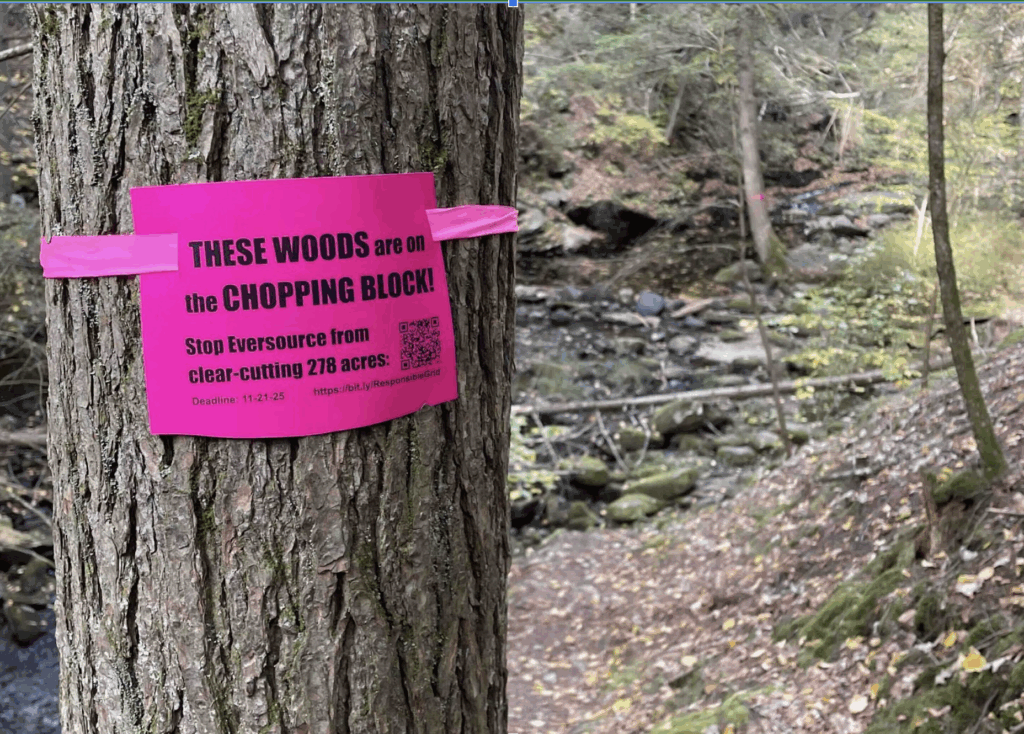
Photo: Stacey McCollugh
Eversource has proposed 278 acres of tree cutting, and the plan they have filed with the state is now open for public comment. The 29.3-mile project corridor runs through Northfield, Erving, Wendell, Montague, Leverett, Shutesbury, Pelham, Belchertown, Amherst, Granby, and Ludlow. Eversource’s right-of-way is wider than the currently-cleared 125-335 feet, and they propose to clear more of it, to an average width of 250-500 feet, citing the need to protect the grid.
Eversource previously proposed a version of this project in 2022, when they hoped to pursue approval via an abbreviated process. That version drew over 339 comment letters, as the Energy and Environmental Affairs (EEA) certificate noted, which “expressed concern for endangered species and wildlife habitat, sensitive wetland areas including drinking water supplies and cold water fisheries, and the future use of herbicides on the newly cut areas… [as well as for] protected open spaces.” In light of significant project impacts, the EEA directed Eversource to proceed through the full Environmental Impact Report process rather than an abbreviated one. Eversource is doing so, and the version that is now open for public comment is Eversource’s Draft Environmental Impact Report (DEIR).
Protecting the grid is critically important given the “increasing severity of storms” noted in Eversource’s DEIR. In the prior phase, many of the public comments acknowledged that goal, while calling on Eversource to accomplish it via selective management: pruning, topping, or cutting trees that pose an emerging risk to wires, while preserving trees that do not. As directed by the EEA certificate, Eversource’s DEIR replies directly to these comments. In those replies, Eversource reinterprets what “selective management” means, stating that they’re practicing it by eliminating six acres from their plan, where they determined that there is no reason to cut. They don’t acknowledge the possibility of selective management within the remaining 278 acres.
Eversource’s cutting maps (downloadable here), which previously had color-coded crosshatching for “Tree removal,” “Selective tree removal,” and “Pruning,” now have only “Proposed tree clearing” in place of those prior categories. Their alternatives analysis excludes selective management as well. Eversource explains that “it is often difficult to avoid/protect compatible [trees]… that are interspersed with incompatible” ones.” However, it is not stated why such an attempt would not be made, with the understanding that it would only partly succeed. Eversource points to federal standards as driving their approach, and those standards do recommend practicing vegetation management across the full width of utilities’ ROWs. However, the standards don’t specify non-selective management, leaving implementation approach up to transmission line owners.
A recently-formed citizen’s group, Responsible Grid, argues that Eversource’s “plan does not show due care in distinguishing between trees that pose a risk to powerlines and those that do not.” Responsible Grid is in favor of selective management – across the whole project if feasible, and otherwise in sensitive areas such as wetlands, riverfront, and/or state-designated Priority Habitat for rare species. Their website, bit.ly/ResponsibleGrid, includes a project summary, links to Eversource’s DEIR documents, detailed positions, and a sample public comment.
Public comments can be submitted now, and until November 21st, to Jennifer.Hughes@mass.gov. Emails should use the subject line: “EEA#16570 WT-11 Transmission Right-of-Way Reliability Project,” and they should include the commenter’s name, address, and contact information.
G’Day Jennifer Hughs,
I recently learned about a project run by Eversource to clear-cut a section of forest in and around the Buffam Falls/Woods Conservation Area in Pelham, MA, to make way for power lines and a pathway to protect them from downed trees. I also understand that there is more than one way to achieve the end goal, and one is to engage in more selective cutting, leaving more of the forest intact.
I am writing to implore you to opt for a more selective cutting solution to the project, leaving as many of the trees in the tract as possible, and NOT apply a clear-cut model. I recently moved to the area from CT and have spent the majority of my 67 years outdoors, including thru-hiking the Appalachian Trail and hiking numerous areas in the western US and Alberta, Canada. My first reaction to the forest in the Buffam Falls Conservation area was one of awe, struck by its absolute, jaw-dropping, unique beauty, and I wanted to share it with all my friends and family. When I learned of its possible destruction today, I was aghast. Once it is gone, it will not grow back as it is.
Thus, please reconsider any plan to clear-cut this tract of woods; the loss of any of this forest will be painful to see, but selective cutting could at least, hopefully, meet the needs of Eversource to efficiently provide electricity while preserving more of the rare beauty of Buffam Falls forest.
Dear Eversource and Members of the Review Committee,
I am writing to express deep concern about Eversource’s proposed vegetation removal and clear-cutting activities along the 29.3-mile reliability project corridor — particularly at the convergence of Amethyst and Buffam Brooks in Pelham. This is one of the most ecologically sensitive and historically cherished areas along the route, and the proposed actions here raise serious environmental, safety, and community concerns.
It is a beautiful and cherished natural area that generations of residents have enjoyed for recreation and reflection. It is a sensitive riverfront habitat, home to wildlife and contributing to local water quality. This is a deep gorge with steep banks and cliffs — the site of a 1950s rockslide that caused the partial collapse of North Valley Road.
Downstream flooding in residential areas (including what is now affordable housing) would be more likely with more heavy rains/severe weather.
Remove trees at the bottom of the gorge, down to the very edge of the water, despite the fact that the bases of transmission towers sit at elevations of approximately 500 and 530 feet — while the brook itself lies at 360 feet. In other words, the trees being targeted could not possibly grow tall enough to threaten the lines; they would have to “fall uphill” to do so.
Eversource has acknowledged that the company has long operated here with a “light touch,” selectively topping individual trees only when necessary. Now, they propose to abandon that successful, site-specific approach in favor of a one-size-fits-all “standard vegetation management practice” — a practice wholly inappropriate for this sensitive gorge.
Adding to the confusion, Eversource repeatedly asserts that “no TRRP activities are planned within the Buffam Falls Conservation Area.” Technically that may be true, but it is misleading. The right-of-way in question — the narrow gap between the Buffam Falls Conservation Area and the Alschuler Conservation Restriction — is precisely where the two brooks converge, where Buffam Falls tumble into a wading pool and flow toward a shaded swimming hole beloved by local residents. This “gap” is at the very heart of the conserved landscape, not apart from it.
Local hiking trails that connect both conservation areas are missing from Eversource’s maps, giving the false impression of a discontinuity that does not exist. These trails cross the right-of-way and would be visibly and permanently scarred by clear-cutting.
The Pelham gorge is a case-in-point that illustrates the broader failure of this project’s vegetation plan to consider site-specific conditions. Along 29.3 miles of corridor, there must be many acres where full clear-cutting could be safely avoided without compromising reliability. Applying rigid “standard practices” across such a varied landscape is a mistake — and in places like Amethyst and Buffam Brooks, it would be a an avoidable environmental and aesthetic travesty.
I respectfully urge Eversource and the reviewing agencies to:
Suspend vegetation removal in this area until a site-specific erosion and habitat assessment is conducted.
Retain existing trees and vegetation on steep slopes and near the brook where there is no genuine risk to transmission lines.
Restore and accurately map local trails and conservation boundaries in all project materials.
Adopt a selective, light-touch vegetation management approach consistent with historic practices and the ecological sensitivity of this site.