
Jewish Community of Amherst Celebrates Hanukkah with Energizing of Solar Canopy
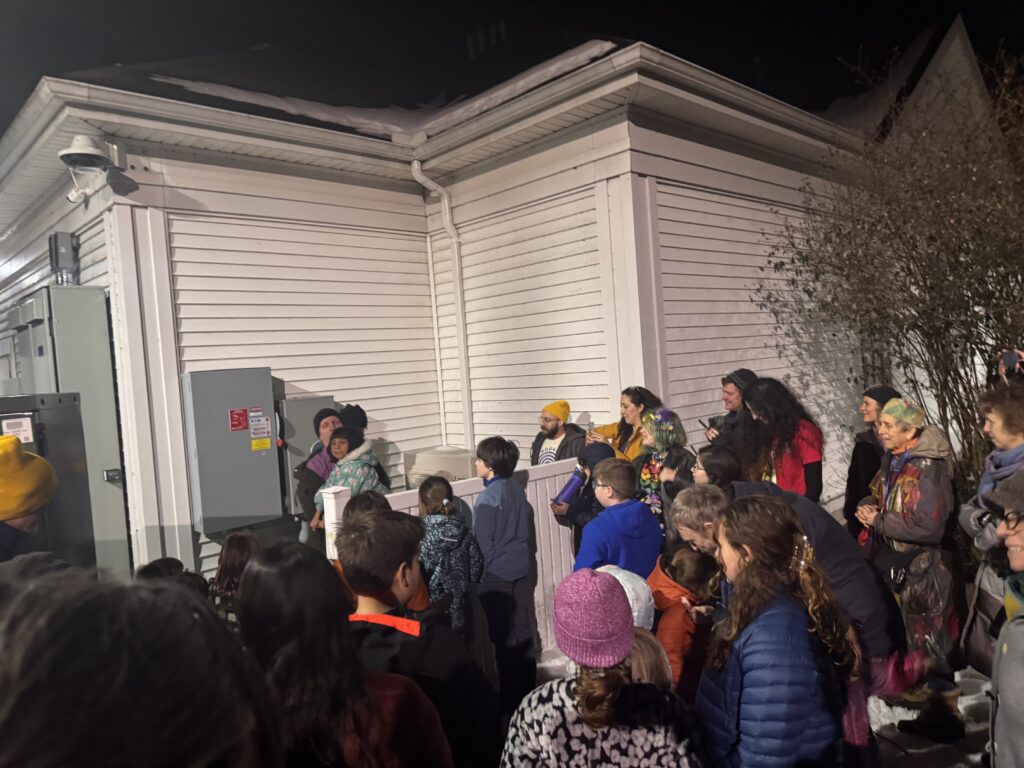
Members of the Jewish Community of Amherst gathered on the fourth night of Hanukah (12/17/25) to electrify their new solar canopy. Photo: Jewish Community of Amherst
By Maura Keene
On the fourth night of Hanukkah, the Jewish Community of Amherst (JCA) turned on the completed solar canopy over its parking lot, fulfilling its partnership of the JCA Energy Transition Committee (ETC) with PV Squared Solar and concluding a multi-year effort to reduce the JCA’s reliance on fossil fuels and ensuring that the building’s energy needs can be met with clean, locally produced solar power.
An enthusiastic crowd participated in the December 17 celebration that included songs, candles, and latkes. Speakers included Robert Pollin, Professor of Economics and Co-Director of the Political Economy Research Institute at UMass; Sam Gladstone ETC member; and Spirit Joseph, Executive Vice-President of PEAR Energy, LLC. The program was open to the Amherst Community.
According to the press release from the JCA, the project represents a thoughtful and proactive response to the climate crisis, one that aligns ecological responsibility with the congregation’s identity and values. Rather than acting out of financial necessity, the JCA chose to pursue renewable energy and electrification because it reflects the congregation’s deeply held commitments to stewardship, resilience, and community well-being.
JCA’s Rabbi Benjamin Weiner wrote, “From the very beginning, this work has grown out of a shared sense of responsibility, to our members, to our children, and to our community. Transitioning to electric systems powered by renewable energy is not only a wise investment in the building’s future, but a moral commitment to reducing our impact on the climate. We hope this project inspires other congregations and households to imagine what’s possible.”
The Energy Transition Committee emphasized that electrification and solar were chosen not simply to reduce utility costs, but to model leadership. The project reduces the JCA’s reliance on fossil fuels, stabilizes long-term operating costs, and places the congregation at the forefront of a statewide movement encouraging houses of worship to take meaningful climate action.
To bring this vision to life, the JCA partnered with PV Squared Solar, a local worker-owned cooperative known for its community-centered approach and technical excellence.
“This project encapsulates what we believe in as a cooperative,” said Brittany Hathaway, Marketing & Outreach Specialist at PV Squared. “The JCA didn’t pursue solar because they had to, they chose it because it reflects who they are and the world they want to help build. Being invited into a project grounded in values, clarity, and care has been deeply meaningful for our team.”
Hathaway added, “Solar is a technical solution, but it’s also a human one. When a community steps forward with courage and intention, it strengthens the resilience of the entire region. The JCA is showing how shared values can become real climate action.”
The new solar canopy, paired with the building’s full electrification, positions the JCA as a model for faith communities across Massachusetts seeking to reduce their environmental footprint while maintaining long-term financial stability. The project has already sparked increased interest among congregants and neighboring organizations seeking guidance on their own transitions.
About the Jewish Community of Amherst
The JCA is an inclusive and vibrant congregation committed to spiritual life, social justice, education, and community connection. The Energy Transition Project, led by the JCA Energy Transition Committee, reflects the congregation’s commitment to environmental stewardship and long-term resilience.
About PV Squared Solar
PV Squared is a worker-owned solar design and installation cooperative serving Western Massachusetts since 2002. Rooted in cooperative principles and community values, PV Squared provides high-quality renewable energy systems for homes, businesses, and institutions across the region.
About Pear Energy
Pear Energy is a mission-driven renewable energy developer, investor, and long-term asset owner focused on advancing clean energy and energy efficiency projects across the United States. Working with select financial partners and trusted local installers, Pear Energy develops, funds, owns, and operates solar and energy efficiency systems that help organizations transition to renewable power while removing financial and operational barriers. Guided by a commitment to defending the environment, fighting climate change, and generating good green jobs, Pear Energy invests in socially committed, sustainable energy assets that deliver lasting environmental impact and support mission-aligned communities.
We also did a new system with PV Ssquared, adding 7 more kWh to the 1KWh we put on back in 2004. We just had our first electric bill that had the solar for the entire month. And even though we’re charging up our plug-in hybrid car every day or two, our bill was $2.30. Of course, like JCA, we had many reasons beyond economics. Climate justice is important to us, and we’ve been greenifying our 1743 farmhouse as e can, back to upgrading the insulation right after we bought it.
Pretty good for a month when the sun hardly shines….You’ll have plenty of excess going into December next year