
Reflections on Grief After Watching “Hamnet” and “The Voice of Hind Rajab”
This column appeared originally in the blog “Tell Me Another“ by Josna Rege, on February 6, 2026, under the title “634. Representing Grief.” Learn more about the blog, find its archives, and subscribe here.
My book group read Maggie O’Farrell’s novel, Hamnet, in the fall of 2021, at a time when we were emerging, shellshocked, from the COVID-19 pandemic. We loved the novel, even though the central fact of the story is the unmitigated tragedy of the death of a child. Perhaps we all needed a way to weep over the world’s collective losses. When I heard that the novel had been made into a movie, my first instinct was to stay well away. I had already plumbed its depths and didn’t have the heart to go through it again. But when my friend Shoba invited me to watch it with her at our local independent cinema, I said yes.
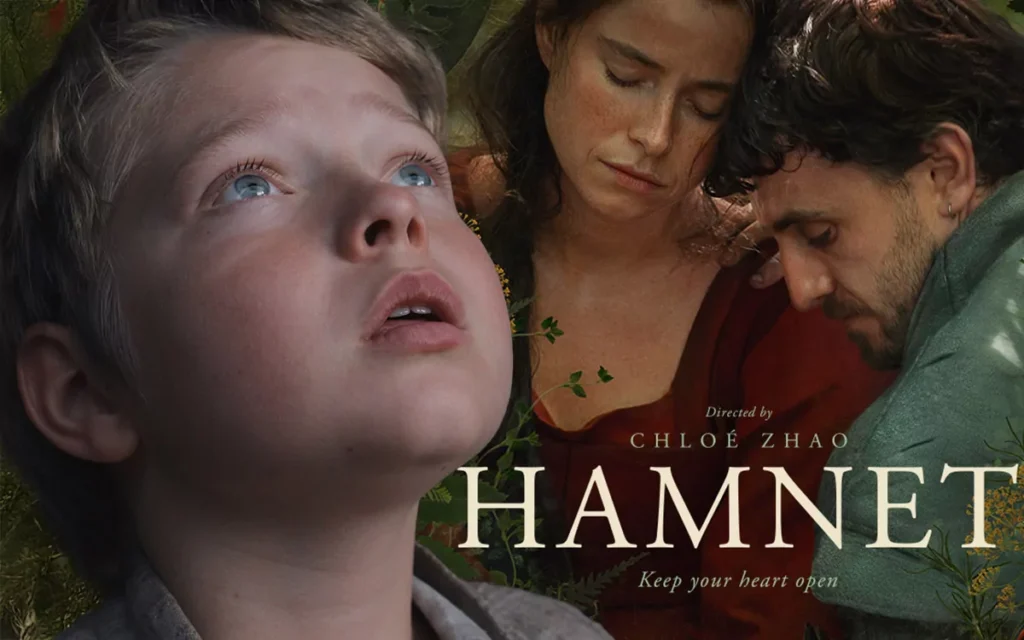
Hamnet the novel is a work of fiction, at whose center is the historical fact that, in 1596, the playwright William Shakespeare lost his 11-year son, Hamnet. Between 1599 and 1601, Shakespeare completed the tragedy of Hamlet, choosing a name which was apparently used interchangeably with Hamnet at the time. O’Farrell’s novel focuses on Shakespeare’s wife Anne Hathaway and the family’s life in Stratford-on-Avon, with her husband away in London most of the time. In it, Hamnet’s life is taken by the bubonic plague, although it is not known how the historical Hamnet died.
Hamnet the movie was beautifully made. When the dreaded, pivotal moment came, my friend reached out and squeezed my hand. I squeezed hers right back. I empathized, through my tears, with each of the very different ways in which the boy’s mother and father became strangers to each other for a time as they dealt alone with their terrible grief and the way in which the mother eventually came to understand how her (unnamed-but-illustrious) spouse had turned his own grief into art.
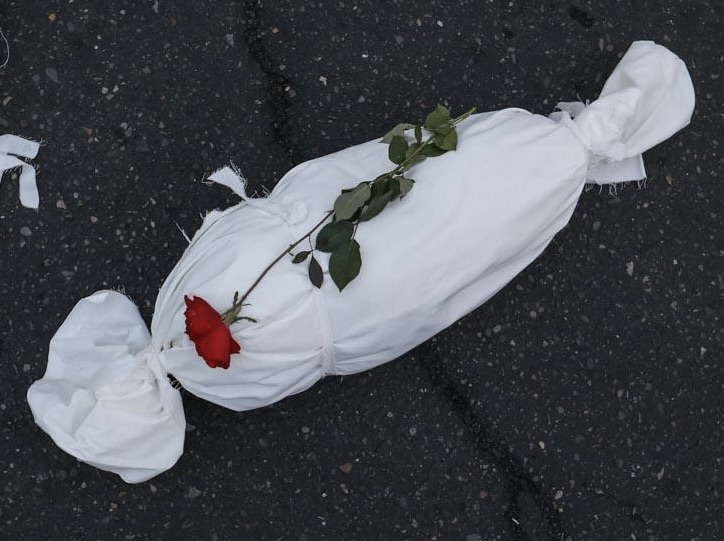
Of course, as with my first experience of Hamnet in the time of COVID, the way one responds to a book or film is shaped at least in part by the historical moment in which you read or watch it. Watching Hamnet the movie in December, 2025, there was one critical moment for me that was so jarring that it colored the whole experience—the scene of the mother bending over the dead body of her child. While no one can witness such a scene without their heart being wrenched out of their chest, what struck me in that moment was the fact I had seen thousands upon thousands of such scenes in the past two years, in Gaza, as thousands upon thousands of parents keened over the tiny, white-shrouded corpses of their children. When I told this to Shoba afterwards, she said that this was exactly what she had felt.
It felt almost obscene to be weeping over this one child, knowing that similar images had become daily fare on our screens. Where was the empathy, the outrage, the outcry? Was this one child who had died in an epidemic more than 400 years ago more worthy of our tears than the thousands of Palestinian children over the past three years who had been, and were still being killed by the Israeli military, armed with U.S. weapons, paid for with our tax dollars? Were the tears I shed as I watched that one mother’s racking grief and guilt, also the tears I had not yet shed for all the innocents whose lives were as nothing to their murderers?
The theater was packed and the atmosphere electric the night Shoba and I went to see Hamnet, which has now been nominated for eight Oscars in the upcoming Academy Awards, including Best Picture, and 11 nominations for the BAFTA Awards, including Best Film and Outstanding British Film. What a contrast with our next outing to Amherst Cinema just two days ago, this time to watch The Voice of Hind Rajab.
The whole world had heard of the killing of this six-year-old Palestinian girl in Gaza in January 2024. The car that she had been riding in with six members of her family was targeted by the Israeli Defense Forces (IDF). They were all shot dead around her, leaving her alone in the car. After hours of waiting, during which Palestinian emergency workers had stayed on the phone with her, helpless to get help to her as she called upon them again and again to come and get her. Later, much later, the car was found riddled with bullet holes—335 in all—along with the ambulance that had been sent to rescue her. Everyone in both vehicles was dead, including little Hind.
When Shoba called to ask me to attend the screening with her, I agreed immediately; I wouldn’t have had the heart to go alone. Neither of our husbands could bear it, so again it was just the two of us. I went early, to save seats, but I need not have worried—there were fewer than five people in the cinema’s smallest screening room. Halfway through, one person left—we will never know why. At the end, Shoba and I clapped fervently, as is the tradition at our cinema, which regularly airs films that don’t get shown in the big chains. But nobody joined us.
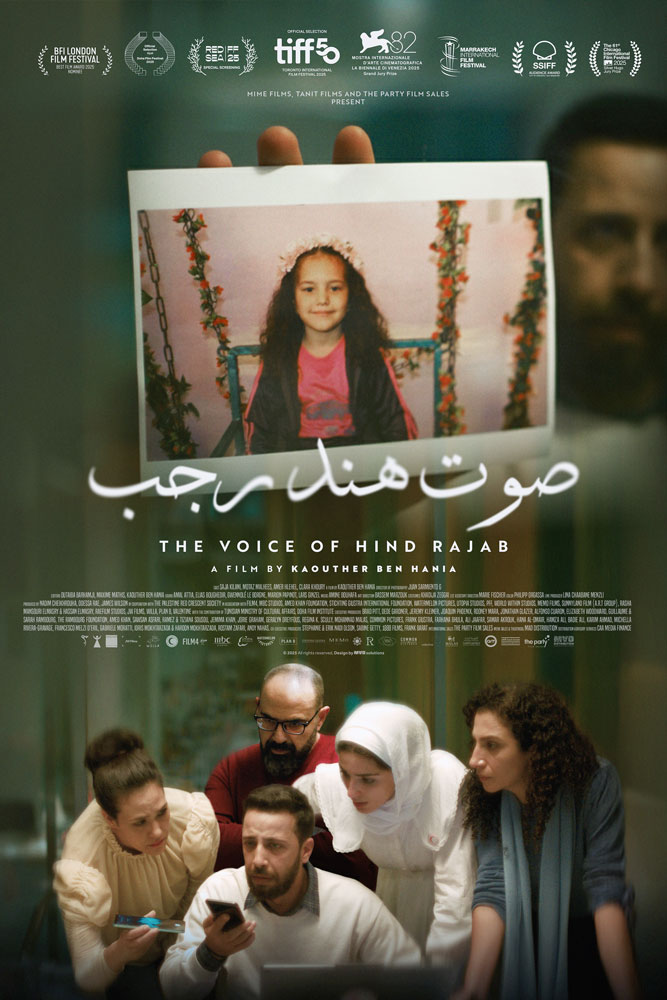
I was wrong to have been afraid to see the film. Rather than focusing voyeuristically on the body of a defenseless child, it represented Hind through a few still photos, a short home videoclip but mostly through recordings of her brave little voice, as the title suggests. It underscored her helplessness by focusing on the desperation of the office staff of the Palestinian Red Crescent, who had to operate out of Ramallah in the West Bank because their facility in the Gaza strip had been shut down, and who had to navigate through Kafkaesque layers of bureaucracy to get their ambulance clearance from the IDF. The film also spared the grief of Hind’s mother, again by focusing on the effects of the extended and, as the audience knew, doomed rescue operation on the well-trained staffers, each of whom broke down in their own way.
The Voice of Hind Rajab won the Grand Jury Prize at the 82nd Venice International Film Festival in September 2025 and has received one Oscar nomination for Best International Feature Film at the 98th Academy Awards, and one nomination for a BAFTA Film Award in the Film Not in the English Language category. Neither Hamnet nor Hind Rajab—both of which have female directors, Chloé Zhao and Kaouther Ben Hania, respectively—is favored by the bookies to win. But when a child dies, nobody wins.
Some Statistics: According to UNICEF, in the two years between October 7, 2023 and October 8, 2025, more than 20,000 Palestinian children have reportedly been killed across the Gaza Strip, including at least 1,000 babies, and another 44,000 maimed. We may never know how many more have died due to preventable illnesses or are buried under the rubble. As of mid-January, 2026, since the so-called ceasefire deal brokered by the United States in October 2025, more than 100 more Palestinian children have been killed in Gaza. And the addition to deaths from bombing and gunfire, children are continuing to die from starvation, hypothermia, disease, and delayed medical care. All entirely preventable.
All children are our children. How can the Palestinian people bear this terrible grief? How can we shoulder this terrible guilt?
To the United States Government I say:
STOP FUNDING GENOCIDE!
(Majid Asgaripour, WANA)
A postscript:
I have just learned that Western Mass Jewish Voice for Peace) is sponsoring free tickets for local organizers and community members to see The Voice of Hind Rajab at Amherst Cinema! See the film, then join them for a discussion on February 24 at 7pm.
Reserve a ticket at tinyurl.com/jvpmovie and find a showtime that works for you at amherstcinema.org/films-and-events/voice-hind-rajab.
Tickets are limited, so do book yours soon,.The film is being held over for a longer run.