
Town Plans Study on How to Increase Housing in East Amherst
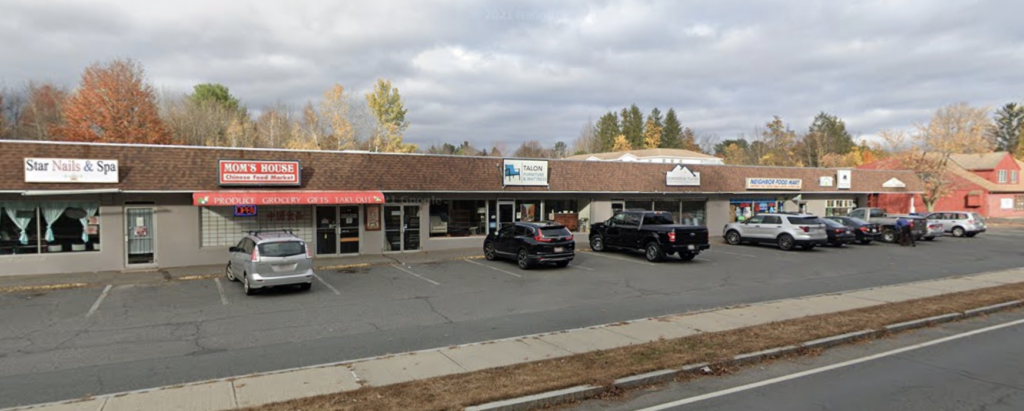
Commercial strip along College Street in East Amherst Village center. Photo: Google Maps
Report on the Meeting of the Amherst Planning Board, March 4, 2026
This meeting was held over Zoom and was recorded.
Present
Doug Marshall (Chair), Bruce Coldham, Fred Hartwell, Angus McLeod, Jesse Mager, Johanna Neumann, and Jerah Smith
Staff: Nate Malloy (Senior Planner) and Pam Field Sadler (Assistant)
East Amherst Housing Study
The town has received a community planning grant to hire a consultant to study East Amherst and recommend ways to increase residential density. The study area is mainly around Route 9 from South Whitney Street to South East Street, most of which is zoned Commercial. The effort is separate from the proposed creation of a local historic district in East Amherst, which is centered around the residential areas on Main Street, North East Street, and the area around the common.
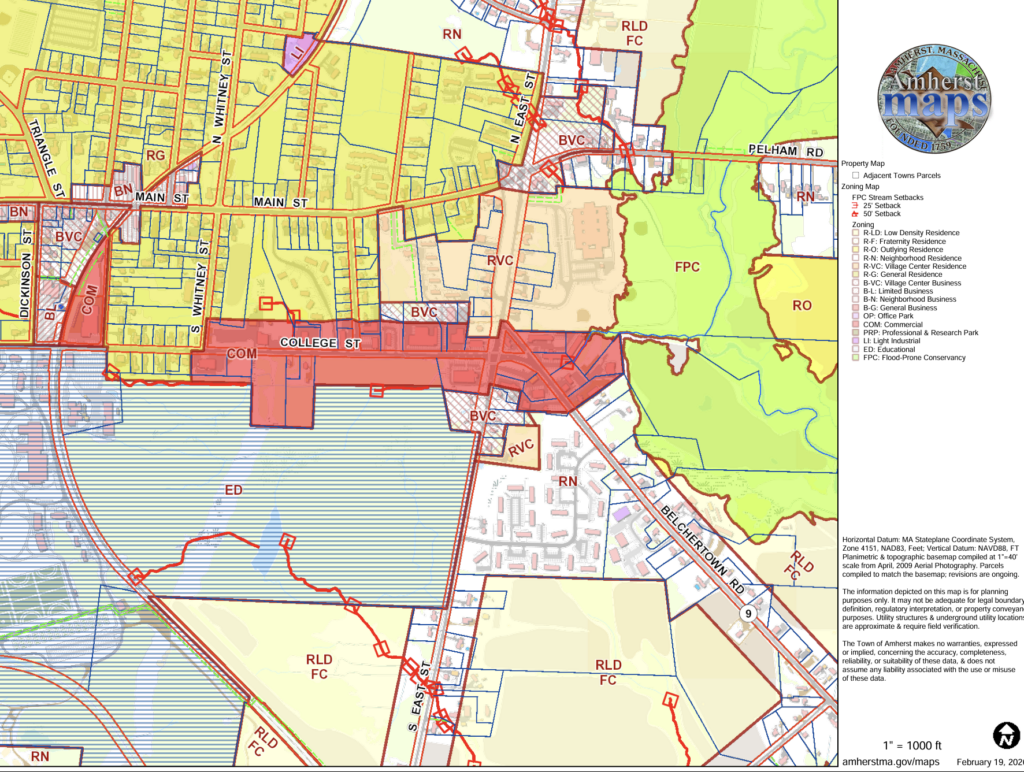
Planners Walker Powell and Nate Malloy said the study will look at possible zoning changes, especially those that would create affordable housing. Powell said one of the easiest ways to achieve these goals would be to create a 40-R smart growth zone that would give developers incentives in density and expedited permitting in exchange for including affordable units. Changing the zoning of the area to Residential Village Center (RVC) or Business Village Center (BVC) is also being considered.
The consultant will work with town staff to analyze existing conditions, review specific properties, recommend strategies to create more housing, and draft possible zoning changes. The consultant’s work should be completed by June 30, after which the Planning Board will be the primary venue for reviewing the recommendations and giving feedback.
Planning Board Chair Doug Marshall was concerned that the focus of this study is almost exclusively on housing, but the section of Route 9 being considered now contains many commercial establishments, and the Amherst tax base has so few businesses that he is wary of squeezing more of them out of town. He hoped that any rezoning would improve conditions for commercial enterprises.
Bruce Coldham agreed. He noted that this area is a gateway into town, and could be made more attractive. He suggested that the study include the long-vacant Maplewood Farms property on Belchertown Road, which has been the subject of “30 years of angst in town.”
He added that East Amherst is on the opposite side of town from UMass and questioned whether it could ease the crunch on student housing, which is the main housing need in town. Jesse Mager also stated that student housing should be included in the study. “Is East Amherst a good place for students?” he asked.
Marshall said that the study should consider changing the definition of an apartment building in the Zoning Bylaw to allow more than 24 units.
The Way Finder’s plan to construct 74 units of largely affordable housing in East Amherst at the East Street School on the common and on Belchertown Road was not mentioned at this meeting.
Revisiting the Idea of Creating a Definition of Student Housing
Although the Planning Board’s attempt to define a “student home” was not received favorably by the Town Council, which worried that it was most likely illegal, Malloy pointed out that the regulating of student housing has been brought up at meetings of several town committees and forums, and has been a major focus of the Planning Board’s Subcommittee on Housing. Even though a majority of Planning Board members said that they would probably not support measures to restrict student housing, most were not averse to getting a legal opinion as to whether it would be possible to create a land use category of a student home as opposed to trying to specify the users of properties. This is how State College, Pennsylvania, another town with a large state university, regulates student housing.
Malloy stated that if it were legal to define a student home in the zoning bylaw, it could provide protection of neighborhoods near the center of town by limiting the number of properties that could be rented to students in those areas, especially if the town increased opportunities for student rentals in other areas.
Board member Angus McLeod opined, “We can try to corral students, but unless we find places for them to live, we’re going to run into other kinds of problems. To me, I wouldn’t investigate it, but we’ve heard from people in the public who are really interested in this strategy.”
The Planning Board debated reinforcing its contention that UMass should take more of the responsibility for housing its students and work with the town to help protect year-round residents. A letter to the university, as well as the Planning Director and Town Manager, would emphasize the importance of this issue to the board.
Coldham and Mager wanted to pursue the idea of a North Amherst overlay, to increase the density of housing geared to students along North Pleasant Street and Meadow Street, despite opposition from North Amherst residents. Malloy suggested that perhaps the idea of threefold increase in density was too great, and a more modest proposal would be more acceptable.
Subcommittee Considering Redefining Mixed-Use Building Requirements in Outlying Districts
The Housing Subcommittee has considered reducing the amount of non-residential space required in mixed-use buildings outside of the downtown, such as in the RVC, BVC, Commercial and BN (neighborhood business) districts. The Zoning Bylaw specifies that 30% of the gross floor area on the ground floor be non-residential. In the new University Drive overlay this requirement has already been reduced to 75% of the façade length along the street to a depth of 24 feet.
Another specification that the committee considered modifying in order to increase density is the lot area currently required for each additional residential unit. Malloy said that an acre lot in the commercial zone would only support five or six dwelling units, because 4,000 square feet of area is needed for each unit. Lot and building coverages in each zone would still apply, even if the area requirements for each unit were lowered.
Marshall cautioned about broadly changing the zoning specifications for different zones, explaining that “having it apply all over town to disparate physical conditions feels like it keeps us from making changes to these zones, because in one of the places where there’s BVC it’s going to be an undesirable outcome.” Instead, he suggested splitting out those areas that are appropriate and rezoning them.
However, McLeod disagreed with this “spot zoning” because it would “make it very challenging for people who are trying to get projects approved.” He actually would favor combining some zones, such as Office Park and Research Park.
Proposed zoning amendments need to be reviewed by the Planning Board and the Community Resources Committee of the Town Council. They then require a public hearing and at least two readings by the full council, so that the timeline for passing them is usually six months or more.
Review of Downtown Design Standards Scheduled for March 11
The three-volume publication of proposed downtown design standards produced by Dodson and Flinker will be presented to the public on Wednesday, March 11, from 6 to 8:30 p.m. in the social hall of the Unitarian Universalist Society, 121 North Pleasant Street.
There will be a comprehensive presentation of the Downtown Design Standards, which cover the context/vision for downtown, standards for private developments, and standards for public improvements. After the presentation, the event will transition to an open house, where attendees can provide feedback on each of the three volumes by engaging directly with project consultants and town staff. All community members are welcome and encouraged to attend.
We really dont need consulting, the solution is simple, build tall, build with brick stone and steel and not wood, have shops on the bottom floor and make sure the sewage is ready to handle it. North Amherst has been taking nearly all of the in-fill so far. There is a massive ammount of space in East and South Amherst but they seem to be much more resistant to any development. I never understood the desire to keep permenant residents and students away from eachother. I remember being 9 years old and growing up living next to student housing in Amherst and it really wasnt an issue or something my parents ever complained about. I hope we can get more development in the east and south as well as downtown, Amherst could easily have the most exciting downtown in the state west of Worcester if we allowed it.
John McPhee you are correct. The only way to get more housing is to build more housing!
One way to not get new housing is to create a local historic district. This will hinder any new building in the area, which I suspect is the real intention of the historic district being proposed in East Amherst.
I tend to consider the East Amherst study area to basically be part of downtown. The corridor from the intersection of South East Street to Pleasant Street should be treated like the downtown area. Mixed use buildings, with no parking mandates, nice wide sidewalks that encourage walking into town and bike lanes. This area is right down the street from Amherst College and would be great for all types of residences. There is already a bike share at the intersection of Route 9 and South East Street (or at least there was), although there is currently not a bus stop on that route there are a few nearby. Maybe we can work with PVTA to get one there, but it should not hinder any development in the area.
The zoning throughout town needs to be revamped as a whole. The patchwork that exists currently is not useful. Residences should be able to be built in any zoning area, especially commercially zoned areas. The idea that we need to separate people’s housing from where they shop is an outdated failure. Many people desire community, but isolate themselves (not necessarily through any fault of their own) in car dependent suburban sprawl neighborhoods. We have a real opportunity to try and make positive change in our housing situation and overall community feel by building dense housing and mixed use in the areas of town where it should be built.
It is not the case that the creation of a local historic district in East Amherst will impede the devlopment of more housing in the same part of the town. As per other happenings in town committees, it is the case that “[Amherst] has received a community planning grant to hire a consultant to study East Amherst and recommend ways to increase residential density. The study area is mainly around Route 9 from South Whitney Street to South East Street, most of which is zoned Commercial. The effort is separate from the proposed creation of a local historic district in East Amherst, which is centered around the residential areas on Main Street, North East Street, and the area around the common.” (Amherst Indy] It is such an old saw to read that historic preservation and housing density are not compatible. It is possible in our complicated world to have a ‘both/and’ rather than an ‘either/or’ for our future as a town.
Hetty,
The creation of the local historic district in East Amherst will definitely impede development there. That area is in desperate need of additional housing (like the entire town) but there is space there. There are plenty of opportunities to build in East Amherst, including the area where the local historic district is proposed. By creating a local historic district we will make building more expensive, make rehabilitation of existing properties more expensive, allow existing properties to fall into disrepair, and purposefully slow roll applications for demolition, or construction in the area.
I understand that the two areas are separate from one another but they are both East Amherst and are only about 1,200 feet away from each other. I agree that we can have both, however, past experience tells me that in this town things like local historic districts and zoning get used far more often to prevent new buildings and developments instead of finding a way to work together to create them.
Many of the homes in the proposed East Amherst local historic district are rentals. Do you think that those landlords have any interest in the historic preservation of those buildings? Why should those buildings be preserved?