
Neighbors Unhappy with Beacon’s Plan to Build 140 Units in North Amherst
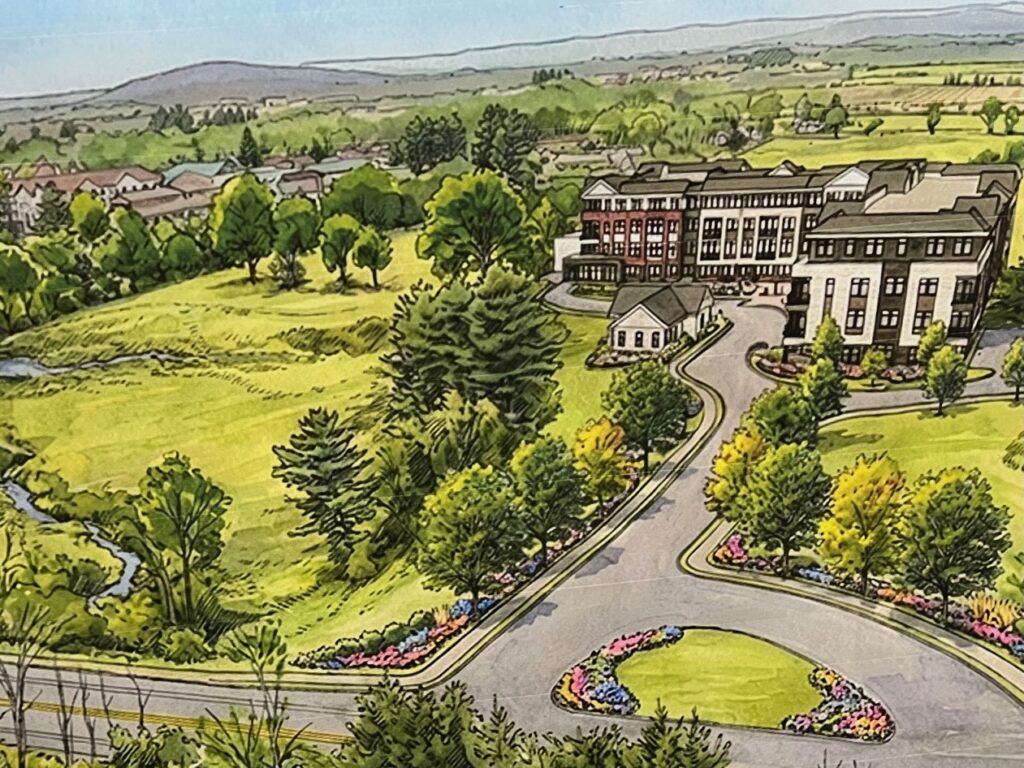
Architect's rendition of Beacon's proposed apartment building at Mitchell Farm in North Amherst. Photo: Maura Keene
At a community meeting held at the Amherst Survival Center on the evening of April 13, Beacon Communities found no supporters for its plan to build 140 units of affordable housing for seniors (over age 55) and families (non-age-restricted) at 246 Montague Road, on land owned by the Mitchell family. There were about 50 attendees at the meeting. Darcy Jameson, Vice President of Development at Beacon Communities LLC, stressed that the plans are at a very early stage and that technical issues will be dealt with through the permitting process.
Those in attendance heard a presentation by Jameson, and Dara Kovel, CEO at Beacon, that detailed the history of Beacon as a leader in developing and managing affordable housing for over 30 years. Locally, the group manages Rolling Green Apartments and developed North Square at the Mill District, which has 104 market rate and 26 affordable units. Nationally, the company owns and manages 20,000 homes at more than 160 locations, mostly in the Northeast and mid-Atlantic regions.
Kovel said that the company’s mission is to “create and nurture healthy, vibrant, and sustainable communities that positively impact the lives of our residents and make enduring contributions to the vitality of our cities and towns.”
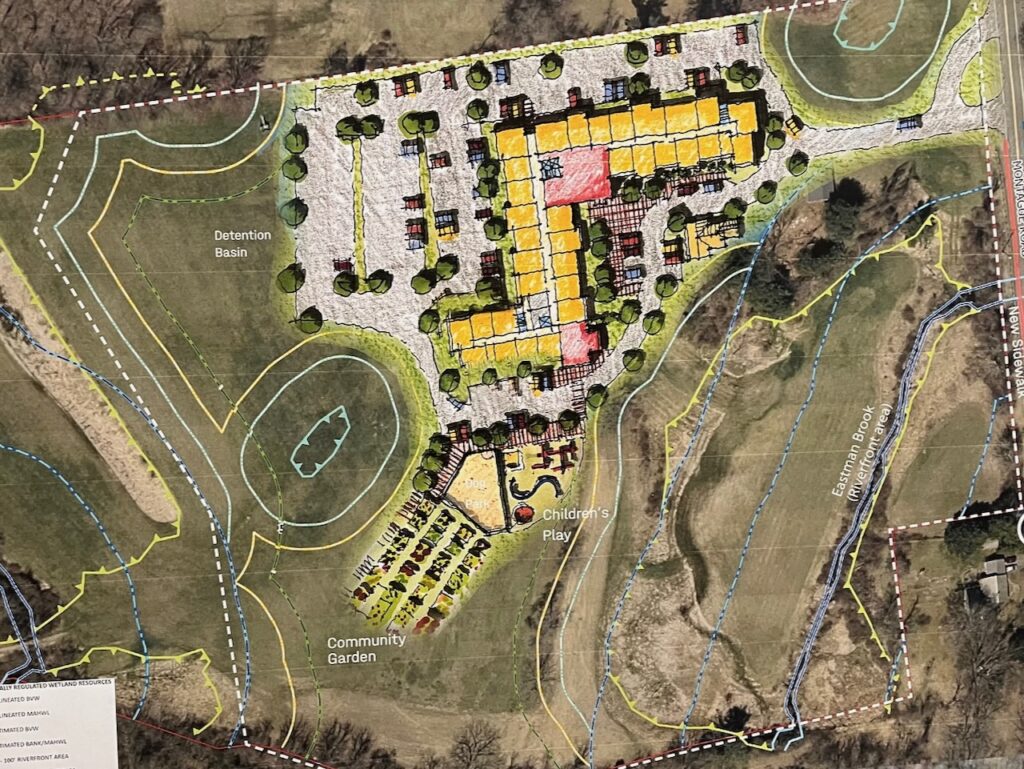
The project planned for the Mitchell property consists of one four-story building on 14-acres off of Montague Road. Jameson said that the 11 acres of the site near Sunderland Road was too wet to be easily developed. The existing barn and house will be demolished. The units will be one, two, and three-bedrooms and will meet passive house standards. There will be solar panels on the roof and 210 parking spaces.
The success of the project will depend on Beacon getting low-income tax credits, meaning that residents of the units will not pay more than one-third of their income, and will need to earn less than 80% of the area median income (AMI), or about $76,000 for a two-person household. Beacon will be applying to the Zoning Board of Appeals for a comprehensive permit under Massachusetts General Law Chapter 40B.
As part of the planning, the town will need to install new sidewalks, a connection to the sewer system, traffic-calming measures, and improved access to bus service. Amherst’s Director of Planning and Economic Development, Jeff Bagg, said that there are grants available to fund most of these if they are associated with new housing.
Bagg noted that the town has fallen short of its five-year goal of creating 250 affordable units and 850 market-rate units set forth in the 2021 Comprehensive Housing Policy passed by the Town Council. However, because more than 10% of Amherst’s housing units are affordable, the state will not require the town to approve more affordable housing. A new project must have a letter of support from the Town Manager, and there is a 30-day public comment period before funding is released. The WayFinders proposal for the East Street School and Belchertown Road is still waiting for state funding. Valley Community Development Corporation was successful in the 40B process for the soon-to-be-completed Amherst Community Homes (the 30 affordable homeownership units between Ball Lane and Pulpit Hill Road in North Amherst.
Bagg outlined the many steps that Beacon must go through before construction can occur. If all proceeds optimally, construction of the project, expected to cost $90 to $100 million would begin in 2028.
Residents Worried About Traffic, Flooding, and Infrastructure Cost
Joe Swartz said that the town should fix the existing traffic before adding more people to the already congested traffic pattern in North Amherst, which necessitates him to drive miles out of his way because he can’t make a left turn out of his driveway due to traffic being backed up on Meadow Street. “I love North Square,” he said, “but it created a traffic nightmare.” He added that the term “traffic calming” is a nightmare when there are bottlenecks for miles.
One of the group of UMass students in attendance asked about having fewer parking spaces to discourage residents of the new project from owning cars, but Kovel said that, although Beacon has built projects with no parking, they realize that people living in Western Massachusetts need cars.
Kovel insisted that the traffic problems “are bigger than us.” She said that they existed before North Square, and that there are other factors that contribute to the situation. Much of the traffic comes from Leverett, Sunderland, and Shutesbury. “Our building did not cause the traffic problems,” she said.
Bagg replied to others who expressed concerns about the additional traffic that modifying the intersection of Sunderland Road, Montague Road, Meadow Street, Pine Street, and North Pleasant Street could not be done with grants linked to this project, since the proposed complex is too far from that intersection. Any modification of the intersection would need to be paid for by the town. It was suggested that a new road be created from the project to Sunderland Road, but that would not be allowed because it would cross wetlands.
Others pointed to the speed of the traffic on Montague Road and the danger to pedestrians, even with the lighted crosswalk near the North Amherst Library. There is a new crosswalk near the Amherst Community Homes development, but apparently the eastern end is in a ditch.
The other concern voiced by several residents was the presence of abundant wetlands on or near the planned construction site. There is a stream running through the property. Lauren McCarthy, whose property abuts the Mitchell site, said her basement regularly floods during heavy rains. Bruce Patterson, whose land is to the west, said his tractor sinks into the mud every spring. The presence of wetlands was the primary reason the proposed Eruptor business incubator project was withdrawn in 2021.
Patterson pointed out that the Mitchell property has both Outlying Residential (RO) and Professional Research Park (PRP) zones. Both are meant to encourage development that is less dense and does not demand intensive services. He noted that the Beacon project met neither of those standards. It was dense development that would require intensive services.
Linda Arsenault asked why the complex couldn’t be two stories instead of four stories. The developers explained that there was an economy of scale, and Beacon wants to create the most units in the smallest possible footprint.
District 1 Town Councilors Cathy Schoen and Jill Brevik worried about the financial liability of the town for the development. The developers noted that the town would need to demonstrate its support by contributing about $2 million in order for the state to fund the majority of the project. Resident Robin Jaffin noted that the town had applied for a MassWorks grant to provide infrastructure for the year-round shelter at the site of the former VFW, and might not be awarded another grant for this project. Brevik asked if Beacon had considered other properties that might be more suitable, such as some downtown, but the representatives said that every other one they looked at was too small.
Vincent O’Connor also pointed out that North Square was given a substantial tax abatement, and suspects that this project will also receive one. He felt a more appropriate location for senior and affordable housing would be downtown.
Hilda Greenbaum gave some historical perspective. She said, “The town bought Cherry Hill under right of first refusal in 1987 to prevent a developer from building more than 200 units there.” The land was under Chapter 61b (recreation use), so the town had the first option to buy it, but the grants awarded meant the property could only be used for recreation. She added, “The town purchased Hickory Ridge Golf Club in part for affordable housing. It is in a developed village center with few immediate neighbors to complain.”
Although the representatives from Beacon stressed that they are eager to work with the residents of North Amherst to address their concerns, it was clear that there was a lack of trust on the part of neighbors, who were un convinced that such a dense project would not increase traffic problems and flooding, and end up costing the town in tax incentives, additional services, upgraded infrastructure, on top of the town’s expected contribution to the project.
This is a great project in the wrong place. Atkins Corner or East Amherst or University Drive all are great places for this project-close to bus lines, food, stores and with roads that can handle traffic. Possibly Hampshire College? There are good reasons the Mitchell Farm site is not zoned for this level of development.
Yet again these developers are desperate to get into North Amherst. South Amherst is becoming a different town at this point because they somehow have the ability to shoot down every single project ever proposed, the place is utterly empty, and every piece of what people call “Amherst” is actually compressed in this tiny area of single family homes in the northern tip that just accept project after project while paying more and more property tax to be wasted on a gold encrusted library or the 13th 6-figure contract with a “consulting company” to overlook the historic preservation of a single brick wall or something.
I want it built, but I want it near the main road with stores on the bottom and I want the whole thing made of brick.
I wonder if space can be found on Hampshire College campus, possibly in some of their existing buildings. They do have a lot of housing, sturdy buildings, gym, tennis courts, pool — and it’s near Atkins Market, bus stops, the Eric Carle Museum, the Yiddish Book Center, Applewood, etc.