
Opinion: Hampshire Closing Opens Door To Regional Innovation Hub
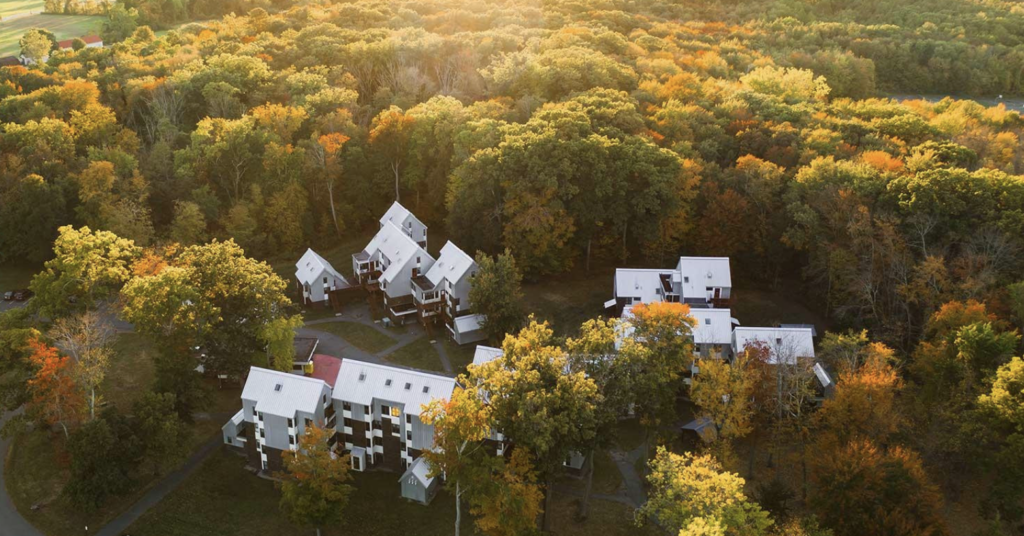
Hampshire College. Photo: hampshire.edu
Campus Could Become Live-Work Innovation Community

The decision to close Hampshire College after the fall 2026 semester is now final. After years of financial strain, one of the region’s most distinctive institutions will wind down, leaving behind not just a legacy, but a question: What should become of its campus?
That question matters far beyond Amherst.
The Pioneer Valley is home to one of the most concentrated clusters of intellectual and creative talent in the country, anchored by Amherst College, Smith College, Mount Holyoke College, and the University of Massachusetts Amherst. Every year, thousands of students graduate from these institutions with ideas, ambition, and the potential to build companies and organizations that could shape the region’s future.
And every year, most of them leave.
Over the past year, I have spoken with more than two dozen students across the Five Colleges. The message has been remarkably consistent: they would consider staying in the Pioneer Valley, but they cannot find a viable path to do so. Housing is too scarce or too expensive. There are few structured opportunities to build something after graduation. The gap between student life and professional opportunity is simply too wide.
So they go to Boston. Or New York. Or wherever that bridge already exists.
If we are serious about addressing the region’s economic challenges, such as rising costs, limited commercial growth, and an overreliance on residential taxes in communities like Northampton and Amherst, we have to confront this talent drain directly.
The closing of Hampshire, as difficult as it is, creates a rare opportunity to do exactly that.
A Regional Talent Gap
The concept of “innovation districts,” places where people can live, work, and build in close proximity, has gained traction in recent years. While former college campuses are often repurposed for housing or mixed-use development, far fewer are reimagined as centers for entrepreneurship and innovation. The Hampshire campus and the uniqueness of this model, with a network of four colleges, could become one of the country’s most compelling examples of a former college campus transformed into a live-work hub for innovation, entrepreneurship, and regional talent retention.
A New Use For A Unique Campus
Imagine the campus as an Innovation and Entrepreneurship Center, transforming into a shared, multi-institutional space where students, recent graduates, and early-stage founders cannot only develop ideas, but stay and grow them here.
This could take the form of a live-work innovation community.
Existing student housing could be adapted into affordable, flexible living space for recent graduates and founders. Academic buildings could become shared labs, maker spaces, and light engineering facilities accessible to students across the four remaining colleges. Structured incubator and accelerator programs could support startups in areas like clean energy, digital technology, advanced manufacturing, and applied life sciences, while also leaving room for social impact ventures that reflect the region’s values.
This would not replace what each college already offers. It would connect and extend it by creating a missing bridge between education and the real economy.
It would also build on Hampshire’s legacy. At its core, Hampshire was an experiment, an institution designed to challenge traditional models of learning. Reimagining the campus as a place where people come not just to study, but to create, test, and launch new ideas, would carry that spirit forward in a new form.
A Narrow Window
There are, of course, other paths. The campus could be absorbed into a single institution, most likely the University of Massachusetts Amherst. That may be efficient. But it would also limit what is possible.
Before decisions are made, the region should consider whether this moment could be used to create something broader: a shared platform that serves all four colleges, connects more directly to surrounding communities, and strengthens the long-term economic future of Western Massachusetts.
Hampshire’s closing is a loss. But what happens next is not yet determined.
With vision, coordination, and the right partnerships, this campus could become something new: a place where the region’s talent doesn’t just pass through, but stays, builds, and helps shape the future of the Pioneer Valley.
Matthew Hoey is a Northampton-based entrepreneur who co-founded and served as Managing Director of Canopy City, an international incubator for mission-driven startups. He has worked with leading university-based startup programs, including at MIT.
I was going to suggest something similar, but now can just second your emotion
Matthew’s vision is exciting and is certainly in the spirit of Hampshire College. It could also be seen as the next phase in Hampshire College’s development. From its beginning, the College stressed the dynamic connection between learning and the worlds of work and creativity, and the nexus of economic, social and individual values. Students were expected to leave the campus to make that connection as part of their degree requirement.
But, as Ed Cutting and others have been pointing out, higher education of all sorts and in all places are in trouble, and in many instances their troubles are the shadow sides of their successes. Successful institutions find themselves in a world of paradox, ambiguity and uncertainty and they are bewildered, as Hampshire College became bewildered. I wish someone had written a sequel to Franklin Patterson’s The Making of Hampshire College entitled The Sustaining of Hampshire College. Maybe Matthew Hoey’s vision is really an outline for such a book.
Love this idea, and there are many alumni who would support this effort with time, money and creative energy. I posted this on the alumni page and if you have a contact for anyone interested in engaging further – please do let me know and I will share it.
I agree that Matthew’s vision is brilliant, exciting and timely. To add to Matthew’s paradigm the model might also include conferring college degrees that are based in large part on apprenticeships. There seems to be funding for this approach. Apprenticeship degrees will be important part of the future of higher education in the U.S. 6 community colleges in Eastern MA are newly (this spring) doing exactly that. Why not do it right here in the Pioneer Valley at Hampshire College as part of an Innovation and Entrepreneurship Center? I can’t help but think this would be supported by Hampshire alums.
There have been many excellent ideas and suggestions of what to do with the campus once the college closes in January, 2027. But before anything can be done, there’s a small matter of the debt.
The first thing to cover is the bond debt that Hampshire says it cannot pay off on its own. The FY25 audit shows $20.4 million in short-term debt and $4.5 million in long-term debt, and it says the college “does not have the assets to pay off the bonds.”
The next issue is the real estate itself, because the college says the bondholders hold a mortgage on some unencumbered properties. That means the property is not simply sitting there unclaimed; a new group would need to satisfy or negotiate around the lender’s security interest before any practical reuse could happen.
So, in rough terms, a group would likely need at least about $25 million just to address the stated debt load, and probably more for legal, transaction, and redevelopment costs. The audit also shows $38.7 million of property, plant, and equipment on the books, but that accounting value is not the same as a purchase price or payoff amount.
Even if the debt were handled, the group would still need board approval, lender release, and likely regulatory approval for any transfer or repurposing of college property. Hampshire’s bylaws say the trustees must authorize the sale or other disposition of real estate or material tangible property.
A wonderful idea!
And some of the faculty and other innovation-oriented seniors of the region could be advisors.
Who will make these decisions? How can we support this idea going forward?
Have you spoken with the folks at LivingLocal413? They were exploring ideas around building intentional innovation communities in Western MA. And I run Innovate413, a new entrepreneurship support org focusing on launching scalable startups rooted in the Valley. Happy to help or chat anytime.