
How UMass’ “Public-Private” Dorm May Be Shortchanging Amherst Taxpayers
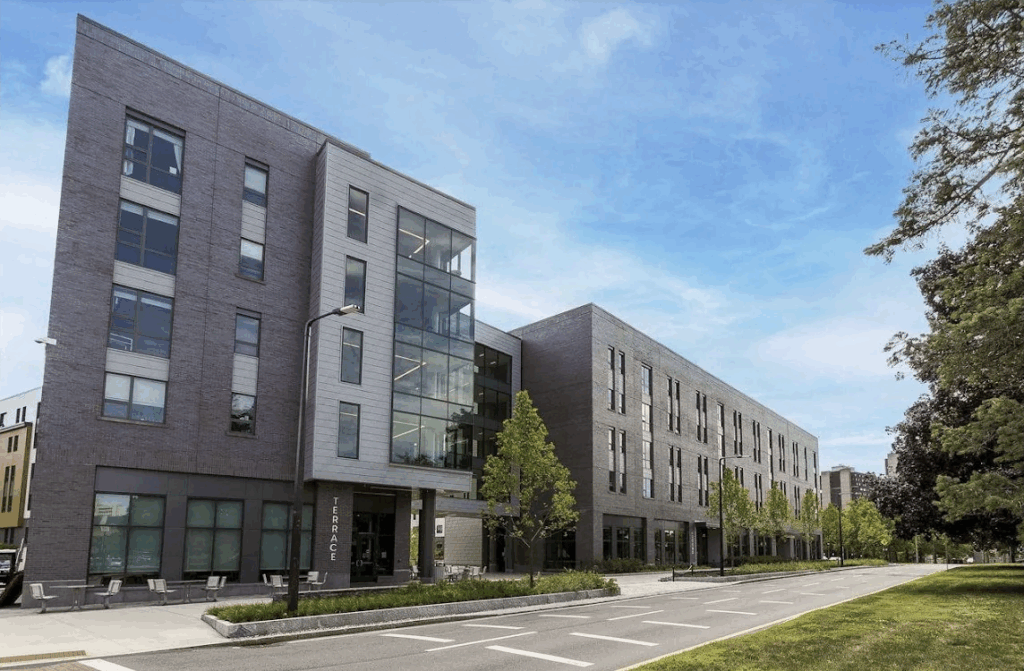
Fieldstone Apartments, UMass Amherst. Photo: Google Maps
The following article was written with the assistance of Perplexity AI.
Some Amherst residents have pointed out a downside of “more dorms on campus” — that if built within the laws of a Public Private Partnership (P3) (see also here), the town of Amherst may never see a dime in property taxes from these buildings (see also here), even as private developers pocket millions in student rent. Fieldstone Apartments, the gleaming new complex on Lincoln Avenue, is Exhibit A
A Deal That Looks Private, But Isn’t — On Paper
Fieldstone opened in fall 2024, housing 623 undergraduates and 201 graduate students in market-rate rooms costing between $1,923 and $2,608 per bedroom per month. The developers — Axium Infrastructure of New York City and Balfour Beatty Campus Solutions of Philadelphia — are unambiguously private, for-profit companies collecting tens of millions of dollars annually from UMass students.
Yet the deal was structured in a very specific way: as a Service Concession Arrangement (SCA), a legal and accounting framework governed by governmental accounting standards. Under an SCA, the private developers paid UMass an upfront service concession fee of $20 million for the right to build and operate the housing on university-owned land. In exchange, they collect rents, run the facility, and — critically — the building legally sits on UMass’s balance sheet as a public infrastructure asset, not on the developers’ books as a private building.
What Is a Service Concession Fee, and Why Does It Matter?
Think of the service concession fee as the price of admission to operate on public land. The private operators paid UMass $20 million upfront — not as rent, but as a concession payment granting them operating rights. UMass records this as a deferred inflow of resources, gradually recognizing the revenue over the life of the arrangement. At the end of the deal’s term, the building reverts entirely to UMass.
This is fundamentally different from a lease. In a standard lease, a private company controls and typically owns improvements it makes to the property — creating a clear, taxable private asset. In a service concession, the government entity (UMass) never really gives up control. It retains authority over what services are provided, to whom, and under what conditions. The private operator is less a landlord and more a contracted manager — albeit one collecting very landlord-like revenues.
The direction of money also tells a story. In a typical lease, the private company pays the public entity periodically over time. In a service concession, the private company pays a large upfront fee and then earns its money back — and more — by collecting rents directly from users. At Fieldstone, that means collecting from thousands of UMass students every single month.
The Loophole That Could Cost Amherst Millions
Here is where Amherst taxpayers should sit up and pay attention. Under Massachusetts law, UMass — as a state university — is tax-exempt. Its land and buildings do not appear on the town’s tax rolls. By structuring Fieldstone as an SCA rather than a straightforward private development or long-term ground lease, the building’s private operators effectively inherit that tax-exempt status.
For context: a comparable private dormitory on Olympia Drive — built on land purchased from a fraternity and therefore not on UMass’s books — is assessed at $18.5 million and does pay real estate taxes to the Town of Amherst. Fieldstone, generating far more rental income from far more students, currently pays nothing.
Town Manager Paul Bockelman has acknowledged that Fieldstone “was constructed with the idea that it would not be taxed,” and warned that any attempt by Amherst to impose a tax would likely end up in court. As of fall 2025, the Finance Committee was actively seeking a legal opinion from Town Assessor Kim Mew on whether the town has any grounds to challenge this arrangement.
The Broader Question for Amherst
The Fieldstone case exposes a gap that communities across Massachusetts — and the country — are grappling with as cash-strapped universities increasingly turn to P3 deals to finance student housing. The SCA structure is a legitimate accounting tool, originally designed to ensure transparency when governments hand over public assets to private operators. But it also creates a situation where a private company can operate what is functionally a luxury apartment complex, charge market-rate rents, generate significant profits, and face no local property tax liability — simply because of the contract’s wording.
If the goal of these partnerships is to add housing while protecting the public interest, towns like Amherst deserve an honest accounting of what they are giving up. A building that walks, talks, and collects rent like a private apartment complex probably shouldn’t be allowed to shelter behind a public university’s tax exemption — regardless of what the balance sheet says.
The Amherst Indy will continue to follow developments as the town seeks legal clarity on this issue.
Is there some protocol that the Town of Amherst, represented by the Town Manager, could not negotiate a better deal for the “town” part of “town/gown”? (being polite? not being aggressive?) Growing up in retail, I learned “don’t give away the store.” There are real and consequences costs incurred by the Town of Amherst as they host our largest employer. Because they are tax exempt, those true costs should be covered by PILOTs equivalent to UMass’ peers, that regularly pay more to their host towns and cities. (I understand this is part of a bigger problem of Boston not supporting public higher ed, but it gets compounded further on the town level – with horrible roads, declining year round population, overproduction of private off campus dorms. So though we seem to have very healthy bonding, we have allowed an accounting loophole to deprive the town of over $2,000,000 in property taxes annually. Possibly this is all made harder by the number of people who work for both the town and UMass, and how even when well intentioned, face difficult conflicts of interest. It seems to me those conflicts make it harder to be more forceful and effective when negotiating PILOTs. Also, consider the student sit-ins of how many students do want more dorms on campus. Plus, UMass says they are not building any more new on-campus dwellings, but instead upgrading 1970s dorms (of course a good thing). I suggest negotiating some increased payment to the town on those projects too. Lastly, UMass should be a steward, leaving their town better than they found it. I’d love if that was their guiding principle in doing anything that impacts Amherst.
Could the Town simply charge a higher rate for the water and sewerage services to these entities? Maybe that would close much of the loophole?