
Flooding and Temperature Extremes Are the Highest Risks in Amherst’s Future
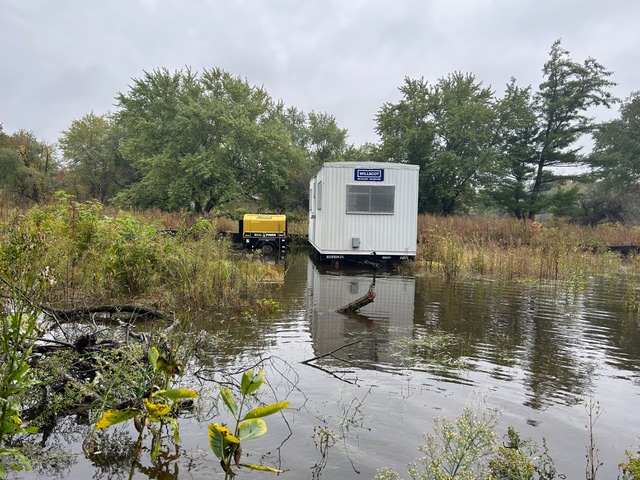
Flooded trailer and generator at the Hickory Ridge solar construction site. Photo: Michael Lipinsky
Report on the Public Meeting on the Updated Hazard Mitigation Plan, April 30, 2026
This hybrid meeting was held in Town Hall and was recorded.
Mimi Kaplan, senior planner at the Pioneer Valley Planning Commission, presented a draft Hazard Mitigation Plan for Amherst. The previous plan was completed in 2017. This was the second and final public meeting about the updated plan; the first was held in November.
A Hazard Mitigation Plan (HMP) is a community-driven, long-term strategy designed to identify natural hazards — such as flooding, winter storms, and hurricanes — and outline actions to reduce risks to life and property. These plans break the cycle of disaster damage and repair, and are required for municipalities to receive Federal Emergency Management Agency (FEMA) mitigation grants. In Massachusetts, these plans are coordinated with the Massachusetts Emergency Management Agency (MEMA) to ensure they meet federal requirements.
Kaplan will summarize the comments she received, incorporate suggestions, and submit a draft of the plan to MEMA and FEMA. Those agencies will review the plan over the next several months and return it to the town with suggestions. The final plan is expected to be approved by the Town Council by Oct. 1. The plan is then valid for five years.
FEMA defines hazard mitigation as “any sustained action taken to reduce or eliminate long-term risk to people and property from natural hazards such as flooding, storms, high winds, hurricanes, wildfires, earthquakes, etc. Mitigation efforts undertaken by communities will help to minimize damages to buildings and infrastructure, such as water supplies, sewers, and utility transmission lines, as well as natural, cultural, and historic resources.”
The plan identifies cost-effective actions to prevent future losses and promotes resilience in the face of a changing climate.
The plan is required to include hazard identification and description, identification and mapping of critical infrastructure, risk assessment (especially for vulnerable populations), an assessment of the town’s mitigation capabilities, and a review of previous mitigation strategies and identification of new ones.
Climate Change Expected to Bring More Hot Days and Increased Flooding
Kaplan noted that climate change increases the risk of all hazards except earthquakes. She said global warming is predicted to result in 60 more days of temperatures above 90 degrees in interior Massachusetts by the end of the century. The Northeast has also experienced the greatest increases in total precipitation and in the number of heavy precipitation events in the country. The mitigation plan recommends multilingual outreach to the vulnerable populations most likely to be affected by temperature extremes.
These changes will result in flooding both in floodplains and in other localized areas. Amherst has already begun taking steps to reduce flood damage. Together with other towns in the Fort River watershed, the town is participating in a Municipal Vulnerability Preparedness (MVP) grant to evaluate all culverts and prioritize those most in need of repair. The town has also purchased land in flood zones at Hickory Ridge and Fort River Gardens for conservation and habitat restoration.
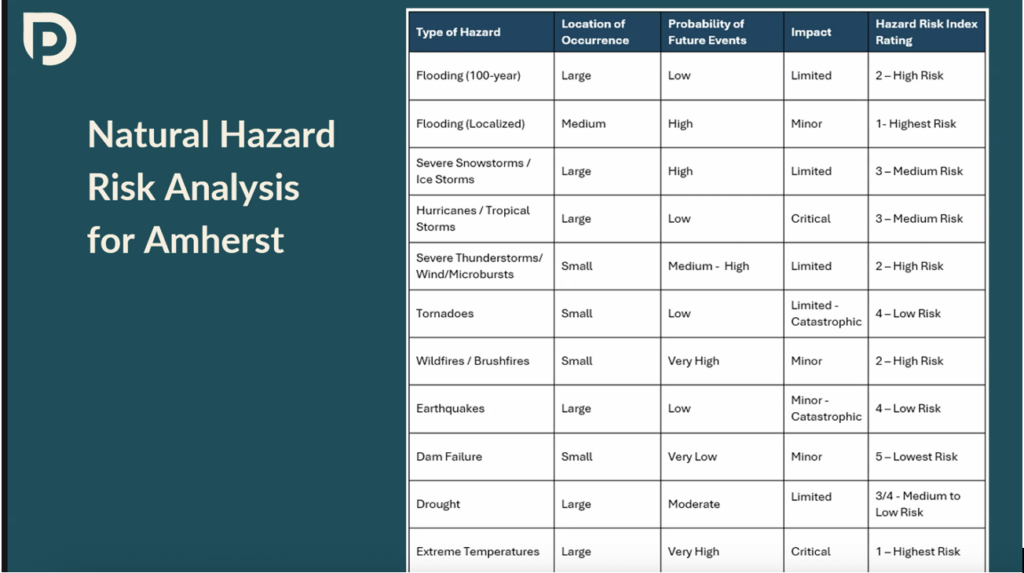
Other strategies for addressing flood risk include green engineering to stabilize flood-prone areas, new stormwater regulations, and repair of the dam at Puffers Pond. Additional recommended actions include reviewing site plan criteria to incorporate best practices for stormwater management, reducing impervious surfaces, and encouraging tree planting to absorb excess stormwater.
The plan also cites a moderate increase in power outages from severe thunderstorms and heavy snowfall, increased frequency and severity of droughts, and the impact of more frequent wildfires on drinking water supplies.
How Will Amherst’s Development Plans Mesh with the Need to Reduce Flood Risk?
During the question-and-answer period, Elisa Campbell noted the Planning Department’s goals of increasing housing density in East Amherst and South Amherst — both areas at risk for flooding. Amherst Fire Chief Lindsay Stromgren said the Hazard Mitigation Plan ensures that any new development has a guide for managing these risks. Kaplan said new projects should minimize impervious surfaces and increase green infrastructure.
I was glad to see the Town Council adopt the new Hazard Mitigation Plan for Amherst yesterday and to hear Lynn Griesemer mention the fact that UMass has a microgrid that could help serve residents during an emergency. I hope the town pursues that avenue as well as that mentioned by the Manager of our new zero energy Amethyst Elementary School, which has high micro grid potential.