
Private Builders of UMass Dorms Will Not Pay Tax to Amherst
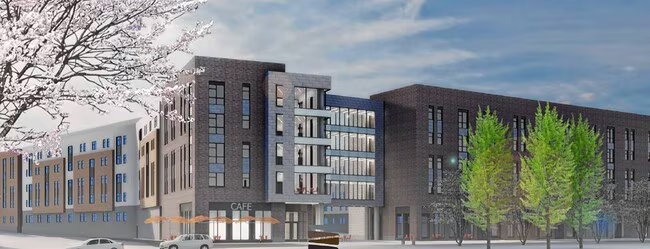
Fieldstone Apartments at UMass Amherst. The apartments were built through a public-private partnership and are tax exempt. Photo: umass.edu
Report of the Meeting of the Town Council, September 14, 2026, Part 1
This hybrid meeting was held in Town Hall and recorded.
Present
Mandi Jo Hanneke (President, at large), Andy Churchill (at large), Jill Brevik and Cathy Schoen (District 1), Amber Cano-Martin and Lynn Griesemer (District 2), Hala Lord and George Ryan (District 3), Pam Rooney and Jennifer Taub (District 4), Ana Devlin Gauthier and Sam MacLeod (District 5). Absent: Ellisha Walker (at large).
Staff: Paul Bockelman (Town Manager) and Athena O’Keeffe (Clerk of Council)
UMass Plans to Renovate Student Housing Through Public-Private Partnerships
UMass leadership met with town leaders on September 8, to outline the university’s plan to update student housing on campus by building new housing in partnership with American Campus Communities, a private developer. According to Town Council President Mandi Jo Hanneke’s report, town officials emphasized the need for town revenue when private companies operate housing for profit on UMass land. Although the town suggested options on arrangements that would provide tax revenue for these public-private partnerships (P3), the university was not receptive. Finance Committee Chair Cathy Schoen said the UMass representatives replied that “this is the way they’re going to be structured.”
The university plans to keep the number of student beds on campus the same unless enrollment or market forces dictate otherwise. The rebuilding is expected to take a decade.
Beyond concerns about not generating tax revenue, Hanneke and Schoen worried about the affordability of student housing under a P3 agreement. Hanneke’s report says, “We voiced concern that the premium charged in these agreements (profits generated by the private corporation) is being paid by students, increasing their costs for housing, as compared to housing managed and operated by the University. Regarding affordability of housing, I pointed out that the Fieldstone rents are some of the highest in town and appeared to result in other similar buildings raising their own rents, making the overall Amherst rental market more expensive since Fieldstone opened. We do not want to see a similar outcome from this planning process, especially for housing considered ‘on-campus.’”
According to Schoen, the university justified the high cost of the new units by noting that the private developer is taking risks and expects to make a profit.
Town staff also highlighted the need for faculty and staff housing and the possibility of building some on university land or selling land to private entities to build employee housing, which would put that land on the tax rolls and fulfill Governor Healey’s goal of using surplus state land for housing.
Hanneke’s report concludes, “In the meeting, our consistent message was the need for private developers of housing, commercial, and retail, even when on UMass land, to pay property taxes and local option taxes, and that any agreement regarding the development of housing with American Campus Communities should include revenue for the town, similar to what private housing developers and operators pay when housing is not located on UMass land. I am concerned that this strategic planning process with American Campus Communities will result in many more buildings housing students on the UMass campus being built, maintained, and/or operated by private corporations without those private corporations paying the taxes and fees required of private corporations operating housing on non-state-owned land.”
Schoen also asked whether the state knew that its underfunding of campus building repairs and maintenance leads the university to turn to these private-sector building agreements, which also increase the campus’s carbon footprint by demolishing existing dormitories. She suggested bringing the situation to the attention of the town’s state representatives and maybe encouraging the university to sell some of its land for private development. However, the university officials at the meeting said they were not planning that at this time.
Another disturbing point was that the university may be planning a similar P3 agreement to renovate the Campus Center Hotel in such a way that the town will no longer get the little bit of revenue it currently receives from the hotel and restaurant tax.
Pam Rooney said that the university’s contract with Axium Infrastructure and Balfour Beatty Campus Solutions is “very, very, very clear that the corporation covers their backside completely in terms of not being taxable, and to the point that they will litigate against the university, should the university even think about helping us find a way to tax those properties.”
Rooney continued, “Not only did the corporation get assistance from the university in terms of some of the utility work that was done for Fieldstone, they did not have to pay for the land. They are charging service fees, not rent. And they didn’t have to pay state tax on building construction materials. All of these factors should have brought in a product that was much more affordable than anybody could possibly imagine, and it was not. It is one of the most expensive properties in town, so I would love legislative assistance. It’s a big corporation. They know exactly how to twist those words.”
Strategic Partnership Agreement Between UMass and Town Expires in June
No follow-up meeting on the UMass development plan has been scheduled, but the university said that the town would receive updates in the future. The strategic partnership agreement (SPA) between the town and the university expires in June, so meetings will be scheduled to discuss a new agreement. While the P3 projects are not the only focus of the SPA meeting, Hanneke said that they will definitely be on the agenda. “Again,” she said, “revenue is one of our recurring themes.”
Recreation Department Will Use Hampshire College Pool
In his report, Town Manager Paul Bockelman said Hampshire College has offered the town full use of its swimming pool this fall at no charge. He said the Recreation Department is organizing different programs at the pool, which is especially important while the middle school pool is not available.
The town’s aquatics programs are self-supporting, but Bockelman said the town and the college would share any profits from programs at the pool. Hampshire students and staff have been able to take advantage of the town’s recreational programs even if they are not town residents.
More Pickleball Courts Needed
The story is not so positive for pickleball enthusiasts after the closing of the courts at Hampshire College. In public comment, Larry Steinhauser and Marian Hoffman asked that pickleball lines be painted on the second tennis court at Mill River Recreation Area. They said that there are typically long waits to play with only one court. Steinhauser noted that Community Preservation Act funds were allocated for a new court five years ago, but none has been built.
Schoen said 450 players were registered at the Bay Road court at Hampshire College and over 200 in the league at Mill River. She pointed to pickleball’s popularity among players of all ages.
Revision of the Regional Agreement Is the Topic for the September 26 Four Towns Meeting
The four towns in the Amherst-Pelham Regional School District will discuss the regional agreement at the Four Towns Meeting on September 26. The in-person-only meeting will be held at the new Shutesbury Library at 9 a.m. The existing regional agreement dates back to 2008. Hanneke and Amber Cano-Martin will represent the Amherst Town Council.
Hanneke said that, at the very least, the new agreement should reflect Amherst’s new form of government, instead of referring to the select board and town meeting. She added that the Department of Elementary and Secondary Education has indicated that parts of the agreement are out of compliance with state law.
Schoen said she would like the agreement to give sixth graders from all four towns the opportunity to be part of the region if their towns agreed, but that would require modifying the assessment formula for each town.
Hanneke also suggested that the region be allowed to pay for small capital projects with cash, instead of borrowing for them all. And she would like legislative bodies of the towns to be able to suggest amendments to the agreement. As it stands now, only the Regional School Committee can propose amendments.
Councilors were encouraged to submit their ideas on the agreement to Cano-Martin and Hanneke, and to attend the meeting, which will also be listed as a town council meeting.
ADU Amendments on September 28 Agenda
Hanneke said several different bylaw amendments have been suggested for the accessory dwelling unit (ADU) bylaw, which has been under much discussion lately. She plans to evaluate the suggestions to see whether they can be combined into one and add a discussion to the agenda for the September 28 council meeting.
Town Manager Working on Forming a Wildwood Re-Use Committee
Bockelman said he is working on a description for the Wildwood School re-use committee, and will bring it to the council soon. Once the committee charge is approved, he will begin appointing residents.
Schoen wanted to ensure the committee has the recent facilities reports, because they found that most of the school’s systems are not functional and the building will require almost a “gut renovation” to be usable. She also wanted the land value of the 14-acre site reassessed, since the previous assessment is out of date.
Bockelman said the town took over the building on September 1, and staff are now evaluating which parts of the building, such as the gym, the town can use. He said that the charge for the re-use committee will be to determine the long-term plan for the building.
Fieldstone not paying taxes, gives them an unfair advantage over others in the student rental business. Everyone else pays a tax and contributes to the services required .
You would think that the rents would be lower at Fieldstone,because they don’t have to
pay tax .
I am glad to see the town council finally pushing back on UMass and infuriated at the PPP partners avoiding the fair payment to the town to cover their costs. The UMass response seems downright unstewardly. At the risk of being called a name caller, I can think of no better descriptor for this than they are schnorrers (moochers or spongers who lives off the generosity of others while acting as though they are completely entitled to the help).
They are a hedge fund/investment firm named “Axium Infrastructure” doing business in a small town with limited budgets, and they are using the university’s tax status on the land underneath it to get a huge break on taxes while charging more than most landlords nearby for rent. This seems like the textbook definition of a tax loophole for the rich. I agree with Ira that they act as though they are entitled to that help, and I hope the Town Council will consider taking it away if they continue to refuse to pay the taxes that everyone else pays. To the extent that is legally possible, the Town Council should look at ceasing to provide any police, fire, DPW, or inspection services to that building unless they plan to pay their fair share. I’m glad we have strong town councilors who see this and are trying their best to tax the rich.